



 Chat with AI
Exam 28: The Evolution of Seed Plants

Exam 1: Studying Life246 Questions
Exam 2: Small Molecules and the Chemistry of Life246 Questions
Exam 3: Proteins, Carbohydrates, and Lipids246 Questions
Exam 4: Nucleic Acids and the Origin of Life246 Questions
Exam 5: Cells: the Working Units of Life248 Questions
Exam 6: Cell Membranes246 Questions
Exam 7: Cell Communication and Multicellularity246 Questions
Exam 8: Energy, Enzymes, and Metabolism246 Questions
Exam 9: Pathways That Harvest Chemical Energy246 Questions
Exam 10: Photosynthesis: Energy From Sunlight242 Questions
Exam 11: The Cell Cycle and Cell Division260 Questions
Exam 12: Inheritance, Genes, and Chromosomes250 Questions
Exam 13: Dna and Its Role in Heredity257 Questions
Exam 14: From Dna to Protein: Gene Expression252 Questions
Exam 15: Gene Mutation and Molecular Medicine251 Questions
Exam 16: Regulation of Gene Expression245 Questions
Exam 17: Genomes249 Questions
Exam 18: Recombinant Dna and Biotechnology243 Questions
Exam 20: Mechanisms of Evolution243 Questions
Exam 21: Reconstructing and Using Phylogenies246 Questions
Exam 22: Speciation247 Questions
Exam 23: Evolution of Genes and Genomes252 Questions
Exam 24: The History of Life on Earth246 Questions
Exam 25: Bacteria, Archaea, and Viruses262 Questions
Exam 26: The Origin and Diversification of Eukaryotes252 Questions
Exam 27: Plants Without Seeds: From Water to Land251 Questions
Exam 28: The Evolution of Seed Plants259 Questions
Exam 29: The Evolution and Diversity of Fungi261 Questions
Exam 30: Animal Origins and the Evolution of Body Plans248 Questions
Exam 31: Protostome Animals244 Questions
Exam 32: Deuterostome Animals246 Questions
Exam 33: The Plant Body243 Questions
Exam 34: Transport in Plants248 Questions
Exam 35: Plant Nutrition247 Questions
Exam 36: Regulation of Plant Growth246 Questions
Exam 37: Reproduction in Flowering Plants247 Questions
Exam 38: Plant Responses to Environmental Challenges246 Questions
Exam 39: Physiology, Homeostasis, and Temperature Regulation258 Questions
Exam 40: Animal Hormones249 Questions
Exam 41: Immunology: Animal Defense Systems265 Questions
Exam 42: Animal Reproduction261 Questions
Exam 43: Animal Development261 Questions
Exam 44: Neurons, Glia, and Nervous Systems250 Questions
Exam 45: Sensory Systems249 Questions
Exam 46: The Mammalian Nervous System: Structure and Higher Functions254 Questions
Exam 47: Musculoskeletal Systems259 Questions
Exam 48: Gas Exchange247 Questions
Exam 49: Circulatory Systems252 Questions
Exam 50: Nutrition, Digestion, and Absorption259 Questions
Exam 51: Salt and Water Balance and Nitrogen Excretion251 Questions
Exam 52: Animal Behavior249 Questions
Exam 53: The Physical Environment and Biogeography of Life248 Questions
Exam 54: Populations259 Questions
Exam 55: Species Interactions254 Questions
Exam 56: Communities247 Questions
Exam 57: Ecosystems238 Questions
Exam 58: A Changing Biosphere222 Questions
Select questions type


What is a cotyledon? What role does it play in the classification of angiosperms into two monophyletic groups?
(Essay)
5.0/5  (77)
(77) California's almond trees are predominantly pollinated by honeybees.In recent years the honeybee population has dramatically declined.If the honeybee population continues to decline, what will be the likely impact on the state's almond production?
(Multiple Choice)
4.9/5 (84)
(84) Though gymnosperms hold the title for tallest as well as longest lived in terms of species representatives, angiosperms have emerged as the dominant group of seed plants on Earth today.Which statement best explains the shift toward angiosperm dominance?
(Multiple Choice)
4.8/5 (88)
(88) In angiosperms, pollen is transferred from the _______ to the _______.
(Multiple Choice)
5.0/5 (78)
(78) Refer to the figure. 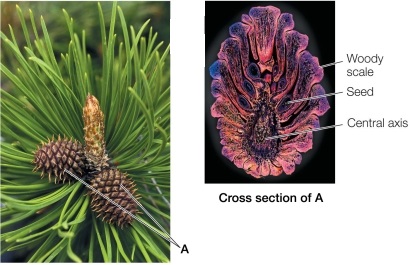 The woody scales shown protect the megastrobilus and are modified
 (Multiple Choice)
4.9/5 (83)
(83) Which plant or plant-related tissue is not known to be medicinally useful?
(Multiple Choice)
4.7/5 (71)
(71) What two types of flowers are characteristic of aster family inflorescences?
(Multiple Choice)
5.0/5 (84)
(84) In angiosperms, a viable pollen grain generally has to be delivered to the _______ to develop.
(Multiple Choice)
4.9/5 (81)
(81) Which of the following is a function of the polyploid tissue formed in double fertilization?
(Multiple Choice)
5.0/5 (75)
(75) How is a perfect flower a kind of "compromise"? In other words, what are the disadvantages of perfect flowers, and under what circumstances would they provide a benefit?
(Essay)
4.9/5 (76)
(76) In angiosperms, two male gametes contained within a single male gametophyte participate in fertilization.One sperm nucleus combines with the egg to produce a diploid zygote, and the other sperm nucleus combines with two other haploid nuclei of the female gametophyte.This process is called
(Multiple Choice)
4.8/5 (88)
(88) In an effort to limit the spread of the Zika virus, pesticides were recently applied in southern Florida to control populations of mosquitoes, which transmit the virus.Unfortunately, this pesticide affects honeybees, which are responsible for pollinating local plants and crops as well.If proper precautions are not taken, what is a possible outcome of this treatment? Explain the reasoning behind your hypothesis.
(Essay)
4.8/5 (90)
(90) In seeds, a dormant but viable state is an advantage because it
(Multiple Choice)
4.8/5 (92)
(92) Refer to the figure. 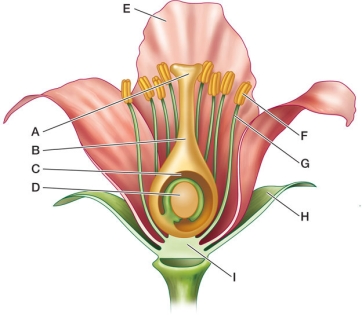 What is the name of the floral parts that collectively make up the calyx? Identify the correct label.
 (Multiple Choice)
4.9/5 (80)
(80) Refer to the figure. 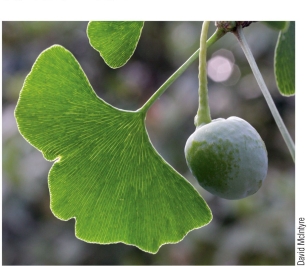 Your roommate visits the botanical gardens over the weekend.When she returns, she excitedly shows you the photograph (shown) of a plant she has identified as an angiosperm.How do you best respond?
 (Multiple Choice)
4.9/5 (96)
(96) Which synapomorphy is not shared by gymnosperms and angiosperms?
(Multiple Choice)
4.8/5 (81)
(81) 
Filters
- Essay(0)
- Multiple Choice(0)
- Short Answer(0)
- True False(0)
- Matching(0)