



 Chat with AI
Exam 36: Regulation of Plant Growth

Exam 1: Studying Life246 Questions
Exam 2: Small Molecules and the Chemistry of Life246 Questions
Exam 3: Proteins, Carbohydrates, and Lipids246 Questions
Exam 4: Nucleic Acids and the Origin of Life246 Questions
Exam 5: Cells: the Working Units of Life248 Questions
Exam 6: Cell Membranes246 Questions
Exam 7: Cell Communication and Multicellularity246 Questions
Exam 8: Energy, Enzymes, and Metabolism246 Questions
Exam 9: Pathways That Harvest Chemical Energy246 Questions
Exam 10: Photosynthesis: Energy From Sunlight242 Questions
Exam 11: The Cell Cycle and Cell Division260 Questions
Exam 12: Inheritance, Genes, and Chromosomes250 Questions
Exam 13: Dna and Its Role in Heredity257 Questions
Exam 14: From Dna to Protein: Gene Expression252 Questions
Exam 15: Gene Mutation and Molecular Medicine251 Questions
Exam 16: Regulation of Gene Expression245 Questions
Exam 17: Genomes249 Questions
Exam 18: Recombinant Dna and Biotechnology243 Questions
Exam 20: Mechanisms of Evolution243 Questions
Exam 21: Reconstructing and Using Phylogenies246 Questions
Exam 22: Speciation247 Questions
Exam 23: Evolution of Genes and Genomes252 Questions
Exam 24: The History of Life on Earth246 Questions
Exam 25: Bacteria, Archaea, and Viruses262 Questions
Exam 26: The Origin and Diversification of Eukaryotes252 Questions
Exam 27: Plants Without Seeds: From Water to Land251 Questions
Exam 28: The Evolution of Seed Plants259 Questions
Exam 29: The Evolution and Diversity of Fungi261 Questions
Exam 30: Animal Origins and the Evolution of Body Plans248 Questions
Exam 31: Protostome Animals244 Questions
Exam 32: Deuterostome Animals246 Questions
Exam 33: The Plant Body243 Questions
Exam 34: Transport in Plants248 Questions
Exam 35: Plant Nutrition247 Questions
Exam 36: Regulation of Plant Growth246 Questions
Exam 37: Reproduction in Flowering Plants247 Questions
Exam 38: Plant Responses to Environmental Challenges246 Questions
Exam 39: Physiology, Homeostasis, and Temperature Regulation258 Questions
Exam 40: Animal Hormones249 Questions
Exam 41: Immunology: Animal Defense Systems265 Questions
Exam 42: Animal Reproduction261 Questions
Exam 43: Animal Development261 Questions
Exam 44: Neurons, Glia, and Nervous Systems250 Questions
Exam 45: Sensory Systems249 Questions
Exam 46: The Mammalian Nervous System: Structure and Higher Functions254 Questions
Exam 47: Musculoskeletal Systems259 Questions
Exam 48: Gas Exchange247 Questions
Exam 49: Circulatory Systems252 Questions
Exam 50: Nutrition, Digestion, and Absorption259 Questions
Exam 51: Salt and Water Balance and Nitrogen Excretion251 Questions
Exam 52: Animal Behavior249 Questions
Exam 53: The Physical Environment and Biogeography of Life248 Questions
Exam 54: Populations259 Questions
Exam 55: Species Interactions254 Questions
Exam 56: Communities247 Questions
Exam 57: Ecosystems238 Questions
Exam 58: A Changing Biosphere222 Questions
Select questions type


Brassinosteroids were first discovered in the pollen of rape, from the _______ family.

Free
(Multiple Choice)
4.8/5  (73)
(73) Correct Answer: Verified
B
Like gibberellins, brassinosteroids promote
Free
(Multiple Choice)
4.9/5 (82)
(82) Correct Answer:Verified
VerifiedA
Refer to the figure below. 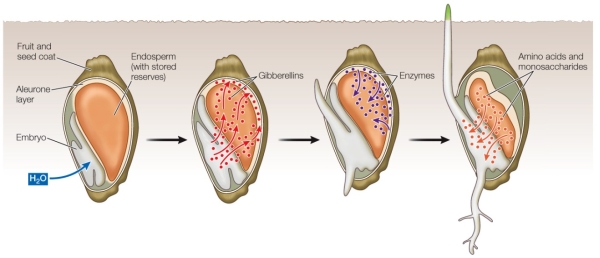 Germination is often stimulated by environmental factors, including the presence of _______, which allows _______ (the first step in the germination process of most seeds).
 (Multiple Choice)
4.8/5 (70)
(70) Seeds of a plant that is native to Mexico are released in mid-spring just as their native habitat is drying out and becoming unfavorably hot.They are quiescent after they are released.This example demonstrates that seed quiescence usually helps ensure that
(Multiple Choice)
4.8/5 (78)
(78) In early experiments, what showed that auxin was water soluble?
(Multiple Choice)
4.9/5 (72)
(72) Which statement about the mechanism by which phytochrome activates gene transcription is false?
(Multiple Choice)
4.9/5 (74)
(74) Refer to the figure below. 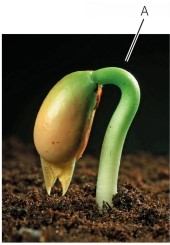 What is the name of structure indicated by the letter "A"? Which hormones control its formation?
 (Short Answer)
4.8/5 (77)
(77) Different wavelengths of light on the color spectrum can affect the growth and development of a plant.These light signals are perceived by what kind of protein?
(Multiple Choice)
4.9/5 (96)
(96) The part of monocot seedlings that was critical in early studies of phototropism and auxin is the
(Multiple Choice)
4.8/5 (69)
(69) A newly excavated archaeological site contains a jar of seeds, which, after soaking for one week in warm water, germinate at 5 percent of the total number of seeds.Those seeds were
(Multiple Choice)
4.8/5 (66)
(66) To create a genetic screen to study plant hormones, one must create what kind of unusual plants?
(Multiple Choice)
4.8/5 (75)
(75) Gibberellins were discovered by the biologist Eiichi Kurosawa while he was studying a fungal infection of _______, in which seedlings _______.
(Multiple Choice)
4.8/5 (77)
(77) Seeds from plants native to a place with hot summers and cold winters would probably need what kind of treatment to promote their germination?
(Multiple Choice)
4.8/5 (81)
(81) Treatment of some plants with gibberellins or auxin causes parthenocarpy, which is the formation of
(Multiple Choice)
4.8/5 (74)
(74) Which of the following light receptors is responsible for absorbing both blue and ultraviolet light?
(Multiple Choice)
4.8/5 (75)
(75) Which plant hormone stimulates axillary buds to grow into branches?
(Multiple Choice)
4.7/5 (76)
(76) The size of seedless grapes can be increased by using which group of plant hormones, applied exogenously?
(Multiple Choice)
4.9/5 (83)
(83) A plant grows toward a directional light when auxin moves to the (lighted/shaded) _______ side.This has the effect of expanding the cell walls in that region, causing asymmetric growth and, thus, bending.
(Short Answer)
4.9/5 (80)
(80) The prephotosynthetic seedling must survive using resources from the _______ or the _______.
(Multiple Choice)
4.9/5 (85)
(85) 
Filters
- Essay(0)
- Multiple Choice(0)
- Short Answer(0)
- True False(0)
- Matching(0)