



 Chat with AI
Exam 36: Regulation of Plant Growth

Exam 1: Studying Life246 Questions
Exam 2: Small Molecules and the Chemistry of Life246 Questions
Exam 3: Proteins, Carbohydrates, and Lipids246 Questions
Exam 4: Nucleic Acids and the Origin of Life246 Questions
Exam 5: Cells: the Working Units of Life248 Questions
Exam 6: Cell Membranes246 Questions
Exam 7: Cell Communication and Multicellularity246 Questions
Exam 8: Energy, Enzymes, and Metabolism246 Questions
Exam 9: Pathways That Harvest Chemical Energy246 Questions
Exam 10: Photosynthesis: Energy From Sunlight242 Questions
Exam 11: The Cell Cycle and Cell Division260 Questions
Exam 12: Inheritance, Genes, and Chromosomes250 Questions
Exam 13: Dna and Its Role in Heredity257 Questions
Exam 14: From Dna to Protein: Gene Expression252 Questions
Exam 15: Gene Mutation and Molecular Medicine251 Questions
Exam 16: Regulation of Gene Expression245 Questions
Exam 17: Genomes249 Questions
Exam 18: Recombinant Dna and Biotechnology243 Questions
Exam 20: Mechanisms of Evolution243 Questions
Exam 21: Reconstructing and Using Phylogenies246 Questions
Exam 22: Speciation247 Questions
Exam 23: Evolution of Genes and Genomes252 Questions
Exam 24: The History of Life on Earth246 Questions
Exam 25: Bacteria, Archaea, and Viruses262 Questions
Exam 26: The Origin and Diversification of Eukaryotes252 Questions
Exam 27: Plants Without Seeds: From Water to Land251 Questions
Exam 28: The Evolution of Seed Plants259 Questions
Exam 29: The Evolution and Diversity of Fungi261 Questions
Exam 30: Animal Origins and the Evolution of Body Plans248 Questions
Exam 31: Protostome Animals244 Questions
Exam 32: Deuterostome Animals246 Questions
Exam 33: The Plant Body243 Questions
Exam 34: Transport in Plants248 Questions
Exam 35: Plant Nutrition247 Questions
Exam 36: Regulation of Plant Growth246 Questions
Exam 37: Reproduction in Flowering Plants247 Questions
Exam 38: Plant Responses to Environmental Challenges246 Questions
Exam 39: Physiology, Homeostasis, and Temperature Regulation258 Questions
Exam 40: Animal Hormones249 Questions
Exam 41: Immunology: Animal Defense Systems265 Questions
Exam 42: Animal Reproduction261 Questions
Exam 43: Animal Development261 Questions
Exam 44: Neurons, Glia, and Nervous Systems250 Questions
Exam 45: Sensory Systems249 Questions
Exam 46: The Mammalian Nervous System: Structure and Higher Functions254 Questions
Exam 47: Musculoskeletal Systems259 Questions
Exam 48: Gas Exchange247 Questions
Exam 49: Circulatory Systems252 Questions
Exam 50: Nutrition, Digestion, and Absorption259 Questions
Exam 51: Salt and Water Balance and Nitrogen Excretion251 Questions
Exam 52: Animal Behavior249 Questions
Exam 53: The Physical Environment and Biogeography of Life248 Questions
Exam 54: Populations259 Questions
Exam 55: Species Interactions254 Questions
Exam 56: Communities247 Questions
Exam 57: Ecosystems238 Questions
Exam 58: A Changing Biosphere222 Questions
Select questions type


Which statement does not describe an observation in studies of the hormone gibberellin?
(Multiple Choice)
4.9/5  (83)
(83) To study the actions of plant hormones, it is useful to expose seeds to a mutagen, raise them up, and identify individuals that behave differently from typical plants.This process is called a(n) _______.
(Short Answer)
4.8/5 (84)
(84) The semi-dwarf wheat and rice plants that led to the Green Revolution described in the chapter opening have mutations in the signal transduction pathway for gibberellins.You wish to use genetic engineering to make corn plants that are semi-dwarf.How would you do a genetic screen to identify the genes in corn involved in gibberellin signaling?
(Short Answer)
4.7/5 (84)
(84) Silver thiosulfate, used by florists, is an antagonist of what plant hormone?
(Multiple Choice)
4.8/5 (76)
(76) Which type of mutant Arabidopsis plants were used to study the mechanics behind phototropism?
(Multiple Choice)
4.8/5 (78)
(78) One manifestation of a(n) _______ in bean plants is the raising and lowering of its leaves.
(Short Answer)
4.9/5 (67)
(67) Which statement about the effects of plant hormones and photoreceptors on plant growth is false?
(Multiple Choice)
4.7/5 (76)
(76) Treatment of seeds that require light for germination with _______ would promote germination.
(Multiple Choice)
4.9/5 (78)
(78) Which of the following hormones would you apply to a dwarf plant to increase its height?
(Multiple Choice)
4.9/5 (74)
(74) Refer to the figure below showing a signal reception pathway. 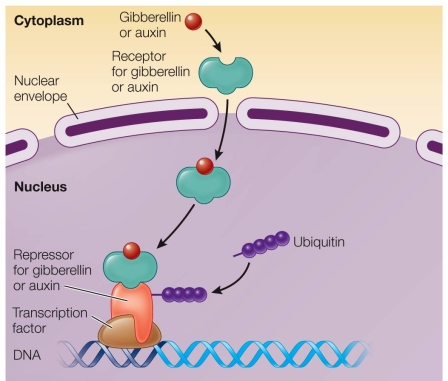 Predict what is most likely to happen when the relevant hormone (e.g., auxin or gibberellin) is present.
 (Multiple Choice)
4.8/5 (73)
(73) A botanist is performing an experiment on some cactus plants that have small, rounded extensions from their flattened stems.Suspecting that these extensions are reduced, modified leaves, the scientist treats the plants with _______ to see if these leaves abscise normally.
(Short Answer)
4.8/5 (68)
(68) Upon observing the early stages of seed germination, one would expect to see what emerging from the seed coat?
(Multiple Choice)
4.8/5 (71)
(71) The pigment protein phytochrome is thought to allow plants to detect photoperiod because
(Multiple Choice)
4.9/5 (74)
(74) Experimental removal of the auxin source demonstrates that leaf abscission is _______ by auxin, and apical dominance is _______ by auxin.
(Multiple Choice)
4.9/5 (65)
(65) Etiolated seedlings are produced by germinating seeds that are kept in total darkness.Plants that are kept in the dark will begin to synthesize chlorophyll after they are given a pulse of
(Multiple Choice)
4.9/5 (78)
(78) Seedless grapes sold in stores would be much smaller if not for the use of
(Multiple Choice)
4.9/5 (85)
(85) 
Filters
- Essay(0)
- Multiple Choice(0)
- Short Answer(0)
- True False(0)
- Matching(0)