



 Chat with AI
Exam 36: Regulation of Plant Growth

Exam 1: Studying Life246 Questions
Exam 2: Small Molecules and the Chemistry of Life246 Questions
Exam 3: Proteins, Carbohydrates, and Lipids246 Questions
Exam 4: Nucleic Acids and the Origin of Life246 Questions
Exam 5: Cells: the Working Units of Life248 Questions
Exam 6: Cell Membranes246 Questions
Exam 7: Cell Communication and Multicellularity246 Questions
Exam 8: Energy, Enzymes, and Metabolism246 Questions
Exam 9: Pathways That Harvest Chemical Energy246 Questions
Exam 10: Photosynthesis: Energy From Sunlight242 Questions
Exam 11: The Cell Cycle and Cell Division260 Questions
Exam 12: Inheritance, Genes, and Chromosomes250 Questions
Exam 13: Dna and Its Role in Heredity257 Questions
Exam 14: From Dna to Protein: Gene Expression252 Questions
Exam 15: Gene Mutation and Molecular Medicine251 Questions
Exam 16: Regulation of Gene Expression245 Questions
Exam 17: Genomes249 Questions
Exam 18: Recombinant Dna and Biotechnology243 Questions
Exam 20: Mechanisms of Evolution243 Questions
Exam 21: Reconstructing and Using Phylogenies246 Questions
Exam 22: Speciation247 Questions
Exam 23: Evolution of Genes and Genomes252 Questions
Exam 24: The History of Life on Earth246 Questions
Exam 25: Bacteria, Archaea, and Viruses262 Questions
Exam 26: The Origin and Diversification of Eukaryotes252 Questions
Exam 27: Plants Without Seeds: From Water to Land251 Questions
Exam 28: The Evolution of Seed Plants259 Questions
Exam 29: The Evolution and Diversity of Fungi261 Questions
Exam 30: Animal Origins and the Evolution of Body Plans248 Questions
Exam 31: Protostome Animals244 Questions
Exam 32: Deuterostome Animals246 Questions
Exam 33: The Plant Body243 Questions
Exam 34: Transport in Plants248 Questions
Exam 35: Plant Nutrition247 Questions
Exam 36: Regulation of Plant Growth246 Questions
Exam 37: Reproduction in Flowering Plants247 Questions
Exam 38: Plant Responses to Environmental Challenges246 Questions
Exam 39: Physiology, Homeostasis, and Temperature Regulation258 Questions
Exam 40: Animal Hormones249 Questions
Exam 41: Immunology: Animal Defense Systems265 Questions
Exam 42: Animal Reproduction261 Questions
Exam 43: Animal Development261 Questions
Exam 44: Neurons, Glia, and Nervous Systems250 Questions
Exam 45: Sensory Systems249 Questions
Exam 46: The Mammalian Nervous System: Structure and Higher Functions254 Questions
Exam 47: Musculoskeletal Systems259 Questions
Exam 48: Gas Exchange247 Questions
Exam 49: Circulatory Systems252 Questions
Exam 50: Nutrition, Digestion, and Absorption259 Questions
Exam 51: Salt and Water Balance and Nitrogen Excretion251 Questions
Exam 52: Animal Behavior249 Questions
Exam 53: The Physical Environment and Biogeography of Life248 Questions
Exam 54: Populations259 Questions
Exam 55: Species Interactions254 Questions
Exam 56: Communities247 Questions
Exam 57: Ecosystems238 Questions
Exam 58: A Changing Biosphere222 Questions
Select questions type


Which of the following is the correct sequence of events that causes auxin to move in a polar direction in a plant stem?
(Multiple Choice)
4.9/5  (80)
(80) As Charles Darwin and his son discovered, blocking light from the _______ of a young wheat plant would prevent phototropism from occurring.
(Short Answer)
4.8/5 (79)
(79) A team of molecular biology researchers is trying to increase the value of agricultural seeds for livestock feed.To increase the store of metabolically useful energy in the seeds, the researchers should focus on increasing which of the following macromolecules?
(Multiple Choice)
4.8/5 (63)
(63) Any molecule that is moved from one end of the plant to another, like auxin, is said to have _______ transport.
(Short Answer)
5.0/5 (80)
(80) Which of the following represents the correct order of the stages of seed germination and subsequent events?
(Multiple Choice)
4.8/5 (71)
(71) Whereas gibberellins promote seed germination, _______ promote(s) dormancy.
(Multiple Choice)
4.8/5 (88)
(88) During an examination of a newly discovered species of grass that is bending toward light, you see that auxin in the coleoptile moves _______ the light, leading to _______ growth there.
(Multiple Choice)
4.7/5 (92)
(92) Which of the following is not an effect of gibberellins in plant development?
(Multiple Choice)
5.0/5 (79)
(79) The movement of auxin in plants is said to be "polar," which means that auxin
(Multiple Choice)
4.9/5 (84)
(84) If a mutant plant were created that lacked the receptor for ethylene, its leaves would
(Multiple Choice)
4.8/5 (84)
(84) Which group of plant hormones was discovered while solving a disease of rice called bakanae, or "foolish seedling disease," where plants grow overly tall and spindly?
(Multiple Choice)
4.8/5 (88)
(88) Lettuce seeds exposed to (in sequence) red light, far-red light, red light, red light, far-red light, far-red light will
(Multiple Choice)
4.7/5 (76)
(76) The "wall-loosening factor" present in the cell wall of plants is now believed to be
(Multiple Choice)
4.8/5 (83)
(83) In promoting normal germination (and also in brewing, when production of sugars for alcoholic fermentation is desired), gibberellins
(Multiple Choice)
4.7/5 (82)
(82) Refer to the figure below. 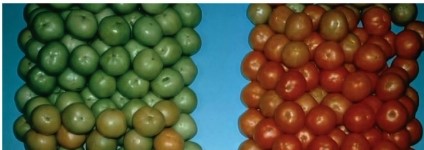 Unlike the green tomatoes on the left, the red tomatoes on the right have probably been treated with the hormone
 (Multiple Choice)
4.8/5 (87)
(87) Which of the following does not increase during the initial stages of seed germination?
(Multiple Choice)
4.9/5 (80)
(80) 
Filters
- Essay(0)
- Multiple Choice(0)
- Short Answer(0)
- True False(0)
- Matching(0)