



 Chat with AI
Exam 41: Immunology: Animal Defense Systems

Exam 1: Studying Life246 Questions
Exam 2: Small Molecules and the Chemistry of Life246 Questions
Exam 3: Proteins, Carbohydrates, and Lipids246 Questions
Exam 4: Nucleic Acids and the Origin of Life246 Questions
Exam 5: Cells: the Working Units of Life248 Questions
Exam 6: Cell Membranes246 Questions
Exam 7: Cell Communication and Multicellularity246 Questions
Exam 8: Energy, Enzymes, and Metabolism246 Questions
Exam 9: Pathways That Harvest Chemical Energy246 Questions
Exam 10: Photosynthesis: Energy From Sunlight242 Questions
Exam 11: The Cell Cycle and Cell Division260 Questions
Exam 12: Inheritance, Genes, and Chromosomes250 Questions
Exam 13: Dna and Its Role in Heredity257 Questions
Exam 14: From Dna to Protein: Gene Expression252 Questions
Exam 15: Gene Mutation and Molecular Medicine251 Questions
Exam 16: Regulation of Gene Expression245 Questions
Exam 17: Genomes249 Questions
Exam 18: Recombinant Dna and Biotechnology243 Questions
Exam 20: Mechanisms of Evolution243 Questions
Exam 21: Reconstructing and Using Phylogenies246 Questions
Exam 22: Speciation247 Questions
Exam 23: Evolution of Genes and Genomes252 Questions
Exam 24: The History of Life on Earth246 Questions
Exam 25: Bacteria, Archaea, and Viruses262 Questions
Exam 26: The Origin and Diversification of Eukaryotes252 Questions
Exam 27: Plants Without Seeds: From Water to Land251 Questions
Exam 28: The Evolution of Seed Plants259 Questions
Exam 29: The Evolution and Diversity of Fungi261 Questions
Exam 30: Animal Origins and the Evolution of Body Plans248 Questions
Exam 31: Protostome Animals244 Questions
Exam 32: Deuterostome Animals246 Questions
Exam 33: The Plant Body243 Questions
Exam 34: Transport in Plants248 Questions
Exam 35: Plant Nutrition247 Questions
Exam 36: Regulation of Plant Growth246 Questions
Exam 37: Reproduction in Flowering Plants247 Questions
Exam 38: Plant Responses to Environmental Challenges246 Questions
Exam 39: Physiology, Homeostasis, and Temperature Regulation258 Questions
Exam 40: Animal Hormones249 Questions
Exam 41: Immunology: Animal Defense Systems265 Questions
Exam 42: Animal Reproduction261 Questions
Exam 43: Animal Development261 Questions
Exam 44: Neurons, Glia, and Nervous Systems250 Questions
Exam 45: Sensory Systems249 Questions
Exam 46: The Mammalian Nervous System: Structure and Higher Functions254 Questions
Exam 47: Musculoskeletal Systems259 Questions
Exam 48: Gas Exchange247 Questions
Exam 49: Circulatory Systems252 Questions
Exam 50: Nutrition, Digestion, and Absorption259 Questions
Exam 51: Salt and Water Balance and Nitrogen Excretion251 Questions
Exam 52: Animal Behavior249 Questions
Exam 53: The Physical Environment and Biogeography of Life248 Questions
Exam 54: Populations259 Questions
Exam 55: Species Interactions254 Questions
Exam 56: Communities247 Questions
Exam 57: Ecosystems238 Questions
Exam 58: A Changing Biosphere222 Questions
Select questions type


Refer to the figure showing a receptor on a cell. 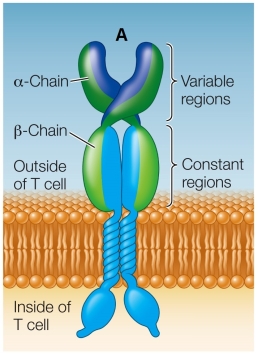 What type of cell is shown in the diagram?
Free
(Multiple Choice)
4.9/5  (86)
(86) Correct Answer: Verified
B
Vaccination against measles can prevent the disease in people because the vaccine
Free
(Multiple Choice)
4.8/5 (91)
(91) Correct Answer:Verified
VerifiedD
Refer to the graph showing a person's immune response, first to a vaccination, and later to exposure to the pathogen that the vaccine targeted.Time is represented on the x-axis, but the scale is different for each subdivision. 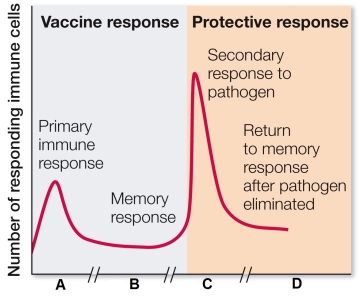 Which immune response event takes the shortest amount of time?
Free
(Short Answer)
4.9/5 (75)
(75) Correct Answer:Verified
VerifiedC, the response to pathogen
If a person is exposed to a virus, which event is part of the activation phase in that person's adaptive immune response to the virus?
(Multiple Choice)
4.8/5 (65)
(65) In comparing the antigen-binding site of an antibody to the binding site of an enzyme, which statement is true?
(Multiple Choice)
4.9/5 (73)
(73) Major histocompatibility proteins function in the immune system by
(Multiple Choice)
4.8/5 (89)
(89) Which statement about innate and adaptive defenses is true?
(Multiple Choice)
4.8/5 (74)
(74) Refer to the figure showing an immune response to an antigen. 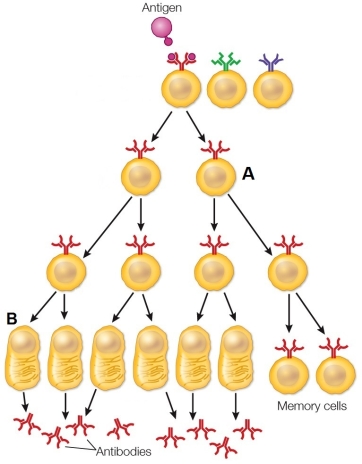 The cell labeled "A" is a _______ cell involved in a(n) _______ immune response.
 (Multiple Choice)
4.9/5 (71)
(71) Many passengers on a cruise ship at sea are exposed to a norovirus, which causes flu-like symptoms.Among the first components that a passenger's immune system produces in fighting the virus, is/are
(Multiple Choice)
4.9/5 (78)
(78) Choose the incorrect pairing between a structural component of an immunoglobulin and its function.
(Multiple Choice)
4.9/5 (77)
(77) The extraordinary diversity of antibodies results in part from
(Multiple Choice)
4.8/5 (66)
(66) When receiving a lung transplant, a patient is likely to be treated with a drug that suppresses the _______ immune response.Unfortunately, this makes the patient more susceptible to cancer and infections.
(Short Answer)
4.8/5 (85)
(85) For an organ transplant to be successful, it is often necessary to give the patient a drug that suppresses the cellular immune system.A drug that _______ is likely to be the most effective at immunosuppression.
(Multiple Choice)
4.9/5 (73)
(73) 
Filters
- Essay(0)
- Multiple Choice(0)
- Short Answer(0)
- True False(0)
- Matching(0)