



 Chat with AI
Exam 41: Immunology: Animal Defense Systems

Exam 1: Studying Life246 Questions
Exam 2: Small Molecules and the Chemistry of Life246 Questions
Exam 3: Proteins, Carbohydrates, and Lipids246 Questions
Exam 4: Nucleic Acids and the Origin of Life246 Questions
Exam 5: Cells: the Working Units of Life248 Questions
Exam 6: Cell Membranes246 Questions
Exam 7: Cell Communication and Multicellularity246 Questions
Exam 8: Energy, Enzymes, and Metabolism246 Questions
Exam 9: Pathways That Harvest Chemical Energy246 Questions
Exam 10: Photosynthesis: Energy From Sunlight242 Questions
Exam 11: The Cell Cycle and Cell Division260 Questions
Exam 12: Inheritance, Genes, and Chromosomes250 Questions
Exam 13: Dna and Its Role in Heredity257 Questions
Exam 14: From Dna to Protein: Gene Expression252 Questions
Exam 15: Gene Mutation and Molecular Medicine251 Questions
Exam 16: Regulation of Gene Expression245 Questions
Exam 17: Genomes249 Questions
Exam 18: Recombinant Dna and Biotechnology243 Questions
Exam 20: Mechanisms of Evolution243 Questions
Exam 21: Reconstructing and Using Phylogenies246 Questions
Exam 22: Speciation247 Questions
Exam 23: Evolution of Genes and Genomes252 Questions
Exam 24: The History of Life on Earth246 Questions
Exam 25: Bacteria, Archaea, and Viruses262 Questions
Exam 26: The Origin and Diversification of Eukaryotes252 Questions
Exam 27: Plants Without Seeds: From Water to Land251 Questions
Exam 28: The Evolution of Seed Plants259 Questions
Exam 29: The Evolution and Diversity of Fungi261 Questions
Exam 30: Animal Origins and the Evolution of Body Plans248 Questions
Exam 31: Protostome Animals244 Questions
Exam 32: Deuterostome Animals246 Questions
Exam 33: The Plant Body243 Questions
Exam 34: Transport in Plants248 Questions
Exam 35: Plant Nutrition247 Questions
Exam 36: Regulation of Plant Growth246 Questions
Exam 37: Reproduction in Flowering Plants247 Questions
Exam 38: Plant Responses to Environmental Challenges246 Questions
Exam 39: Physiology, Homeostasis, and Temperature Regulation258 Questions
Exam 40: Animal Hormones249 Questions
Exam 41: Immunology: Animal Defense Systems265 Questions
Exam 42: Animal Reproduction261 Questions
Exam 43: Animal Development261 Questions
Exam 44: Neurons, Glia, and Nervous Systems250 Questions
Exam 45: Sensory Systems249 Questions
Exam 46: The Mammalian Nervous System: Structure and Higher Functions254 Questions
Exam 47: Musculoskeletal Systems259 Questions
Exam 48: Gas Exchange247 Questions
Exam 49: Circulatory Systems252 Questions
Exam 50: Nutrition, Digestion, and Absorption259 Questions
Exam 51: Salt and Water Balance and Nitrogen Excretion251 Questions
Exam 52: Animal Behavior249 Questions
Exam 53: The Physical Environment and Biogeography of Life248 Questions
Exam 54: Populations259 Questions
Exam 55: Species Interactions254 Questions
Exam 56: Communities247 Questions
Exam 57: Ecosystems238 Questions
Exam 58: A Changing Biosphere222 Questions
Select questions type


Refer to the figure. 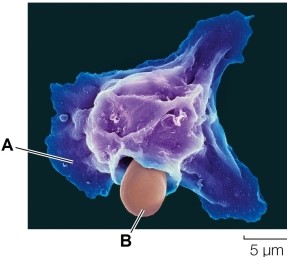 The figure is most likely illustrating
 (Multiple Choice)
4.7/5  (81)
(81) Patients infected with HIV are susceptible to a variety of infections because
(Multiple Choice)
4.9/5 (82)
(82) Even without treatment, some people who are infected with HIV but untreated may not develop severe symptoms of AIDS for a period of time.The longest period of time that has been recorded is _______ years.
(Multiple Choice)
4.8/5 (82)
(82) Kaposi's sarcoma, which is induced by a herpes virus, and lymphoma tumors induced by the Epstein-Barr virus are the result of _______ infections associated with AIDS.
(Short Answer)
4.8/5 (73)
(73) Refer to the figure. 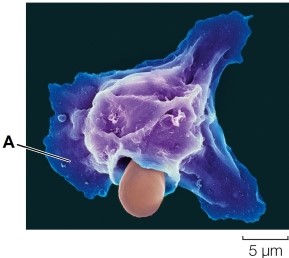 If you find a cell similar to the one labeled "A" in an infected wound, the cell is most likely a(n) _______.
 (Short Answer)
4.8/5 (80)
(80) Which class of antibodies is critical in the activation of B cells?
(Multiple Choice)
4.9/5 (75)
(75) Development of an effective HIV vaccine requires that the person being vaccinated develop both cellular and humoral immunity against HIV.What experiments would you do to test whether both types of immunity developed in people given a potential new vaccine?
(Short Answer)
4.7/5 (67)
(67) The lymphocytes specific for particular antigenic determinants proliferate via the process known as _______.
(Short Answer)
5.0/5 (85)
(85) Many bacteria and fungi typically live and reproduce on the skin without causing disease.Therefore, they can be considered
(Multiple Choice)
4.7/5 (82)
(82) Mucous membranes produce small peptides known as _______ that are toxic to numerous pathogens, meaning that they are a type of innate defense.
(Short Answer)
4.9/5 (74)
(74) Lymphocytes specific for certain antigens proliferate by a process known as
(Multiple Choice)
4.9/5 (78)
(78) Multiple sclerosis is a degenerative disease that is caused by the immune response attacking the myelin sheath that surrounds the nerves of the central nervous system.An immunologist would describe this as a(n)
(Multiple Choice)
4.8/5 (86)
(86) Virally infected cells often produce small amounts of antimicrobial proteins known as _______ that increase the resistance of neighboring cells to infection.
(Short Answer)
4.7/5 (84)
(84) 
Filters
- Essay(0)
- Multiple Choice(0)
- Short Answer(0)
- True False(0)
- Matching(0)