



 Chat with AI
Exam 41: Immunology: Animal Defense Systems

Exam 1: Studying Life246 Questions
Exam 2: Small Molecules and the Chemistry of Life246 Questions
Exam 3: Proteins, Carbohydrates, and Lipids246 Questions
Exam 4: Nucleic Acids and the Origin of Life246 Questions
Exam 5: Cells: the Working Units of Life248 Questions
Exam 6: Cell Membranes246 Questions
Exam 7: Cell Communication and Multicellularity246 Questions
Exam 8: Energy, Enzymes, and Metabolism246 Questions
Exam 9: Pathways That Harvest Chemical Energy246 Questions
Exam 10: Photosynthesis: Energy From Sunlight242 Questions
Exam 11: The Cell Cycle and Cell Division260 Questions
Exam 12: Inheritance, Genes, and Chromosomes250 Questions
Exam 13: Dna and Its Role in Heredity257 Questions
Exam 14: From Dna to Protein: Gene Expression252 Questions
Exam 15: Gene Mutation and Molecular Medicine251 Questions
Exam 16: Regulation of Gene Expression245 Questions
Exam 17: Genomes249 Questions
Exam 18: Recombinant Dna and Biotechnology243 Questions
Exam 20: Mechanisms of Evolution243 Questions
Exam 21: Reconstructing and Using Phylogenies246 Questions
Exam 22: Speciation247 Questions
Exam 23: Evolution of Genes and Genomes252 Questions
Exam 24: The History of Life on Earth246 Questions
Exam 25: Bacteria, Archaea, and Viruses262 Questions
Exam 26: The Origin and Diversification of Eukaryotes252 Questions
Exam 27: Plants Without Seeds: From Water to Land251 Questions
Exam 28: The Evolution of Seed Plants259 Questions
Exam 29: The Evolution and Diversity of Fungi261 Questions
Exam 30: Animal Origins and the Evolution of Body Plans248 Questions
Exam 31: Protostome Animals244 Questions
Exam 32: Deuterostome Animals246 Questions
Exam 33: The Plant Body243 Questions
Exam 34: Transport in Plants248 Questions
Exam 35: Plant Nutrition247 Questions
Exam 36: Regulation of Plant Growth246 Questions
Exam 37: Reproduction in Flowering Plants247 Questions
Exam 38: Plant Responses to Environmental Challenges246 Questions
Exam 39: Physiology, Homeostasis, and Temperature Regulation258 Questions
Exam 40: Animal Hormones249 Questions
Exam 41: Immunology: Animal Defense Systems265 Questions
Exam 42: Animal Reproduction261 Questions
Exam 43: Animal Development261 Questions
Exam 44: Neurons, Glia, and Nervous Systems250 Questions
Exam 45: Sensory Systems249 Questions
Exam 46: The Mammalian Nervous System: Structure and Higher Functions254 Questions
Exam 47: Musculoskeletal Systems259 Questions
Exam 48: Gas Exchange247 Questions
Exam 49: Circulatory Systems252 Questions
Exam 50: Nutrition, Digestion, and Absorption259 Questions
Exam 51: Salt and Water Balance and Nitrogen Excretion251 Questions
Exam 52: Animal Behavior249 Questions
Exam 53: The Physical Environment and Biogeography of Life248 Questions
Exam 54: Populations259 Questions
Exam 55: Species Interactions254 Questions
Exam 56: Communities247 Questions
Exam 57: Ecosystems238 Questions
Exam 58: A Changing Biosphere222 Questions
Select questions type


The American lobster is susceptible to a bacterial infection that eats holes in its shell.It is likely that an environmental factor, such as warmer ocean temperatures, is compromising the animal's immune response.Which immune defense is most likely to be the first that is compromised, allowing the pathogenic bacteria to get a foothold?
(Multiple Choice)
4.7/5  (81)
(81) The fact that B cells and T cells are both clonally selected means that
(Multiple Choice)
5.0/5 (73)
(73) The _______ acid in gastric juice is lethal to many pathogens.
(Multiple Choice)
4.9/5 (84)
(84) Compared to the secondary immune response of the adaptive immune system, the primary immune response is _______ powerful and lasts _______ amount of time.
(Multiple Choice)
4.7/5 (82)
(82) If a new vaccine against HIV is developed, it will be important to test its effectiveness by determining if it stimulates both the production of antibodies in a humoral response against HIV and the proliferation of a clone of _______ that can destroy HIV-infected cells.
(Short Answer)
4.8/5 (79)
(79) A child comes down with the chickenpox, caused by the varicella-zoster virus.Her mother takes care of the child, exposing herself to the virus, but does not come down with chickenpox herself.What is the most likely explanation for this?
(Multiple Choice)
4.9/5 (80)
(80) Which statement about the humoral immune response is correct?
(Multiple Choice)
4.9/5 (81)
(81) Typically slow to act and long lasting, the _______ (innate/adaptive) immune system is involved in specific responses.
(Short Answer)
5.0/5 (66)
(66) The outer extracellular material surrounding eggs ovulated by female mammals is called the zona pellucida (ZP).Injecting fragments of the ZP into wildlife species has been explored as a means of birth control because future ovulations lead to an immune response preventing implantation.This technique relies on the species'_______ (innate/adaptive) immunity.
(Short Answer)
4.9/5 (79)
(79) A student studying abroad finds himself feeling ill.He recovers after about a week and does not experience the same symptoms again.He likely is benefiting from _______ (innate/adaptive) immunity.
(Short Answer)
4.9/5 (87)
(87) Which blood components are generally restricted to the vessels and heart in a closed circulatory system?
(Multiple Choice)
4.9/5 (86)
(86) If a person suffers from the autoimmune disease multiple sclerosis, it is likely that the person's immune system is attacking self antigens because
(Multiple Choice)
4.9/5 (79)
(79) Your elderly grandmother complains that she is always tired and that she recently has put on some weight; she also shows signs of depression.You suspect the autoimmune disease _______.
(Short Answer)
4.8/5 (83)
(83) Refer to the figure showing a receptor on a cell. 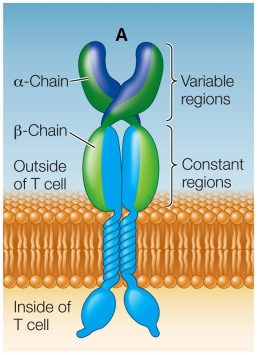 Which binds to the region of the receptor indicated by the letter "A"?
 (Multiple Choice)
4.7/5 (73)
(73) 
Filters
- Essay(0)
- Multiple Choice(0)
- Short Answer(0)
- True False(0)
- Matching(0)