



 Chat with AI
Exam 44: Neurons, Glia, and Nervous Systems

Exam 1: Studying Life246 Questions
Exam 2: Small Molecules and the Chemistry of Life246 Questions
Exam 3: Proteins, Carbohydrates, and Lipids246 Questions
Exam 4: Nucleic Acids and the Origin of Life246 Questions
Exam 5: Cells: the Working Units of Life248 Questions
Exam 6: Cell Membranes246 Questions
Exam 7: Cell Communication and Multicellularity246 Questions
Exam 8: Energy, Enzymes, and Metabolism246 Questions
Exam 9: Pathways That Harvest Chemical Energy246 Questions
Exam 10: Photosynthesis: Energy From Sunlight242 Questions
Exam 11: The Cell Cycle and Cell Division260 Questions
Exam 12: Inheritance, Genes, and Chromosomes250 Questions
Exam 13: Dna and Its Role in Heredity257 Questions
Exam 14: From Dna to Protein: Gene Expression252 Questions
Exam 15: Gene Mutation and Molecular Medicine251 Questions
Exam 16: Regulation of Gene Expression245 Questions
Exam 17: Genomes249 Questions
Exam 18: Recombinant Dna and Biotechnology243 Questions
Exam 20: Mechanisms of Evolution243 Questions
Exam 21: Reconstructing and Using Phylogenies246 Questions
Exam 22: Speciation247 Questions
Exam 23: Evolution of Genes and Genomes252 Questions
Exam 24: The History of Life on Earth246 Questions
Exam 25: Bacteria, Archaea, and Viruses262 Questions
Exam 26: The Origin and Diversification of Eukaryotes252 Questions
Exam 27: Plants Without Seeds: From Water to Land251 Questions
Exam 28: The Evolution of Seed Plants259 Questions
Exam 29: The Evolution and Diversity of Fungi261 Questions
Exam 30: Animal Origins and the Evolution of Body Plans248 Questions
Exam 31: Protostome Animals244 Questions
Exam 32: Deuterostome Animals246 Questions
Exam 33: The Plant Body243 Questions
Exam 34: Transport in Plants248 Questions
Exam 35: Plant Nutrition247 Questions
Exam 36: Regulation of Plant Growth246 Questions
Exam 37: Reproduction in Flowering Plants247 Questions
Exam 38: Plant Responses to Environmental Challenges246 Questions
Exam 39: Physiology, Homeostasis, and Temperature Regulation258 Questions
Exam 40: Animal Hormones249 Questions
Exam 41: Immunology: Animal Defense Systems265 Questions
Exam 42: Animal Reproduction261 Questions
Exam 43: Animal Development261 Questions
Exam 44: Neurons, Glia, and Nervous Systems250 Questions
Exam 45: Sensory Systems249 Questions
Exam 46: The Mammalian Nervous System: Structure and Higher Functions254 Questions
Exam 47: Musculoskeletal Systems259 Questions
Exam 48: Gas Exchange247 Questions
Exam 49: Circulatory Systems252 Questions
Exam 50: Nutrition, Digestion, and Absorption259 Questions
Exam 51: Salt and Water Balance and Nitrogen Excretion251 Questions
Exam 52: Animal Behavior249 Questions
Exam 53: The Physical Environment and Biogeography of Life248 Questions
Exam 54: Populations259 Questions
Exam 55: Species Interactions254 Questions
Exam 56: Communities247 Questions
Exam 57: Ecosystems238 Questions
Exam 58: A Changing Biosphere222 Questions
Select questions type


The _______ toxin causes uncontrolled muscle contraction.

Free
(Short Answer)
5.0/5  (71)
(71) Correct Answer: Verified
tetanus
Synapses between neurons can be excitatory or inhibitory.How the postsynaptic neurons will respond to signals is determined by
Free
(Multiple Choice)
4.8/5 (69)
(69) Correct Answer:Verified
VerifiedD
Refer to the graph showing the tracing of membrane potential change during the course of an action potential. 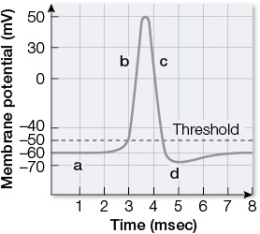 Which of the following is the correct sequence of events and conditions indicated by the labels "a," "b," "c," and "d"?
Free
(Multiple Choice)
4.8/5 (77)
(77) Correct Answer:Verified
VerifiedD
Which of the following is not necessary for the formation of a neural network?
(Multiple Choice)
4.9/5 (90)
(90) Microglia play an essential role in the brain and spinal cord by
(Multiple Choice)
4.8/5 (71)
(71) Which statement about the resting potential of a neuronal cell membrane is true?
(Multiple Choice)
4.8/5 (86)
(86) The electrochemical gradient of a given ion determines the movement of that ion across a cell membrane.Based on your knowledge of the normal intra- and extracellular concentrations of Na+ and K+ ions across a resting membrane, what would you expect to happen when both Na+ and K+ voltage-gated channels were opened in response to an action potential?
(Multiple Choice)
4.8/5 (72)
(72) The technique by which neurobiologists can monitor in real time the openings and closings of single ion channels is called _______.
(Short Answer)
4.7/5 (82)
(82) The three functional categories of neurons that make up neural networks are _______ neurons, efferent neurons, and interneurons.
(Short Answer)
4.8/5 (73)
(73) The vertebrate neuromuscular junction is a chemical synapse that uses _______ as a neurotransmitter.
(Multiple Choice)
4.9/5 (88)
(88) The part of the squid giant axon used by Hodgkin and Huxley to sample ion concentrations was the
(Multiple Choice)
4.8/5 (83)
(83) The concept of a tripartite synapse is the idea that a synapse consists not only of pre- and postsynaptic neurons but also of connections from _______.This concept takes into account the _______ at the synapse.
(Multiple Choice)
4.8/5 (93)
(93) Which presynaptic activity would be the most effective in producing the greatest increase in firing rate of a postsynaptic neuron?
(Multiple Choice)
5.0/5 (83)
(83) After examining a patient with a neurological disorder that interferes with walking, a neurologist determines that a Mycoplasma bacterium is causing the destruction of the myelin sheath around the axons in the patient's peripheral nerves.What specific cell type is affected in this patient?
(Multiple Choice)
4.8/5 (83)
(83) Two scientists calculated the membrane potential of a neuron using two different equations, the Nernst equation and the Goldman equation.Their calculations gave them slightly different predictions.What is the most likely reason for this difference?
(Multiple Choice)
4.9/5 (79)
(79) Refer to the figure showing the knee-jerk reflex. 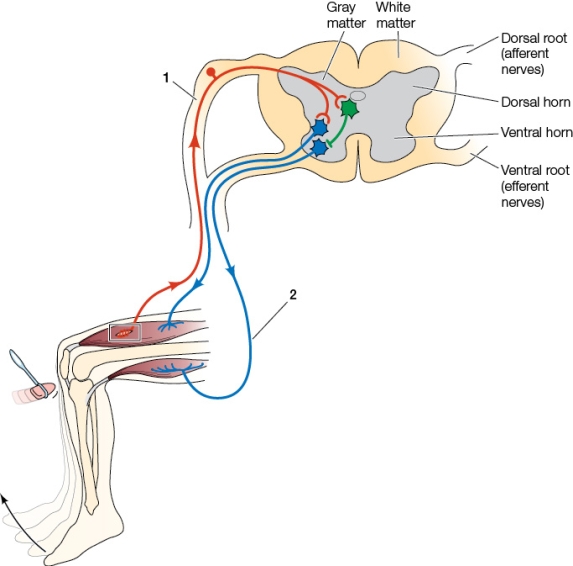 What is happening at point 1?
 (Multiple Choice)
4.8/5 (76)
(76) Diseases that cause damage to oligodendrocytes and Schwann cells often cause motor impairment due to the loss of _______.
(Short Answer)
4.7/5 (84)
(84) Ion channels may be open continuously, or they may only open or close in response to certain stimuli.The ones that require specific stimuli are known as _______ channels.
(Multiple Choice)
4.9/5 (76)
(76) 
Filters
- Essay(0)
- Multiple Choice(0)
- Short Answer(0)
- True False(0)
- Matching(0)