



 Chat with AI
Exam 44: Neurons, Glia, and Nervous Systems

Exam 1: Studying Life246 Questions
Exam 2: Small Molecules and the Chemistry of Life246 Questions
Exam 3: Proteins, Carbohydrates, and Lipids246 Questions
Exam 4: Nucleic Acids and the Origin of Life246 Questions
Exam 5: Cells: the Working Units of Life248 Questions
Exam 6: Cell Membranes246 Questions
Exam 7: Cell Communication and Multicellularity246 Questions
Exam 8: Energy, Enzymes, and Metabolism246 Questions
Exam 9: Pathways That Harvest Chemical Energy246 Questions
Exam 10: Photosynthesis: Energy From Sunlight242 Questions
Exam 11: The Cell Cycle and Cell Division260 Questions
Exam 12: Inheritance, Genes, and Chromosomes250 Questions
Exam 13: Dna and Its Role in Heredity257 Questions
Exam 14: From Dna to Protein: Gene Expression252 Questions
Exam 15: Gene Mutation and Molecular Medicine251 Questions
Exam 16: Regulation of Gene Expression245 Questions
Exam 17: Genomes249 Questions
Exam 18: Recombinant Dna and Biotechnology243 Questions
Exam 20: Mechanisms of Evolution243 Questions
Exam 21: Reconstructing and Using Phylogenies246 Questions
Exam 22: Speciation247 Questions
Exam 23: Evolution of Genes and Genomes252 Questions
Exam 24: The History of Life on Earth246 Questions
Exam 25: Bacteria, Archaea, and Viruses262 Questions
Exam 26: The Origin and Diversification of Eukaryotes252 Questions
Exam 27: Plants Without Seeds: From Water to Land251 Questions
Exam 28: The Evolution of Seed Plants259 Questions
Exam 29: The Evolution and Diversity of Fungi261 Questions
Exam 30: Animal Origins and the Evolution of Body Plans248 Questions
Exam 31: Protostome Animals244 Questions
Exam 32: Deuterostome Animals246 Questions
Exam 33: The Plant Body243 Questions
Exam 34: Transport in Plants248 Questions
Exam 35: Plant Nutrition247 Questions
Exam 36: Regulation of Plant Growth246 Questions
Exam 37: Reproduction in Flowering Plants247 Questions
Exam 38: Plant Responses to Environmental Challenges246 Questions
Exam 39: Physiology, Homeostasis, and Temperature Regulation258 Questions
Exam 40: Animal Hormones249 Questions
Exam 41: Immunology: Animal Defense Systems265 Questions
Exam 42: Animal Reproduction261 Questions
Exam 43: Animal Development261 Questions
Exam 44: Neurons, Glia, and Nervous Systems250 Questions
Exam 45: Sensory Systems249 Questions
Exam 46: The Mammalian Nervous System: Structure and Higher Functions254 Questions
Exam 47: Musculoskeletal Systems259 Questions
Exam 48: Gas Exchange247 Questions
Exam 49: Circulatory Systems252 Questions
Exam 50: Nutrition, Digestion, and Absorption259 Questions
Exam 51: Salt and Water Balance and Nitrogen Excretion251 Questions
Exam 52: Animal Behavior249 Questions
Exam 53: The Physical Environment and Biogeography of Life248 Questions
Exam 54: Populations259 Questions
Exam 55: Species Interactions254 Questions
Exam 56: Communities247 Questions
Exam 57: Ecosystems238 Questions
Exam 58: A Changing Biosphere222 Questions
Select questions type


When an action potential arrives at an axon terminal, it causes the opening of _______ channels, which triggers fusion of neurotransmitter vesicles with the cell membrane.
(Multiple Choice)
4.8/5  (87)
(87) Prozac works by slowing the reuptake of serotonin by the _______ neuron, which enhances the activity of serotonin at the synapse.
(Short Answer)
4.8/5 (86)
(86) The force that causes electrically charged particles to move between two points is _______.
(Short Answer)
4.8/5 (75)
(75) Which statement about the process of summation in a neuron is false?
(Multiple Choice)
4.8/5 (85)
(85) Astrocytes influence the connectivity between a pre- and postsynaptic neuron by
(Multiple Choice)
4.8/5 (76)
(76) Transmission at chemical synapses is slow compared with that at electrical synapses.This difference might reflect
(Multiple Choice)
4.9/5 (74)
(74) When you step on a sharp tack and pull your foot away, this movement involves all of the following except
(Multiple Choice)
4.8/5 (93)
(93) Damage to which brain structure would affect basic physiological functions?
(Multiple Choice)
4.8/5 (78)
(78) In the vertebrate neuromuscular junction, acetylcholine leaves the presynaptic neuron through the process of _______.It then diffuses across the synaptic cleft and _______.
(Multiple Choice)
4.9/5 (73)
(73) Which characteristic of chemical synapses contributes to diverse postsynaptic responses?
(Multiple Choice)
4.8/5 (83)
(83) In a thin section through brain tissue, you see a cell that is wrapped around the axon of a neuron, forming concentric layers of cell membrane.This cell most likely
(Multiple Choice)
4.9/5 (83)
(83) In the spinal cord, the gray matter contains the _______, and the white matter contains the _______.
(Multiple Choice)
4.7/5 (93)
(93) In the neural tube of an early frog embryo, neuronal stem cells begin to divide asymmetrically.What cells result from these asymmetrical divisions?
(Essay)
4.8/5 (75)
(75) Refer to the graph showing the course of an action potential. 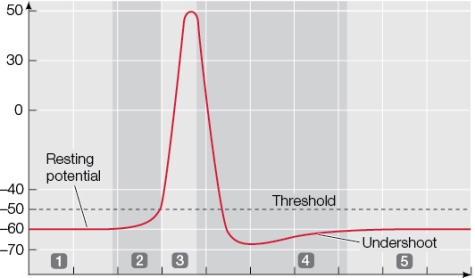 Which of the numbered points along the graph represents a state created by leak potassium channels? What is this state of the membrane called?
 (Short Answer)
4.9/5 (87)
(87) Multiple sclerosis and Guillain-Barre syndrome both involve damage to myelin, although the location of the affected myelin differs.Multiple sclerosis affects myelin in the central nervous system, whereas Guillain-Barre syndrome affects myelin in the peripheral nervous system.This means that multiple sclerosis affects _______ and Guillain-Barre affects _______.
(Multiple Choice)
4.9/5 (90)
(90) Refer to the figure showing a postsynaptic neuron summing information. 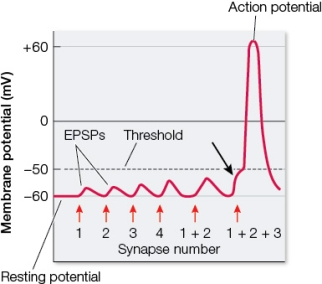 The black arrow in the figure indicates
 (Multiple Choice)
4.9/5 (76)
(76) If you were a neurobiologist interested in recording in real time the activities of single ion channels, then you might use the technique of _______.
(Short Answer)
4.8/5 (79)
(79) Which statement about the summation of postsynaptic potentials is false?
(Multiple Choice)
4.8/5 (81)
(81) 
Filters
- Essay(0)
- Multiple Choice(0)
- Short Answer(0)
- True False(0)
- Matching(0)