



 Chat with AI
Exam 20: Mechanisms of Evolution

Exam 1: Studying Life246 Questions
Exam 2: Small Molecules and the Chemistry of Life246 Questions
Exam 3: Proteins, Carbohydrates, and Lipids246 Questions
Exam 4: Nucleic Acids and the Origin of Life246 Questions
Exam 5: Cells: the Working Units of Life248 Questions
Exam 6: Cell Membranes246 Questions
Exam 7: Cell Communication and Multicellularity246 Questions
Exam 8: Energy, Enzymes, and Metabolism246 Questions
Exam 9: Pathways That Harvest Chemical Energy246 Questions
Exam 10: Photosynthesis: Energy From Sunlight242 Questions
Exam 11: The Cell Cycle and Cell Division260 Questions
Exam 12: Inheritance, Genes, and Chromosomes250 Questions
Exam 13: Dna and Its Role in Heredity257 Questions
Exam 14: From Dna to Protein: Gene Expression252 Questions
Exam 15: Gene Mutation and Molecular Medicine251 Questions
Exam 16: Regulation of Gene Expression245 Questions
Exam 17: Genomes249 Questions
Exam 18: Recombinant Dna and Biotechnology243 Questions
Exam 20: Mechanisms of Evolution243 Questions
Exam 21: Reconstructing and Using Phylogenies246 Questions
Exam 22: Speciation247 Questions
Exam 23: Evolution of Genes and Genomes252 Questions
Exam 24: The History of Life on Earth246 Questions
Exam 25: Bacteria, Archaea, and Viruses262 Questions
Exam 26: The Origin and Diversification of Eukaryotes252 Questions
Exam 27: Plants Without Seeds: From Water to Land251 Questions
Exam 28: The Evolution of Seed Plants259 Questions
Exam 29: The Evolution and Diversity of Fungi261 Questions
Exam 30: Animal Origins and the Evolution of Body Plans248 Questions
Exam 31: Protostome Animals244 Questions
Exam 32: Deuterostome Animals246 Questions
Exam 33: The Plant Body243 Questions
Exam 34: Transport in Plants248 Questions
Exam 35: Plant Nutrition247 Questions
Exam 36: Regulation of Plant Growth246 Questions
Exam 37: Reproduction in Flowering Plants247 Questions
Exam 38: Plant Responses to Environmental Challenges246 Questions
Exam 39: Physiology, Homeostasis, and Temperature Regulation258 Questions
Exam 40: Animal Hormones249 Questions
Exam 41: Immunology: Animal Defense Systems265 Questions
Exam 42: Animal Reproduction261 Questions
Exam 43: Animal Development261 Questions
Exam 44: Neurons, Glia, and Nervous Systems250 Questions
Exam 45: Sensory Systems249 Questions
Exam 46: The Mammalian Nervous System: Structure and Higher Functions254 Questions
Exam 47: Musculoskeletal Systems259 Questions
Exam 48: Gas Exchange247 Questions
Exam 49: Circulatory Systems252 Questions
Exam 50: Nutrition, Digestion, and Absorption259 Questions
Exam 51: Salt and Water Balance and Nitrogen Excretion251 Questions
Exam 52: Animal Behavior249 Questions
Exam 53: The Physical Environment and Biogeography of Life248 Questions
Exam 54: Populations259 Questions
Exam 55: Species Interactions254 Questions
Exam 56: Communities247 Questions
Exam 57: Ecosystems238 Questions
Exam 58: A Changing Biosphere222 Questions
Select questions type


In a population of 200 individuals at Hardy-Weinberg equilibrium, 72 are homozygous recessive for the character of eye color (cc).One hundred individuals from this population die from a fatal disease.Thirty-six of the survivors are homozygous recessive.In the new population, the frequency of the dominant allele is

Free
(Multiple Choice)
4.7/5  (74)
(74) Correct Answer: Verified
C
Draw a graph showing how the frequency of heterozygotes in a population would vary depending on the frequency of the alleles in the population, assuming Hardy-Weinberg equilibrium.
Free
(Essay)
4.9/5 (86)
(86) Correct Answer:Verified
Verified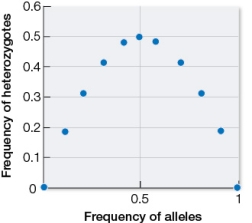 At an allele frequency of 0.5 the proportion of heterozygotes at a maximum
Which observation from Darwin's stay in the Galápagos Islands was most instrumental toward his eventual development of evolutionary theory?
Free
(Multiple Choice)
4.8/5 (85)
(85) Correct Answer:Verified
VerifiedA
Which mode(s) of selection arise(s) when individuals at both extremes of the distribution have high fitness?
(Multiple Choice)
4.8/5 (89)
(89) Individuals who carry two copies of the sickle allele of a gene for hemoglobin suffer from a usually fatal anemia.However, individuals who carry one sickle allele have a greater resistance to malaria.Such individuals demonstrate the principle of _______, which accounts for the maintenance of both the normal and the sickle alleles.
(Short Answer)
4.9/5 (74)
(74) A population of monkeyflowers has 39 individuals that are BB at a locus, 42 that are Bb, and 19 that are bb.This population has _______ fewer heterozygotes than would be expected under Hardy‒Weinberg equilibrium.
(Short Answer)
4.8/5 (77)
(77) Selection currently maintains an intermediate body size in a population of salmon.Bears selectively prey on the largest individuals, while smaller individuals produce fewer offspring because they have difficulty competing with the larger individuals.Suppose that the food supply increased, reducing the competition among the salmon for food.Most likely, the salmon size would decrease due to _______ selection.
(Short Answer)
4.9/5 (77)
(77) The average survival rates of individuals of different sizes in a mouse population were assayed and are presented in the table. 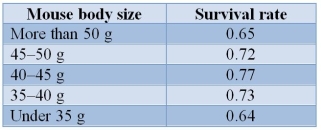 Assume that body size is at least partially heritable.Assuming that all other aspects are independent of size, this population is most likely experiencing _______ selection, and the variation in the population should _______ over many generations.
 (Multiple Choice)
4.8/5 (90)
(90) Due to various causes, including DDT poisoning, the population size of whooping cranes was reduced to about a dozen during the 1970s.The population size has since rebounded, and there are now hundreds of whooping cranes.Which feature would not be expected in the current populations of whooping cranes?
(Multiple Choice)
4.8/5 (82)
(82) Charles Darwin and _______ independently articulated the concept of natural selection.
(Short Answer)
4.8/5 (74)
(74) Suppose a population of flour beetles has 1,000 individuals.Normally the beetles are red; however, this population is polymorphic for a mutant autosomal body color, black, designated by bb.Red is dominant to black, so BB and Bb genotypes are red.Assume the population is at Hardy-Weinberg equilibrium, with equal frequencies of the two alleles.What would be the allele frequencies if a population bottleneck occurred and only four individuals survived: one female red heterozygote and three black males?
(Multiple Choice)
4.9/5 (89)
(89) Suppose variants at a single locus affect wing length in a species of crickets, with homozygotes for the L allele having long wings, homozygotes for the l allele having short wings, and heterozygotes having wings of intermediate length.In one population of 500 individuals, 340 have long wings, 120 have intermediate-length wings, and 40 have short wings.The frequency of the L allele is _______.
(Short Answer)
4.9/5 (63)
(63) In Drosophila melanogaster, body size increases as the distance from the equator increases, at least partly because of genetic differences.Population geneticists refer to such a geographical pattern as _______.
(Short Answer)
4.7/5 (73)
(73) A small population of sawflies that was once connected to a larger population but is now isolated is no longer experiencing
(Multiple Choice)
4.8/5 (77)
(77) Which is not a mechanism for maintaining genetic variation in populations?
(Multiple Choice)
5.0/5 (65)
(65) In a population of pitcher plants, 200 individuals are sampled for variation at a locus.Sixteen are heterozygous for the X1 allele, and four are homozygous for it.What is the frequency of the X1 allele?
(Multiple Choice)
4.9/5 (81)
(81) Which statement about fitness and natural selection is true?
(Multiple Choice)
4.8/5 (68)
(68) 
Filters
- Essay(0)
- Multiple Choice(0)
- Short Answer(0)
- True False(0)
- Matching(0)