



 Chat with AI
Exam 20: Mechanisms of Evolution

Exam 1: Studying Life246 Questions
Exam 2: Small Molecules and the Chemistry of Life246 Questions
Exam 3: Proteins, Carbohydrates, and Lipids246 Questions
Exam 4: Nucleic Acids and the Origin of Life246 Questions
Exam 5: Cells: the Working Units of Life248 Questions
Exam 6: Cell Membranes246 Questions
Exam 7: Cell Communication and Multicellularity246 Questions
Exam 8: Energy, Enzymes, and Metabolism246 Questions
Exam 9: Pathways That Harvest Chemical Energy246 Questions
Exam 10: Photosynthesis: Energy From Sunlight242 Questions
Exam 11: The Cell Cycle and Cell Division260 Questions
Exam 12: Inheritance, Genes, and Chromosomes250 Questions
Exam 13: Dna and Its Role in Heredity257 Questions
Exam 14: From Dna to Protein: Gene Expression252 Questions
Exam 15: Gene Mutation and Molecular Medicine251 Questions
Exam 16: Regulation of Gene Expression245 Questions
Exam 17: Genomes249 Questions
Exam 18: Recombinant Dna and Biotechnology243 Questions
Exam 20: Mechanisms of Evolution243 Questions
Exam 21: Reconstructing and Using Phylogenies246 Questions
Exam 22: Speciation247 Questions
Exam 23: Evolution of Genes and Genomes252 Questions
Exam 24: The History of Life on Earth246 Questions
Exam 25: Bacteria, Archaea, and Viruses262 Questions
Exam 26: The Origin and Diversification of Eukaryotes252 Questions
Exam 27: Plants Without Seeds: From Water to Land251 Questions
Exam 28: The Evolution of Seed Plants259 Questions
Exam 29: The Evolution and Diversity of Fungi261 Questions
Exam 30: Animal Origins and the Evolution of Body Plans248 Questions
Exam 31: Protostome Animals244 Questions
Exam 32: Deuterostome Animals246 Questions
Exam 33: The Plant Body243 Questions
Exam 34: Transport in Plants248 Questions
Exam 35: Plant Nutrition247 Questions
Exam 36: Regulation of Plant Growth246 Questions
Exam 37: Reproduction in Flowering Plants247 Questions
Exam 38: Plant Responses to Environmental Challenges246 Questions
Exam 39: Physiology, Homeostasis, and Temperature Regulation258 Questions
Exam 40: Animal Hormones249 Questions
Exam 41: Immunology: Animal Defense Systems265 Questions
Exam 42: Animal Reproduction261 Questions
Exam 43: Animal Development261 Questions
Exam 44: Neurons, Glia, and Nervous Systems250 Questions
Exam 45: Sensory Systems249 Questions
Exam 46: The Mammalian Nervous System: Structure and Higher Functions254 Questions
Exam 47: Musculoskeletal Systems259 Questions
Exam 48: Gas Exchange247 Questions
Exam 49: Circulatory Systems252 Questions
Exam 50: Nutrition, Digestion, and Absorption259 Questions
Exam 51: Salt and Water Balance and Nitrogen Excretion251 Questions
Exam 52: Animal Behavior249 Questions
Exam 53: The Physical Environment and Biogeography of Life248 Questions
Exam 54: Populations259 Questions
Exam 55: Species Interactions254 Questions
Exam 56: Communities247 Questions
Exam 57: Ecosystems238 Questions
Exam 58: A Changing Biosphere222 Questions
Select questions type


A population of beavers has 135 individuals that are homozygous for one allele, 230 that are heterozygous, and 135 that are homozygous for the other allele.Compared with Hardy-Weinberg expectations, this population has _______ too _____ heterozygotes.
(Multiple Choice)
4.9/5  (75)
(75) In a population of sea otters, the frequency of the alpha allele at locus Y6 is 0.8.If the population has 400 individuals, what is the expected number of alpha alleles in the population?
(Multiple Choice)
4.9/5 (89)
(89) Allele frequencies can be used to measure the _______ of a Mendelian population, whereas _______ show(s) how it is/they are distributed among the population's members.
(Multiple Choice)
4.9/5 (80)
(80) Studies of enzyme genotypes and flight in Colias butterflies showed that
(Multiple Choice)
4.9/5 (73)
(73) The survivorship of individuals from three different populations of a beetle species has been assayed and is presented in the table. 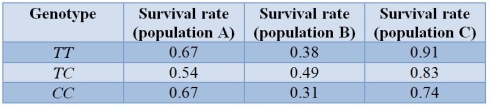 TT, TC, and CC represent genotypes at a locus that affects survival.Assuming that genotypes at this locus have no other effects on fitness, in which population(s) would we expect variation to be maintained by selection?
 (Multiple Choice)
4.7/5 (79)
(79) What was Darwin's explanation for the evolution of bright colors and other apparently useless (and potentially deleterious) but conspicuous characters in males of many species?
(Multiple Choice)
4.9/5 (86)
(86) Small populations are _______ likely to be near Hardy-Weinberg equilibrium than large populations, because genetic drift is _______ important in small populations.
(Multiple Choice)
4.9/5 (82)
(82) The size of a particular appendage in many populations of beetles is determined by alleles at many genetic loci and is largely unaffected by selection.Initially, many populations start with about the same average size of the appendage.Assuming that genetic drift is the only evolutionary process operating, we would expect that over the course of many generations, the average size of the appendage would _______ and that there would be _______ difference in the size of the appendage among the different populations.
(Multiple Choice)
4.9/5 (91)
(91) The numbers of fledged young from female robins of different sizes were assayed and are presented in the table. 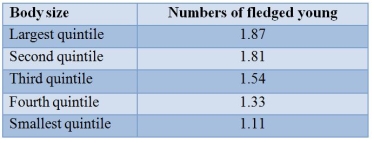 Assume that body size is at least partially heritable.Assuming that all other aspects (survival, etc.) are independent of size, this population is most likely experiencing _______ selection, and the variation in the population should _______ over many generations.
 (Multiple Choice)
4.9/5 (80)
(80) In a small, asexual population of rotifers, the average number of mutations in any individual increases steadily in each generation.The most likely mechanism for this is _______.
(Short Answer)
5.0/5 (92)
(92) The numbers of fledged young of female swamp sparrows of different sizes were assayed and are presented in the table. 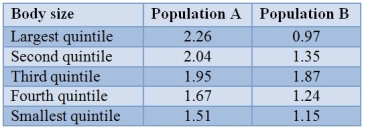 Assume that body size is at least partially heritable.What type of selection is most likely occurring in population A? Assume that all other aspects (survival, etc.) are independent of size.
 (Multiple Choice)
4.8/5 (70)
(70) Warfarin is a popular and potent rodent poison, as well as a blood-thinning medicine.Rats that have one copy of the allele for resistance to warfarin have increased resistance and thus better survival in an environment with warfarin.Rats that are homozygous for this allele are less fit than heterozygotes, even in the presence of warfarin, because they have much higher requirements for vitamin K.Which best describes what occurs in an environment with warfarin?
(Multiple Choice)
4.7/5 (81)
(81) A population of mice has been monitored for change over several generations.Following are five different bones and the changes to their means and extents of variation. Tibia: Mean increased 0.14 units; variation decreased.
Femur: Mean increased 0.08 units; variation increased.
Ulna: Mean did not change; variation increased.
Clavicle: Mean did not change; variation decreased.
Radius: Mean decreased 0.12 units; variation decreased.
Which is most likely to be under diversifying selection?
(Multiple Choice)
4.8/5 (77)
(77) The FY3 gene plays a role in immune responses in flies.In one population, there are two alleles, and the frequency of one allele is 0.6.If the population is at Hardy-Weinberg equilibrium, what is the frequency of heterozygotes?
(Multiple Choice)
4.8/5 (84)
(84) Assuming there are only two alleles at a given locus, if the frequency of one allele is 0.3, what is the frequency of the other allele?
(Multiple Choice)
4.9/5 (81)
(81) In a species of beetles, males that have large horns are better able to fight off other males for access to females.This is an example of _______ selection.
(Multiple Choice)
4.9/5 (74)
(74) Disruptive selection for body size would most likely occur when
(Multiple Choice)
4.8/5 (89)
(89) The presence of pathogens will tend to _______ the evolution of sexual reproduction because _______.
(Multiple Choice)
4.9/5 (74)
(74) Although Darwin's voyage aboard the HMS Beagle took him around the world, most of his observations on natural history were made on the continent of _______ and its nearby islands.
(Short Answer)
4.8/5 (72)
(72) 
Filters
- Essay(0)
- Multiple Choice(0)
- Short Answer(0)
- True False(0)
- Matching(0)