



 Chat with AI
Exam 20: Mechanisms of Evolution

Exam 1: Studying Life246 Questions
Exam 2: Small Molecules and the Chemistry of Life246 Questions
Exam 3: Proteins, Carbohydrates, and Lipids246 Questions
Exam 4: Nucleic Acids and the Origin of Life246 Questions
Exam 5: Cells: the Working Units of Life248 Questions
Exam 6: Cell Membranes246 Questions
Exam 7: Cell Communication and Multicellularity246 Questions
Exam 8: Energy, Enzymes, and Metabolism246 Questions
Exam 9: Pathways That Harvest Chemical Energy246 Questions
Exam 10: Photosynthesis: Energy From Sunlight242 Questions
Exam 11: The Cell Cycle and Cell Division260 Questions
Exam 12: Inheritance, Genes, and Chromosomes250 Questions
Exam 13: Dna and Its Role in Heredity257 Questions
Exam 14: From Dna to Protein: Gene Expression252 Questions
Exam 15: Gene Mutation and Molecular Medicine251 Questions
Exam 16: Regulation of Gene Expression245 Questions
Exam 17: Genomes249 Questions
Exam 18: Recombinant Dna and Biotechnology243 Questions
Exam 20: Mechanisms of Evolution243 Questions
Exam 21: Reconstructing and Using Phylogenies246 Questions
Exam 22: Speciation247 Questions
Exam 23: Evolution of Genes and Genomes252 Questions
Exam 24: The History of Life on Earth246 Questions
Exam 25: Bacteria, Archaea, and Viruses262 Questions
Exam 26: The Origin and Diversification of Eukaryotes252 Questions
Exam 27: Plants Without Seeds: From Water to Land251 Questions
Exam 28: The Evolution of Seed Plants259 Questions
Exam 29: The Evolution and Diversity of Fungi261 Questions
Exam 30: Animal Origins and the Evolution of Body Plans248 Questions
Exam 31: Protostome Animals244 Questions
Exam 32: Deuterostome Animals246 Questions
Exam 33: The Plant Body243 Questions
Exam 34: Transport in Plants248 Questions
Exam 35: Plant Nutrition247 Questions
Exam 36: Regulation of Plant Growth246 Questions
Exam 37: Reproduction in Flowering Plants247 Questions
Exam 38: Plant Responses to Environmental Challenges246 Questions
Exam 39: Physiology, Homeostasis, and Temperature Regulation258 Questions
Exam 40: Animal Hormones249 Questions
Exam 41: Immunology: Animal Defense Systems265 Questions
Exam 42: Animal Reproduction261 Questions
Exam 43: Animal Development261 Questions
Exam 44: Neurons, Glia, and Nervous Systems250 Questions
Exam 45: Sensory Systems249 Questions
Exam 46: The Mammalian Nervous System: Structure and Higher Functions254 Questions
Exam 47: Musculoskeletal Systems259 Questions
Exam 48: Gas Exchange247 Questions
Exam 49: Circulatory Systems252 Questions
Exam 50: Nutrition, Digestion, and Absorption259 Questions
Exam 51: Salt and Water Balance and Nitrogen Excretion251 Questions
Exam 52: Animal Behavior249 Questions
Exam 53: The Physical Environment and Biogeography of Life248 Questions
Exam 54: Populations259 Questions
Exam 55: Species Interactions254 Questions
Exam 56: Communities247 Questions
Exam 57: Ecosystems238 Questions
Exam 58: A Changing Biosphere222 Questions
Select questions type


In addition to Darwin, who do we credit for formulating the theory of evolution by natural selection?
(Multiple Choice)
4.8/5  (87)
(87) Following is a list of the performance of the different genotypes at the S locus in two environments for three populations of lizards.The first number is their running speed (in m/s), and the second is their relative strength. 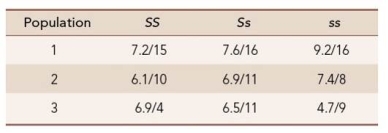 In which population(s) is there evidence for a trade-off between running speed and relative strength?
 (Multiple Choice)
4.8/5 (90)
(90) Next-generation sequencing reveals that six new mutations have occurred in the coding regions of genes in an individual diploid fly.If the coding regions of this fly comprise 100 million nucleotides per haploid genome, what is the mutation rate per nucleotide?
(Multiple Choice)
4.9/5 (69)
(69) Calculate the frequency of homozygotes for an allele at a locus in a population at Hardy-Weinberg equilibrium if the frequency of the allele is 0.15.
(Multiple Choice)
4.8/5 (87)
(87) A large meteor hit Earth 66 million years ago.As a result, most large animals went extinct, including the nonavian dinosaurs, despite their success for millions of years before that time.This is an example of
(Multiple Choice)
4.8/5 (69)
(69) A species of yeast can reproduce either sexually or asexually.Five populations of this yeast were initially asexual but were moved to different environments.Which population would likely evolve sexual reproduction and recombination?
(Multiple Choice)
4.8/5 (79)
(79) The table shows the number of offspring produced by individuals of three genotypes at the B locus in five different populations. 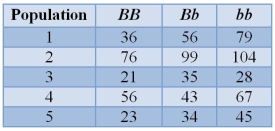 Assuming survival rates and all other factors are equal across genotypes, in which population would you most likely expect variation at the B locus to be maintained?
 (Multiple Choice)
5.0/5 (69)
(69) The sizes of eyes in a population of spiders are monitored over several generations.The average eye size does not noticeably change, but the range of variation decreases.Assuming that no other evolutionary processes are occurring, what type of selection is most likely taking place?
(Multiple Choice)
4.8/5 (80)
(80) Which of the following statements about the Hardy-Weinberg equilibrium is false?
(Multiple Choice)
4.7/5 (80)
(80) Biologists recently discovered that black wolves got their coat color from exchanging genes with dogs.This is an example of
(Multiple Choice)
4.9/5 (85)
(85) By definition, a population that is fixed for an allele _______ at that locus.
(Multiple Choice)
4.8/5 (81)
(81) Suppose a population of flour beetles has 1,000 individuals.Normally the beetles are red; however, this population is polymorphic for a mutant autosomal body color, black, designated by bb.Red is dominant to black, so BB and Bb genotypes are red.Assume the population is at Hardy-Weinberg equilibrium, with equal frequencies of the two alleles.What would be the expected frequencies of the homozygous dominant, heterozygous, and homozygous recessive genotypes (in that order) after 100 generations, assuming that no selection or other evolutionary processes were operating?
(Multiple Choice)
4.8/5 (70)
(70) The generation of broccoli from the ancestral Brassica oletracea was achieved by _______ selection for specific features of the _______.
(Multiple Choice)
4.9/5 (85)
(85) The numbers of fledged young of female swamp sparrows of different sizes were assayed and are presented in the table. 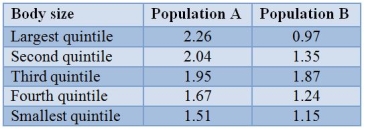 Assume that body size is at least partially heritable.What is the most likely response to selection in population B?
 (Multiple Choice)
5.0/5 (87)
(87) Suppose mutation and selection no longer occurred in a small, isolated population of nematodes.Which process would most likely continue operating, and what would be the most likely effect on the extent of genetic variation?
(Multiple Choice)
4.7/5 (89)
(89) A population of crickets has 84 individuals that are homozygous for one allele, 152 that are heterozygous, and 184 that are homozygous for the other allele.Compared with Hardy-Weinberg expectations, this population has _______ too few heterozygotes.
(Short Answer)
4.9/5 (102)
(102) 
Filters
- Essay(0)
- Multiple Choice(0)
- Short Answer(0)
- True False(0)
- Matching(0)