



 Chat with AI
Exam 20: Mechanisms of Evolution

Exam 1: Studying Life246 Questions
Exam 2: Small Molecules and the Chemistry of Life246 Questions
Exam 3: Proteins, Carbohydrates, and Lipids246 Questions
Exam 4: Nucleic Acids and the Origin of Life246 Questions
Exam 5: Cells: the Working Units of Life248 Questions
Exam 6: Cell Membranes246 Questions
Exam 7: Cell Communication and Multicellularity246 Questions
Exam 8: Energy, Enzymes, and Metabolism246 Questions
Exam 9: Pathways That Harvest Chemical Energy246 Questions
Exam 10: Photosynthesis: Energy From Sunlight242 Questions
Exam 11: The Cell Cycle and Cell Division260 Questions
Exam 12: Inheritance, Genes, and Chromosomes250 Questions
Exam 13: Dna and Its Role in Heredity257 Questions
Exam 14: From Dna to Protein: Gene Expression252 Questions
Exam 15: Gene Mutation and Molecular Medicine251 Questions
Exam 16: Regulation of Gene Expression245 Questions
Exam 17: Genomes249 Questions
Exam 18: Recombinant Dna and Biotechnology243 Questions
Exam 20: Mechanisms of Evolution243 Questions
Exam 21: Reconstructing and Using Phylogenies246 Questions
Exam 22: Speciation247 Questions
Exam 23: Evolution of Genes and Genomes252 Questions
Exam 24: The History of Life on Earth246 Questions
Exam 25: Bacteria, Archaea, and Viruses262 Questions
Exam 26: The Origin and Diversification of Eukaryotes252 Questions
Exam 27: Plants Without Seeds: From Water to Land251 Questions
Exam 28: The Evolution of Seed Plants259 Questions
Exam 29: The Evolution and Diversity of Fungi261 Questions
Exam 30: Animal Origins and the Evolution of Body Plans248 Questions
Exam 31: Protostome Animals244 Questions
Exam 32: Deuterostome Animals246 Questions
Exam 33: The Plant Body243 Questions
Exam 34: Transport in Plants248 Questions
Exam 35: Plant Nutrition247 Questions
Exam 36: Regulation of Plant Growth246 Questions
Exam 37: Reproduction in Flowering Plants247 Questions
Exam 38: Plant Responses to Environmental Challenges246 Questions
Exam 39: Physiology, Homeostasis, and Temperature Regulation258 Questions
Exam 40: Animal Hormones249 Questions
Exam 41: Immunology: Animal Defense Systems265 Questions
Exam 42: Animal Reproduction261 Questions
Exam 43: Animal Development261 Questions
Exam 44: Neurons, Glia, and Nervous Systems250 Questions
Exam 45: Sensory Systems249 Questions
Exam 46: The Mammalian Nervous System: Structure and Higher Functions254 Questions
Exam 47: Musculoskeletal Systems259 Questions
Exam 48: Gas Exchange247 Questions
Exam 49: Circulatory Systems252 Questions
Exam 50: Nutrition, Digestion, and Absorption259 Questions
Exam 51: Salt and Water Balance and Nitrogen Excretion251 Questions
Exam 52: Animal Behavior249 Questions
Exam 53: The Physical Environment and Biogeography of Life248 Questions
Exam 54: Populations259 Questions
Exam 55: Species Interactions254 Questions
Exam 56: Communities247 Questions
Exam 57: Ecosystems238 Questions
Exam 58: A Changing Biosphere222 Questions
Select questions type


Suppose individual robins with longer beaks have somewhat more offspring than those with shorter beaks and this has led to increases in beak length over time.We can say that beak size is associated with the _______ of the robin and that there is _______ selection operating on beak size.
(Multiple Choice)
4.9/5  (88)
(88) In the northern regions of its range, a species of bird experiences selection for increased size.Farther south, it experiences selection for decreased size.Given some migration across its range, the most likely result is
(Multiple Choice)
4.7/5 (74)
(74) If the effective rate of reproduction of an asexual lineage is 6 per year, what would be the effective rate of reproduction of a lineage that was identical to the asexual lineage in every way, except that it was sexual?
(Multiple Choice)
4.8/5 (69)
(69) Yeast cells are sequenced periodically to examine them for new mutations.The table shows the results. 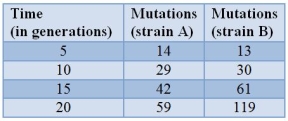 Assuming the mutation rate remains the same and mutations accumulate linearly, about how many mutations should there be in strain A after 50 generations?
 (Multiple Choice)
4.8/5 (72)
(72) A sparrow population currently eats seeds that are mostly of medium size.Which condition will most likely lead to more diversifying selection?
(Multiple Choice)
4.9/5 (84)
(84) Suppose that a particular species of flowering plant that lives only one year can produce red, pink, or white blossoms, depending on its genotype: AA, Aa, and aa produce, respectively, red, pink, and white blossoms.Biologists studying a population of this species count 300 red-flowering, 600 pink-flowering, and 800 white-flowering plants.In a census in the same area the following year, biologists find a population with 600 red-flowering, 900 pink-flowering, and 1,000 white-flowering plants.Which color has the highest fitness?
(Multiple Choice)
4.9/5 (82)
(82) If a population is monomorphic for an allele at one locus, the population is _______ for that allele, and the frequency of the allele is _______.
(Multiple Choice)
4.8/5 (85)
(85) The numbers of fledged young from female robins of different sizes were assayed and are presented in the table. 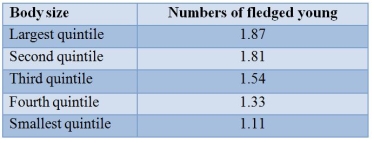 Assume that body size is at least partially heritable.Assuming that all other fitness aspects (survival, etc.) are independent of size, this population is most likely experiencing ______ selection, and the population should _______ in size over many generations.
 (Multiple Choice)
4.9/5 (77)
(77) Male earwigs that are DD at a locus have greater success in mating than those that are Dd or dd.Which statement is correct?
(Multiple Choice)
4.8/5 (73)
(73) Yeast cells are sequenced periodically to examine them for new mutations.The table shows the results. 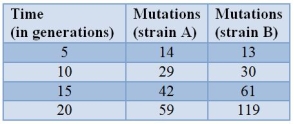 What is the approximate mutation rate per generation for strain A?
 (Multiple Choice)
4.9/5 (93)
(93) Following is a list of loci of a mustard plant and the frequencies of their most common allele, at different points along geographic distances from a minefield. 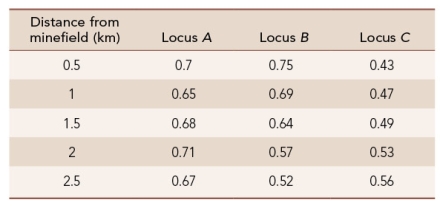 In which is there evidence of a cline?
 (Multiple Choice)
4.8/5 (85)
(85) The frequency of an allele in a population of Drosophila melanogaster changes haphazardly over time, sometimes going up and sometimes going down.In this population, 17 percent had the allele in 1998 and 30 percent had it in 2016.Biologists found no effect of this allele (versus the other alleles in the population) on any phenotypic trait.What is the best explanation for this pattern?
(Multiple Choice)
4.8/5 (74)
(74) In a population of 800 wolves, 320 are CC and 360 are Cc for a locus with two alleles.Which statement is true?
(Multiple Choice)
4.9/5 (73)
(73) Diversifying selection is operating on size in a species of barnacles.This means that _______ have the highest fitness and that the variation should _______ over time if size is heritable and if no other forces are operating.
(Multiple Choice)
4.9/5 (83)
(83) A population of ocotillo plants has four alleles at the Dopa locus, with allelic frequencies of 0.38, 0.32, 0.19, and 0.11, and the genotype frequencies are roughly consistent with the Hardy-Weinberg equilibrium.This is a description of the genetic _______ of the population.
(Multiple Choice)
4.7/5 (78)
(78) The survivorship of individuals from four different populations of a beetle species has been assayed and is presented in the table.TT, TC, and CC represent genotypes at a locus that is important in survival.  Assuming that genotypes at this locus have no other effects on fitness, would we expect variation to be maintained by selection in any of the populations? Why? What would be the expected outcomes in the populations in the absence of any other evolutionary processes?
 (Essay)
5.0/5 (77)
(77) A1 and A2 are different forms of the same gene.These are thus different
(Multiple Choice)
4.8/5 (86)
(86) Three different alleles (b1, b2, and b3) at the b locus exist in a hypothetical population of juniper trees.If the frequency of b1 is 0.4, what can be said about the frequency of b3?
(Multiple Choice)
4.9/5 (85)
(85) 
Filters
- Essay(0)
- Multiple Choice(0)
- Short Answer(0)
- True False(0)
- Matching(0)