



 Chat with AI
Exam 56: Communities

Exam 1: Studying Life246 Questions
Exam 2: Small Molecules and the Chemistry of Life246 Questions
Exam 3: Proteins, Carbohydrates, and Lipids246 Questions
Exam 4: Nucleic Acids and the Origin of Life246 Questions
Exam 5: Cells: the Working Units of Life248 Questions
Exam 6: Cell Membranes246 Questions
Exam 7: Cell Communication and Multicellularity246 Questions
Exam 8: Energy, Enzymes, and Metabolism246 Questions
Exam 9: Pathways That Harvest Chemical Energy246 Questions
Exam 10: Photosynthesis: Energy From Sunlight242 Questions
Exam 11: The Cell Cycle and Cell Division260 Questions
Exam 12: Inheritance, Genes, and Chromosomes250 Questions
Exam 13: Dna and Its Role in Heredity257 Questions
Exam 14: From Dna to Protein: Gene Expression252 Questions
Exam 15: Gene Mutation and Molecular Medicine251 Questions
Exam 16: Regulation of Gene Expression245 Questions
Exam 17: Genomes249 Questions
Exam 18: Recombinant Dna and Biotechnology243 Questions
Exam 20: Mechanisms of Evolution243 Questions
Exam 21: Reconstructing and Using Phylogenies246 Questions
Exam 22: Speciation247 Questions
Exam 23: Evolution of Genes and Genomes252 Questions
Exam 24: The History of Life on Earth246 Questions
Exam 25: Bacteria, Archaea, and Viruses262 Questions
Exam 26: The Origin and Diversification of Eukaryotes252 Questions
Exam 27: Plants Without Seeds: From Water to Land251 Questions
Exam 28: The Evolution of Seed Plants259 Questions
Exam 29: The Evolution and Diversity of Fungi261 Questions
Exam 30: Animal Origins and the Evolution of Body Plans248 Questions
Exam 31: Protostome Animals244 Questions
Exam 32: Deuterostome Animals246 Questions
Exam 33: The Plant Body243 Questions
Exam 34: Transport in Plants248 Questions
Exam 35: Plant Nutrition247 Questions
Exam 36: Regulation of Plant Growth246 Questions
Exam 37: Reproduction in Flowering Plants247 Questions
Exam 38: Plant Responses to Environmental Challenges246 Questions
Exam 39: Physiology, Homeostasis, and Temperature Regulation258 Questions
Exam 40: Animal Hormones249 Questions
Exam 41: Immunology: Animal Defense Systems265 Questions
Exam 42: Animal Reproduction261 Questions
Exam 43: Animal Development261 Questions
Exam 44: Neurons, Glia, and Nervous Systems250 Questions
Exam 45: Sensory Systems249 Questions
Exam 46: The Mammalian Nervous System: Structure and Higher Functions254 Questions
Exam 47: Musculoskeletal Systems259 Questions
Exam 48: Gas Exchange247 Questions
Exam 49: Circulatory Systems252 Questions
Exam 50: Nutrition, Digestion, and Absorption259 Questions
Exam 51: Salt and Water Balance and Nitrogen Excretion251 Questions
Exam 52: Animal Behavior249 Questions
Exam 53: The Physical Environment and Biogeography of Life248 Questions
Exam 54: Populations259 Questions
Exam 55: Species Interactions254 Questions
Exam 56: Communities247 Questions
Exam 57: Ecosystems238 Questions
Exam 58: A Changing Biosphere222 Questions
Select questions type


Several members of a mouse species living in a weedy edge environment migrate into a nearby crop field.They find plenty of fallen seeds to eat, so they dig tunnels and begin to colonize.The soil often receives inputs of concentrated chemicals, including pesticides.The mice begin to die, and after a few generations the survivors move back into the edge environment.The mice have failed to colonize the new community because of

Free
(Multiple Choice)
4.7/5  (84)
(84) Correct Answer: Verified
B
Peas, beans, clover, and peanuts are all legumes, which are nitrogen-fixing plants.Ecologically, these plants can all be placed in the same _______.
Free
(Short Answer)
4.8/5 (80)
(80) Correct Answer:Verified
Verifiedfunctional group
Which statement describes an important difference between a keystone species and a foundation species?
Free
(Multiple Choice)
4.8/5 (88)
(88) Correct Answer:Verified
VerifiedB
Which of these is not an environmental factor that might prevent a species of mollusk from becoming established in a shallow-water marine community?
(Multiple Choice)
4.8/5 (82)
(82) A wetland is drained, filled, and planted with corn.After 20 years, the farmer decides to restore the wetland and works with a local conservation agency to return the habitat to its original conditions.After some time, it becomes obvious that the species composition is very different from that of the original wetland.What is the most likely explanation for what has happened to the wetland?
(Multiple Choice)
4.8/5 (93)
(93) Two species eat the same prey, which is a limiting resource, and both their populations remain stable.Species A is removed, and the population of species B begins to increase rapidly.This suggests that the two species are _______ and the interaction is _______.
(Multiple Choice)
4.9/5 (86)
(86) Corals affect their communities by producing elaborate limestone skeletons (coral reefs) that provide habitat for thousands of species and by helping to concentrate resources on the reef.Sea otters affect their communities by acting as top predators that generate trophic cascades, helping to maintain species richness, abundance, and composition.Are these animals considered keystone species or foundation species?
(Multiple Choice)
4.8/5 (75)
(75) Seagrass beds extend along much of the Atlantic coast of the United States.A group of scientists is studying an estuary that contains seagrass beds.They arbitrarily set a boundary around their study community such that it includes a 100-yard length of seagrass plus the next 100 feet of water extending from it in all directions.Are the scientists defining their community in theoretical or practical terms?
(Multiple Choice)
4.9/5 (81)
(81) Lottery (neutral) models of species diversity in a community are most likely to operate when
(Multiple Choice)
4.8/5 (73)
(73) Which statement best explains the difference between primary and secondary succession?
(Multiple Choice)
4.8/5 (69)
(69) Species composition was analyzed for fish communities in two Brazilian rivers.The higher (headwaters), middle, and lower (floodplain) sections of both the Iguatemi River and the Jogui River were sampled.The Iguatemi had 34 species and the Jogui had 31.In both rivers, some species occurred only in the headwaters, others only in the floodplains.Water velocity decreased and turbidity increased from the headwaters to the floodplains.Neither river had rooted vegetation, and the communities did not differ significantly from season to season.The factor most important in determining species composition in the two rivers was most likely
(Multiple Choice)
4.9/5 (89)
(89) Plant species A has only one pollinator; if the pollinator disappears, the plant is not pollinated and its numbers decline.Plant species B has multiple pollinators; if a single pollinator disappears, the remaining pollinators ensure that species B is still pollinated and its numbers remain stable.Which species shows the greatest interaction strength with its pollinators?
(Multiple Choice)
4.9/5 (71)
(71) The type of succession most often resulting from human activities such as deforestation is _______ succession.
(Short Answer)
4.8/5 (82)
(82) Tropical rainforests have hundreds of tree species.It has been hypothesized that the model that best describes the causes of species richness in these tree communities is the neutral, or lottery, model.This is because rainforest trees likely
(Multiple Choice)
5.0/5 (75)
(75) In a salt marsh habitat, snails feed on marsh grasses, and blue crabs feed on snails.A high population of snails can graze the marsh so intensely that it becomes a mudflat.When blue crabs are present, the levels of all three species remain balanced and the marsh is healthy.What change in the salt marsh would be expected if blue crabs were removed?
(Multiple Choice)
4.9/5 (75)
(75) Which example of trophic interactions represents an indirect interaction in a community?
(Multiple Choice)
4.8/5 (72)
(72) Bison were introduced to a small fenced-in prairie region and allowed to reproduce.The bison soon overpopulated the area and overgrazed the native prairie grasses.After several years of overpopulation and overgrazing, managers removed the bison.However, after 10 years, the prairie has still not returned to its original species composition.This suggests it has undergone the process of _______.
(Short Answer)
4.8/5 (80)
(80) Which of these species or groups of species would be considered both foundation species and ecosystem engineering species?
(Multiple Choice)
4.8/5 (89)
(89) A freak cold spell in October 2009 in the northeastern United States dramatically reduced the survival of several small mammal species.In this situation, the cold spell was acting as a(n) _______.
(Short Answer)
5.0/5 (89)
(89) There are several meanings of the word "community" and several ways to subdivide a community.Three are shown in the figure.Distinguish among these three subdivisions and explain why the members of a subdivision can be considered a community. 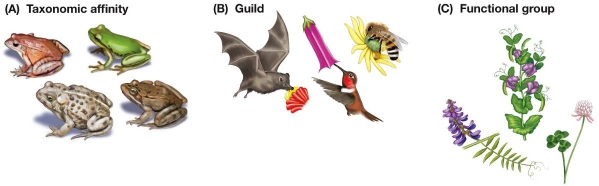
(Essay)
5.0/5 (73)
(73) 
Filters
- Essay(0)
- Multiple Choice(0)
- Short Answer(0)
- True False(0)
- Matching(0)