



 Chat with AI
Exam 56: Communities

Exam 1: Studying Life246 Questions
Exam 2: Small Molecules and the Chemistry of Life246 Questions
Exam 3: Proteins, Carbohydrates, and Lipids246 Questions
Exam 4: Nucleic Acids and the Origin of Life246 Questions
Exam 5: Cells: the Working Units of Life248 Questions
Exam 6: Cell Membranes246 Questions
Exam 7: Cell Communication and Multicellularity246 Questions
Exam 8: Energy, Enzymes, and Metabolism246 Questions
Exam 9: Pathways That Harvest Chemical Energy246 Questions
Exam 10: Photosynthesis: Energy From Sunlight242 Questions
Exam 11: The Cell Cycle and Cell Division260 Questions
Exam 12: Inheritance, Genes, and Chromosomes250 Questions
Exam 13: Dna and Its Role in Heredity257 Questions
Exam 14: From Dna to Protein: Gene Expression252 Questions
Exam 15: Gene Mutation and Molecular Medicine251 Questions
Exam 16: Regulation of Gene Expression245 Questions
Exam 17: Genomes249 Questions
Exam 18: Recombinant Dna and Biotechnology243 Questions
Exam 20: Mechanisms of Evolution243 Questions
Exam 21: Reconstructing and Using Phylogenies246 Questions
Exam 22: Speciation247 Questions
Exam 23: Evolution of Genes and Genomes252 Questions
Exam 24: The History of Life on Earth246 Questions
Exam 25: Bacteria, Archaea, and Viruses262 Questions
Exam 26: The Origin and Diversification of Eukaryotes252 Questions
Exam 27: Plants Without Seeds: From Water to Land251 Questions
Exam 28: The Evolution of Seed Plants259 Questions
Exam 29: The Evolution and Diversity of Fungi261 Questions
Exam 30: Animal Origins and the Evolution of Body Plans248 Questions
Exam 31: Protostome Animals244 Questions
Exam 32: Deuterostome Animals246 Questions
Exam 33: The Plant Body243 Questions
Exam 34: Transport in Plants248 Questions
Exam 35: Plant Nutrition247 Questions
Exam 36: Regulation of Plant Growth246 Questions
Exam 37: Reproduction in Flowering Plants247 Questions
Exam 38: Plant Responses to Environmental Challenges246 Questions
Exam 39: Physiology, Homeostasis, and Temperature Regulation258 Questions
Exam 40: Animal Hormones249 Questions
Exam 41: Immunology: Animal Defense Systems265 Questions
Exam 42: Animal Reproduction261 Questions
Exam 43: Animal Development261 Questions
Exam 44: Neurons, Glia, and Nervous Systems250 Questions
Exam 45: Sensory Systems249 Questions
Exam 46: The Mammalian Nervous System: Structure and Higher Functions254 Questions
Exam 47: Musculoskeletal Systems259 Questions
Exam 48: Gas Exchange247 Questions
Exam 49: Circulatory Systems252 Questions
Exam 50: Nutrition, Digestion, and Absorption259 Questions
Exam 51: Salt and Water Balance and Nitrogen Excretion251 Questions
Exam 52: Animal Behavior249 Questions
Exam 53: The Physical Environment and Biogeography of Life248 Questions
Exam 54: Populations259 Questions
Exam 55: Species Interactions254 Questions
Exam 56: Communities247 Questions
Exam 57: Ecosystems238 Questions
Exam 58: A Changing Biosphere222 Questions
Select questions type


As global temperatures rise, warm seasons lengthen.Flowering dates for some flowers are now about 10 days earlier than in the recent past.For pollination to occur, pollinators depend on flowers to bloom at specific times.Pollinators also alter their seasons-for example, insects emerge earlier.But these alterations do not necessarily coincide with changes in flowering.What is the most likely near-term consequence of these mismatches in flowering and pollinator readiness?
(Multiple Choice)
4.9/5  (85)
(85) Following disturbance to a community, succession-characterized by a change in community structure over time-can eventually result in a relatively stable stage called a
(Multiple Choice)
4.8/5 (72)
(72) The plants that grow best on recently formed moraines at Glacier Bay are those that
(Multiple Choice)
4.8/5 (75)
(75) Organisms most likely to tolerate harsh abiotic conditions are found
(Multiple Choice)
4.8/5 (88)
(88) Two species of protozoa are competing in a laboratory environment.A third species is introduced, with no other changes made to the experimental conditions.The population size of the third species gradually decreases for several days, and then it eventually goes extinct.What is the most likely reason this species went extinct?
(Multiple Choice)
4.9/5 (92)
(92) Keystone species and foundation species are sometimes also ecosystem engineers, which change the environment and provide habitat for a variety of species.In the process, they have a profound effect on community structure.Which of the following would be considered members of keystone or foundation species but not ecosystem engineers?
(Multiple Choice)
5.0/5 (82)
(82) Refer to the figure. 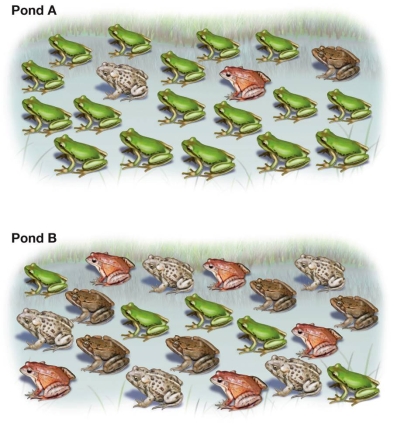 Compare the samples of frogs in the two communities.Assume that frogs that appear different are separate species.Compared to pond A, pond B has
 (Multiple Choice)
4.9/5 (82)
(82) Two areas in similar climates undergo disturbance.Area X is completely destroyed; nothing living is visible.Area Y is heavily damaged, but a few plants and animals remain.The area that will recover most rapidly is area _______.
(Short Answer)
4.9/5 (81)
(81) The Hawaiian Islands were formed by volcanic activity, and the original lava and soil substrate was deficient in nutrients, particularly nitrogen.This suggests that many of the earliest plants to become established on the islands were probably
(Multiple Choice)
4.8/5 (91)
(91) Scientists reported that the reintroduction of wolves into Yellowstone National Park initiated a trophic cascade.Which factual statement best supports this conclusion?
(Multiple Choice)
5.0/5 (76)
(76) In which case would secondary, rather than primary, succession occur?
(Multiple Choice)
4.8/5 (84)
(84) Tilman's experiments showed that increasing species richness enhanced the stability of plant production in the plots because
(Multiple Choice)
4.7/5 (77)
(77) Two communities are analyzed using the Shannon index of species diversity.Community A has an H value of 1.5.Community B has an H value of 3.0.What is the strongest conclusion that can be drawn about the species diversity of these two communities?
(Multiple Choice)
4.8/5 (65)
(65) The reintroduction of wolves into Yellowstone Park in 1995 had a(n) _______ effect on aspen and _______ effect on elk.
(Multiple Choice)
4.8/5 (73)
(73) Explain the concept of "filters" in determining which species become members of a community.Describe the three major filters determining community structure.
(Essay)
4.9/5 (88)
(88) Which concept would a community ecologist be most likely to study?
(Multiple Choice)
4.8/5 (69)
(69) A farmer has routinely planted soybeans, a nitrogen-fixing crop, in her fields, alternating it with corn, which requires high amounts of nitrogen.Then, for several years, she stops planting soybeans and plants only corn.Her corn crops decline more every year.This indicates that the interactor species (soybeans) has a (positive/negative) _______ interaction with the target species (corn).
(Short Answer)
4.8/5 (80)
(80) The Shannon index of species diversity is calculated using this equation: 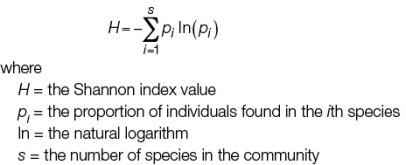 Habitat A has a total of 100 birds, with the following numbers of individuals per species: 20, 25, 20, 15, and 20.Habitat B also has 100 birds, with the following numbers of individuals per species: 80, 5, 5, 5, and 5.Based on the Shannon indices for habitats A and B, which habitat (if either) has a higher species diversity?
 (Multiple Choice)
4.9/5 (83)
(83) An area is undergoing secondary succession.Early in the process, facilitating species such as nitrogen fixers and decomposers predominate.Later in succession, there are more inhibiting species, such as competitors.What is a major reason that facilitating species outnumber inhibiting species early in succession?
(Multiple Choice)
4.8/5 (87)
(87) The intermediate disturbance hypothesis states that a community experiencing an intermediate level of disturbance will have higher species diversity than it would with low or high disturbance.What is a major justification for this hypothesis?
(Multiple Choice)
4.9/5 (79)
(79) 
Filters
- Essay(0)
- Multiple Choice(0)
- Short Answer(0)
- True False(0)
- Matching(0)