



 Chat with AI
Exam 56: Communities

Exam 1: Studying Life246 Questions
Exam 2: Small Molecules and the Chemistry of Life246 Questions
Exam 3: Proteins, Carbohydrates, and Lipids246 Questions
Exam 4: Nucleic Acids and the Origin of Life246 Questions
Exam 5: Cells: the Working Units of Life248 Questions
Exam 6: Cell Membranes246 Questions
Exam 7: Cell Communication and Multicellularity246 Questions
Exam 8: Energy, Enzymes, and Metabolism246 Questions
Exam 9: Pathways That Harvest Chemical Energy246 Questions
Exam 10: Photosynthesis: Energy From Sunlight242 Questions
Exam 11: The Cell Cycle and Cell Division260 Questions
Exam 12: Inheritance, Genes, and Chromosomes250 Questions
Exam 13: Dna and Its Role in Heredity257 Questions
Exam 14: From Dna to Protein: Gene Expression252 Questions
Exam 15: Gene Mutation and Molecular Medicine251 Questions
Exam 16: Regulation of Gene Expression245 Questions
Exam 17: Genomes249 Questions
Exam 18: Recombinant Dna and Biotechnology243 Questions
Exam 20: Mechanisms of Evolution243 Questions
Exam 21: Reconstructing and Using Phylogenies246 Questions
Exam 22: Speciation247 Questions
Exam 23: Evolution of Genes and Genomes252 Questions
Exam 24: The History of Life on Earth246 Questions
Exam 25: Bacteria, Archaea, and Viruses262 Questions
Exam 26: The Origin and Diversification of Eukaryotes252 Questions
Exam 27: Plants Without Seeds: From Water to Land251 Questions
Exam 28: The Evolution of Seed Plants259 Questions
Exam 29: The Evolution and Diversity of Fungi261 Questions
Exam 30: Animal Origins and the Evolution of Body Plans248 Questions
Exam 31: Protostome Animals244 Questions
Exam 32: Deuterostome Animals246 Questions
Exam 33: The Plant Body243 Questions
Exam 34: Transport in Plants248 Questions
Exam 35: Plant Nutrition247 Questions
Exam 36: Regulation of Plant Growth246 Questions
Exam 37: Reproduction in Flowering Plants247 Questions
Exam 38: Plant Responses to Environmental Challenges246 Questions
Exam 39: Physiology, Homeostasis, and Temperature Regulation258 Questions
Exam 40: Animal Hormones249 Questions
Exam 41: Immunology: Animal Defense Systems265 Questions
Exam 42: Animal Reproduction261 Questions
Exam 43: Animal Development261 Questions
Exam 44: Neurons, Glia, and Nervous Systems250 Questions
Exam 45: Sensory Systems249 Questions
Exam 46: The Mammalian Nervous System: Structure and Higher Functions254 Questions
Exam 47: Musculoskeletal Systems259 Questions
Exam 48: Gas Exchange247 Questions
Exam 49: Circulatory Systems252 Questions
Exam 50: Nutrition, Digestion, and Absorption259 Questions
Exam 51: Salt and Water Balance and Nitrogen Excretion251 Questions
Exam 52: Animal Behavior249 Questions
Exam 53: The Physical Environment and Biogeography of Life248 Questions
Exam 54: Populations259 Questions
Exam 55: Species Interactions254 Questions
Exam 56: Communities247 Questions
Exam 57: Ecosystems238 Questions
Exam 58: A Changing Biosphere222 Questions
Select questions type


Consider the following segment of a food web:  Of these organisms, which is considered the primary consumer?
 (Multiple Choice)
4.7/5  (73)
(73) Tropical forest fig trees provide habitat for thousands of species of animals and are an important food source for many more.Animals that live in and feed on figs provide prey for the diversity of rainforest predators.These functions of fig trees suggest they can be considered a(n) _______ species.
(Short Answer)
4.9/5 (82)
(82) Would disturbance or stress be likely to have the most rapid effect on community structure?
(Multiple Choice)
4.8/5 (65)
(65) Based on our current understanding of polycultures, an increase in stability of a community will likely lead to a(n) _______ in productivity of that system.
(Short Answer)
4.9/5 (81)
(81) A rancher wants to ensure that her cattle will get sufficient food by grazing on her grassland ecosystem every year, regardless of the year's temperature and precipitation levels.She knows that to ensure this, she must maintain high species diversity in the grassland.This is because high species diversity has all the following effects except
(Multiple Choice)
4.9/5 (79)
(79) A community ecologist defined a rotting log in a forest as a community, and she set up a series of observations and experiments to study it.When defining this community, the researcher most likely considered all of the following aspects except that the log had a
(Multiple Choice)
5.0/5 (78)
(78) The Shannon index of species diversity is calculated using this equation: 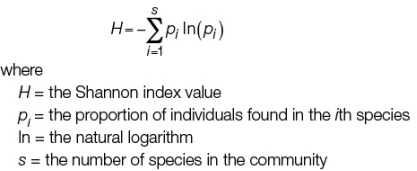 Habitat A has a total of 100 birds, with the following numbers of individuals per species: 20, 25, 20, 15, and 20.Habitat B also has 100 birds, with the following numbers of individuals per species: 80, 5, 5, 5, and 5.What is the Shannon index for habitat A?
 (Multiple Choice)
4.9/5 (76)
(76) As trees grow in a forest, they shade the understory plants, decreasing their ability to receive light and carry out photosynthesis.This is an example of _______.
(Short Answer)
4.8/5 (77)
(77) Refer to the figure. 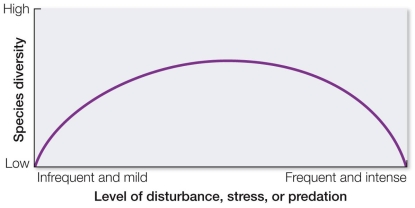 According to the intermediate disturbance hypothesis represented in the figure, species diversity in a community will be highest when the community
 (Multiple Choice)
4.9/5 (82)
(82) An ecologist creates a diagram showing the trophic interactions within a community.His diagram also includes information about competition, mutualism, and commensalism among species in the community.This diagram is best described as a(n) _______.
(Short Answer)
4.9/5 (83)
(83) During succession at Glacier Bay, Dryas and alders carry out nitrogen fixation, helping spruce trees become established.Established spruce trees then compete for nutrients and light with other tree species, hindering them from becoming established.Should these two interactions be categorized as facilitation or inhibition?
(Multiple Choice)
4.8/5 (76)
(76) The West Nile virus is carried by invasive Asian tiger mosquitoes and can infect humans.The Dutch elm fungus, spread by the invasive European elm bark beetle, as well as other elm bark beetles, has devastated elm tree populations in the northern United States.These two invasive species are similar in that both
(Multiple Choice)
4.9/5 (75)
(75) Climate change is causing many species to move out of their present habitats into new habitats.These migrations are likely happening because of a change in
(Multiple Choice)
4.9/5 (75)
(75) The ages of the moraines of Glacier Bay show the pattern of succession that has occurred there.On the oldest moraines, the communities are dominated by
(Multiple Choice)
5.0/5 (69)
(69) In 1963, an oceanic volcanic eruption off the southern coast of Iceland formed the island of Surtsey.Given the process of primary succession, which organisms were likely the first to establish populations on the new island?
(Multiple Choice)
4.8/5 (80)
(80) Coral reefs are found in shallow, coastal, tropical waters.Many species of organisms that might fit well in a coral reef community live some distance away.Which of these organisms would be most likely to colonize the coral reef?
(Multiple Choice)
4.7/5 (75)
(75) Refer to the graph, showing the percentage of aspens added to the Yellowstone National Park forests each decade for a century, with and without the presence of wolves. 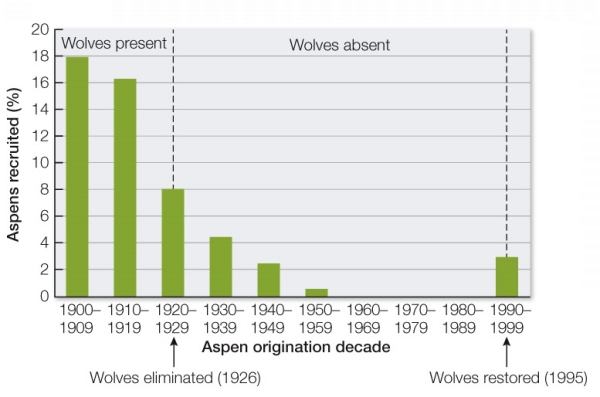 When present, wolves in the park feed on elk and control the elk population.Elk graze on aspen trees.Based on the graph, one can conclude that when wolves are not present to control the size of the elk population, aspen forests are
 (Multiple Choice)
4.9/5 (80)
(80) Consider the following segment of a food web:  If the removal of hawks from this part of the food web triggered a trophic cascade, what would be the effects, if any, on the population sizes of snakes and frogs?
 (Multiple Choice)
4.8/5 (84)
(84) Areas formed by volcanic activity, such as the Hawaiian Islands, have a lava substrate that is nitrogen-deficient.Many successful invaders in these areas are nitrogen fixers.By increasing nitrogen availability, these invaders enable the establishment of other invasive but non-nitrogen-fixing plant species.The changes to community structure result from _______.
(Short Answer)
4.9/5 (81)
(81) 
Filters
- Essay(0)
- Multiple Choice(0)
- Short Answer(0)
- True False(0)
- Matching(0)