



 Chat with AI
Exam 56: Communities

Exam 1: Studying Life246 Questions
Exam 2: Small Molecules and the Chemistry of Life246 Questions
Exam 3: Proteins, Carbohydrates, and Lipids246 Questions
Exam 4: Nucleic Acids and the Origin of Life246 Questions
Exam 5: Cells: the Working Units of Life248 Questions
Exam 6: Cell Membranes246 Questions
Exam 7: Cell Communication and Multicellularity246 Questions
Exam 8: Energy, Enzymes, and Metabolism246 Questions
Exam 9: Pathways That Harvest Chemical Energy246 Questions
Exam 10: Photosynthesis: Energy From Sunlight242 Questions
Exam 11: The Cell Cycle and Cell Division260 Questions
Exam 12: Inheritance, Genes, and Chromosomes250 Questions
Exam 13: Dna and Its Role in Heredity257 Questions
Exam 14: From Dna to Protein: Gene Expression252 Questions
Exam 15: Gene Mutation and Molecular Medicine251 Questions
Exam 16: Regulation of Gene Expression245 Questions
Exam 17: Genomes249 Questions
Exam 18: Recombinant Dna and Biotechnology243 Questions
Exam 20: Mechanisms of Evolution243 Questions
Exam 21: Reconstructing and Using Phylogenies246 Questions
Exam 22: Speciation247 Questions
Exam 23: Evolution of Genes and Genomes252 Questions
Exam 24: The History of Life on Earth246 Questions
Exam 25: Bacteria, Archaea, and Viruses262 Questions
Exam 26: The Origin and Diversification of Eukaryotes252 Questions
Exam 27: Plants Without Seeds: From Water to Land251 Questions
Exam 28: The Evolution of Seed Plants259 Questions
Exam 29: The Evolution and Diversity of Fungi261 Questions
Exam 30: Animal Origins and the Evolution of Body Plans248 Questions
Exam 31: Protostome Animals244 Questions
Exam 32: Deuterostome Animals246 Questions
Exam 33: The Plant Body243 Questions
Exam 34: Transport in Plants248 Questions
Exam 35: Plant Nutrition247 Questions
Exam 36: Regulation of Plant Growth246 Questions
Exam 37: Reproduction in Flowering Plants247 Questions
Exam 38: Plant Responses to Environmental Challenges246 Questions
Exam 39: Physiology, Homeostasis, and Temperature Regulation258 Questions
Exam 40: Animal Hormones249 Questions
Exam 41: Immunology: Animal Defense Systems265 Questions
Exam 42: Animal Reproduction261 Questions
Exam 43: Animal Development261 Questions
Exam 44: Neurons, Glia, and Nervous Systems250 Questions
Exam 45: Sensory Systems249 Questions
Exam 46: The Mammalian Nervous System: Structure and Higher Functions254 Questions
Exam 47: Musculoskeletal Systems259 Questions
Exam 48: Gas Exchange247 Questions
Exam 49: Circulatory Systems252 Questions
Exam 50: Nutrition, Digestion, and Absorption259 Questions
Exam 51: Salt and Water Balance and Nitrogen Excretion251 Questions
Exam 52: Animal Behavior249 Questions
Exam 53: The Physical Environment and Biogeography of Life248 Questions
Exam 54: Populations259 Questions
Exam 55: Species Interactions254 Questions
Exam 56: Communities247 Questions
Exam 57: Ecosystems238 Questions
Exam 58: A Changing Biosphere222 Questions
Select questions type


Refer to the figure. 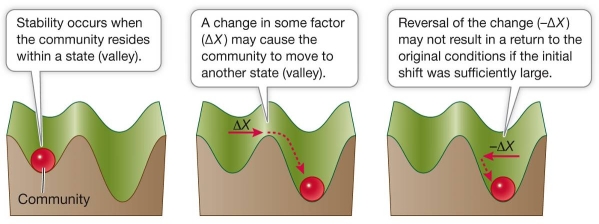 The process illustrated in the figure is known as
 (Multiple Choice)
4.8/5  (81)
(81) Lottery models of natural communities are considered neutral because they assume that
(Multiple Choice)
4.9/5 (82)
(82) Lawn A was planted with a single species of grass, which covers 90 percent of the lawn.The other plant species there include five species of weeds, each covering 2 percent of the lawn.Lawn B has the same six species, but with percentages of 75 percent grass and 5 percent for each of the five weeds.How do species richness and species evenness of the two lawns compare?
(Multiple Choice)
4.9/5 (87)
(87) During succession, two plant species become established at different times.Species A is a perennial with roots that secrete chemicals to maintain a distance between members of the species and similar species.Species B is a low-growing annual with nitrogen-fixing bacteria in its root nodules.Which (if either) of these two species most likely appears first during succession, and why?
(Multiple Choice)
4.8/5 (79)
(79) Refer to the graph. 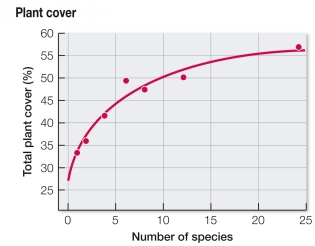 According to the graph, which statement best describes the relationship between total plant cover (a measure of productivity) and number of species (species richness) in test plots?
 (Multiple Choice)
4.9/5 (79)
(79) The eruption of Mount St.Helens in 1980 gave scientists the opportunity to study all natural situations except
(Multiple Choice)
4.9/5 (82)
(82) The greatest noticeable change in the community structure of a natural community would most likely occur as a result of
(Multiple Choice)
4.9/5 (75)
(75) The initial cause that is triggering the loss of polar bears, and the resulting change in Arctic communities, is
(Multiple Choice)
4.9/5 (71)
(71) In the traditional definition of succession (which may not always be achieved), a climax community is characterized by
(Multiple Choice)
4.9/5 (84)
(84) A volcanic eruption occurs.Which resulting condition would likely be considered a stress, rather than a disturbance?
(Multiple Choice)
4.9/5 (73)
(73) Which of these is a biotic factor that can affect community structure?
(Multiple Choice)
4.8/5 (78)
(78) A new herbivore species is introduced into a community and appears to be well adapted to the environmental conditions.However, it fails to compete well with existing herbivores and, after several years of low reproductive success, it dies out.This species was excluded through the process of _______.
(Short Answer)
4.8/5 (75)
(75) Refer to the figure, showing the soil food web. 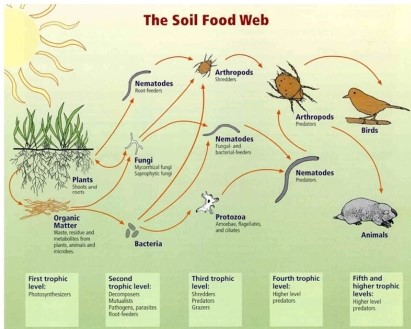 Based on this food web, which organisms are members of the detritivore/decomposer level of the web?
 (Multiple Choice)
4.7/5 (75)
(75) Two species of gobies (small fish) live on a coral reef.The two species use similar habitats and compete equally for vacant corals.The "winner" is the goby that arrives first.Juveniles and adults of the two species have the same relative abundance.When one species is removed experimentally, either species can colonize the vacant coral.These factors indicate that the presence of the two species on the reef can best be described by a model called the
(Multiple Choice)
4.9/5 (75)
(75) Approximately once every century, a coastal region suffers a severe flood that inundates freshwater marshes, swamps, and low-lying fields with salt water for an extended time period.After each of these floods, the communities undergo secondary succession, eventually returning to climax states.Will these communities always return to the same climax states, with the same species compositions? If so, why? If not, what factors can cause them to attain alternative states?
(Essay)
4.8/5 (86)
(86) Kudzu originated in Asia and was introduced to the southern United States for uses including cattle fodder and erosion control.Kudzu grows extremely rapidly, obtains resources very quickly, and absorbs nitrogen from the air.Its rapid growth smothers plants, including whole trees, and covers buildings and other structures.These characteristics suggest that kudzu would have what effect on community structure?
(Multiple Choice)
4.8/5 (91)
(91) Beginning about 500 million years ago, plants began to colonize land.One factor that made this colonization possible was the presence of an atmosphere with high concentrations of carbon dioxide, which was necessary for photosynthesis.This suggests that before colonization, the green aquatic algae that eventually evolved into plants were prevented from forming land communities by
(Multiple Choice)
4.9/5 (85)
(85) The aspect of community structure that measures both the number of species in a community and how evenly they are apportioned is the _______ of the community.
(Short Answer)
4.8/5 (68)
(68) An ecologist is studying two competing snail species in a woodland habitat.She hypothesizes that one species, the interactor, is controlling the population size of the other, the target species.She designs an experiment to determine the interaction strength between the two species.What should she manipulate and measure?
(Multiple Choice)
4.8/5 (81)
(81) A scientist analyzes genetic differences in all the frog species in a pond.She also determines the total number of frog species in the community and calculates the Shannon diversity index.She is measuring which aspect(s) of biodiversity?
(Multiple Choice)
4.8/5 (86)
(86) 
Filters
- Essay(0)
- Multiple Choice(0)
- Short Answer(0)
- True False(0)
- Matching(0)