



 Chat with AI
Exam 17: Genomes

Exam 1: Studying Life246 Questions
Exam 2: Small Molecules and the Chemistry of Life246 Questions
Exam 3: Proteins, Carbohydrates, and Lipids246 Questions
Exam 4: Nucleic Acids and the Origin of Life246 Questions
Exam 5: Cells: the Working Units of Life248 Questions
Exam 6: Cell Membranes246 Questions
Exam 7: Cell Communication and Multicellularity246 Questions
Exam 8: Energy, Enzymes, and Metabolism246 Questions
Exam 9: Pathways That Harvest Chemical Energy246 Questions
Exam 10: Photosynthesis: Energy From Sunlight242 Questions
Exam 11: The Cell Cycle and Cell Division260 Questions
Exam 12: Inheritance, Genes, and Chromosomes250 Questions
Exam 13: Dna and Its Role in Heredity257 Questions
Exam 14: From Dna to Protein: Gene Expression252 Questions
Exam 15: Gene Mutation and Molecular Medicine251 Questions
Exam 16: Regulation of Gene Expression245 Questions
Exam 17: Genomes249 Questions
Exam 18: Recombinant Dna and Biotechnology243 Questions
Exam 20: Mechanisms of Evolution243 Questions
Exam 21: Reconstructing and Using Phylogenies246 Questions
Exam 22: Speciation247 Questions
Exam 23: Evolution of Genes and Genomes252 Questions
Exam 24: The History of Life on Earth246 Questions
Exam 25: Bacteria, Archaea, and Viruses262 Questions
Exam 26: The Origin and Diversification of Eukaryotes252 Questions
Exam 27: Plants Without Seeds: From Water to Land251 Questions
Exam 28: The Evolution of Seed Plants259 Questions
Exam 29: The Evolution and Diversity of Fungi261 Questions
Exam 30: Animal Origins and the Evolution of Body Plans248 Questions
Exam 31: Protostome Animals244 Questions
Exam 32: Deuterostome Animals246 Questions
Exam 33: The Plant Body243 Questions
Exam 34: Transport in Plants248 Questions
Exam 35: Plant Nutrition247 Questions
Exam 36: Regulation of Plant Growth246 Questions
Exam 37: Reproduction in Flowering Plants247 Questions
Exam 38: Plant Responses to Environmental Challenges246 Questions
Exam 39: Physiology, Homeostasis, and Temperature Regulation258 Questions
Exam 40: Animal Hormones249 Questions
Exam 41: Immunology: Animal Defense Systems265 Questions
Exam 42: Animal Reproduction261 Questions
Exam 43: Animal Development261 Questions
Exam 44: Neurons, Glia, and Nervous Systems250 Questions
Exam 45: Sensory Systems249 Questions
Exam 46: The Mammalian Nervous System: Structure and Higher Functions254 Questions
Exam 47: Musculoskeletal Systems259 Questions
Exam 48: Gas Exchange247 Questions
Exam 49: Circulatory Systems252 Questions
Exam 50: Nutrition, Digestion, and Absorption259 Questions
Exam 51: Salt and Water Balance and Nitrogen Excretion251 Questions
Exam 52: Animal Behavior249 Questions
Exam 53: The Physical Environment and Biogeography of Life248 Questions
Exam 54: Populations259 Questions
Exam 55: Species Interactions254 Questions
Exam 56: Communities247 Questions
Exam 57: Ecosystems238 Questions
Exam 58: A Changing Biosphere222 Questions
Select questions type


A particular bacterial species lacks the enzymes needed to synthesize certain amino acids.Other related species have these enzymes.Which inference about this bacterium is most likely?

Free
(Multiple Choice)
5.0/5  (82)
(82) Correct Answer: Verified
D
Biologists are examining changes in the proteins expressed by a nematode species under different levels of crowding.Which is the most likely tool or approach that they would use?
Free
(Multiple Choice)
4.8/5 (81)
(81) Correct Answer:Verified
VerifiedC
Refer to the table showing various sequenced genomes 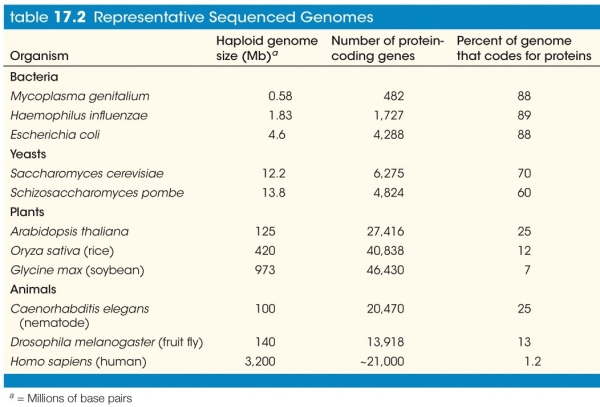 Calculate the size of the average protein-coding gene in Drosophila melanogaster.
Free
(Multiple Choice)
4.9/5 (76)
(76) Correct Answer:Verified
VerifiedA
The Alu element, which accounts for over 10 percent of the human genome, uses an RNA intermediate and employs a "copy and paste" mechanism of replication.It is not translated.It is thus an example of a
(Multiple Choice)
4.8/5 (70)
(70) A 10-bp single-stranded DNA fragment is cut by three different restriction enzymes to produce the following fragments: (1) AC, TAC, and GGATG
(2) TA, CGG, and ATGAC
(3) GAC, GAT, and TACG
The nucleotide sequence of the 10-bp fragment
(Multiple Choice)
4.8/5 (76)
(76) A team of biologists collects samples from a stream.Using PCR and other techniques, they amplify numerous DNA sequences.In doing so, they discover many new bacterial species.These biologists are working in the field of
(Multiple Choice)
4.7/5 (72)
(72) Genomic analysis of a fish reveals that this species has dozens of functional copies of a gene that are all nearly identical to one another.What is the most likely explanation for this finding?
(Multiple Choice)
4.9/5 (68)
(68) One commonly used method of high-throughput sequencing relies on _______ to amplify DNA fragments on a solid surface.
(Short Answer)
4.9/5 (86)
(86) The genome of Arabidopsis is least like that of the typical plant in that the Arabidopsis genome
(Multiple Choice)
4.9/5 (72)
(72) If you were to sequence the pathogenic E.coli strain O157:H7, you would most likely find genes that came from
(Multiple Choice)
4.9/5 (73)
(73) Refer to the table showing several prokaryote species (labeled F-J) that have been sequenced, and the genes they contain.(Note: "x" marks the species possessing a functional copy of the gene.) 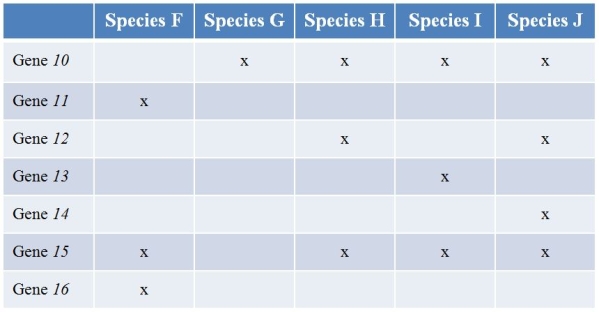 Unlike the other species here, species F cannot grow if it is given maltose, a disaccharide, as its sole carbon source.It can grow when given the by-products of maltose.Based on the data, what is the most likely genetic hypothesis for this inability? How would you test your hypothesis?
 (Essay)
4.8/5 (70)
(70) The Human Genome Project could not have proceeded without the new field of _______, which uses complex mathematics and computer programs to analyze DNA sequences.
(Short Answer)
4.9/5 (97)
(97) A biologist is attempting to find the promoters for a set of important developmental genes in crickets.This activity is best described as
(Multiple Choice)
4.9/5 (86)
(86) A hypothetical drug has a side effect of increasing blood pressure.Individuals who are homozygous for G at SNP 1 break down this drug faster than average.Individuals who are homozygous for A at SNP 2 break down this drug slower than average.The effects of these two SNPs roughly cancel each other out, such that homozygotes at both SNPs generally have average rates of breakdown of the enzyme.Which combination of genotypes is most likely to put an individual at risk for having the side effect? (Note: The genotype of SNP 1 is listed first, followed by that of SNP 2.)
(Multiple Choice)
4.9/5 (63)
(63) Refer to the table showing the number of genes in three bacteria (E.coli, Haemophilus influenzae, and Mycoplasma genitalium) for different functions. 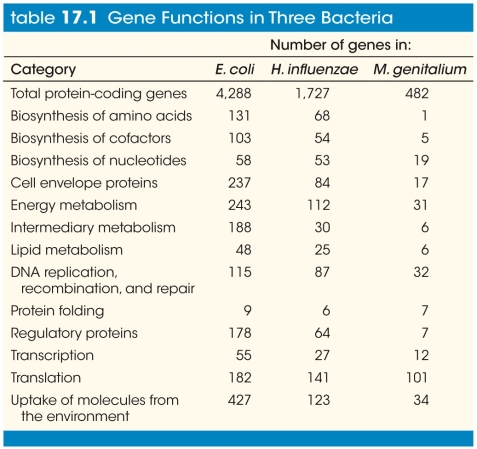 M.genitalium has lost many genes during its evolution.What type of gene has been lost the most in M.genitalium?
 (Multiple Choice)
4.9/5 (80)
(80) A biologist is interested in determining how the diversity of microbes in ponds changes with levels of phosphate in the ponds.The most useful type of study to address this question is a _______ study.
(Short Answer)
4.7/5 (85)
(85) 
Filters
- Essay(0)
- Multiple Choice(0)
- Short Answer(0)
- True False(0)
- Matching(0)