



 Chat with AI
Exam 17: Genomes

Exam 1: Studying Life246 Questions
Exam 2: Small Molecules and the Chemistry of Life246 Questions
Exam 3: Proteins, Carbohydrates, and Lipids246 Questions
Exam 4: Nucleic Acids and the Origin of Life246 Questions
Exam 5: Cells: the Working Units of Life248 Questions
Exam 6: Cell Membranes246 Questions
Exam 7: Cell Communication and Multicellularity246 Questions
Exam 8: Energy, Enzymes, and Metabolism246 Questions
Exam 9: Pathways That Harvest Chemical Energy246 Questions
Exam 10: Photosynthesis: Energy From Sunlight242 Questions
Exam 11: The Cell Cycle and Cell Division260 Questions
Exam 12: Inheritance, Genes, and Chromosomes250 Questions
Exam 13: Dna and Its Role in Heredity257 Questions
Exam 14: From Dna to Protein: Gene Expression252 Questions
Exam 15: Gene Mutation and Molecular Medicine251 Questions
Exam 16: Regulation of Gene Expression245 Questions
Exam 17: Genomes249 Questions
Exam 18: Recombinant Dna and Biotechnology243 Questions
Exam 20: Mechanisms of Evolution243 Questions
Exam 21: Reconstructing and Using Phylogenies246 Questions
Exam 22: Speciation247 Questions
Exam 23: Evolution of Genes and Genomes252 Questions
Exam 24: The History of Life on Earth246 Questions
Exam 25: Bacteria, Archaea, and Viruses262 Questions
Exam 26: The Origin and Diversification of Eukaryotes252 Questions
Exam 27: Plants Without Seeds: From Water to Land251 Questions
Exam 28: The Evolution of Seed Plants259 Questions
Exam 29: The Evolution and Diversity of Fungi261 Questions
Exam 30: Animal Origins and the Evolution of Body Plans248 Questions
Exam 31: Protostome Animals244 Questions
Exam 32: Deuterostome Animals246 Questions
Exam 33: The Plant Body243 Questions
Exam 34: Transport in Plants248 Questions
Exam 35: Plant Nutrition247 Questions
Exam 36: Regulation of Plant Growth246 Questions
Exam 37: Reproduction in Flowering Plants247 Questions
Exam 38: Plant Responses to Environmental Challenges246 Questions
Exam 39: Physiology, Homeostasis, and Temperature Regulation258 Questions
Exam 40: Animal Hormones249 Questions
Exam 41: Immunology: Animal Defense Systems265 Questions
Exam 42: Animal Reproduction261 Questions
Exam 43: Animal Development261 Questions
Exam 44: Neurons, Glia, and Nervous Systems250 Questions
Exam 45: Sensory Systems249 Questions
Exam 46: The Mammalian Nervous System: Structure and Higher Functions254 Questions
Exam 47: Musculoskeletal Systems259 Questions
Exam 48: Gas Exchange247 Questions
Exam 49: Circulatory Systems252 Questions
Exam 50: Nutrition, Digestion, and Absorption259 Questions
Exam 51: Salt and Water Balance and Nitrogen Excretion251 Questions
Exam 52: Animal Behavior249 Questions
Exam 53: The Physical Environment and Biogeography of Life248 Questions
Exam 54: Populations259 Questions
Exam 55: Species Interactions254 Questions
Exam 56: Communities247 Questions
Exam 57: Ecosystems238 Questions
Exam 58: A Changing Biosphere222 Questions
Select questions type


A lab sequencing the DNA of various species of pathogenic bacteria with the goal of determining their evolutionary relationships would be practicing _______ genomics.
(Multiple Choice)
4.7/5  (74)
(74) Butterflies use taste receptors to detect the presence of different foods.The receptors are encoded by genes in a gene family.Which circumstance would most likely lead to the evolution of pseudogenes in this gene family?
(Multiple Choice)
4.7/5 (81)
(81) Below are four overlapping reads from sequencing.(Note: All reads are in the 5′-to-3′ direction.)
Read 1: TTACACGCCATCGACTGGATCATATATGC
Read 2: CATATATGCATGCAGCGCATGACCCCTAG
Read 3: AGTCTGCAAATGCTGCGATTACACGCCA
Read 4: CCCCTAGAGCTGGGGATCAGAGTCGATT
In the correct order, read 3 is the first sequence, followed by read _______.
(Short Answer)
4.9/5 (72)
(72) Recent studies show that baboons have different levels of hormones under different social settings.Such studies are best described as
(Multiple Choice)
4.8/5 (67)
(67) The following are overlapping sequence fragments: AAGCGTGGCA, ATTCGGTAATAC, and TGGCATCGATTCGG.The larger sequence fragment is _______.(Note: All of the sequences have 5′-to-3′ polarity.)
(Short Answer)
4.7/5 (67)
(67) The noncoding strand of a 10 bp fragment of DNA was cut in three different ways to yield the following subfragments: cut 1 yielded TG, ATG, and CCTAC; cut 2 yielded AT, GCC, and TACTG; and cut 3 yielded CTG, CTA, and ATGC.What is the correct sequence of the large fragment?
(Multiple Choice)
4.9/5 (80)
(80) Refer to the hypothetical data set comparing the gene content of Salmonella and Shigella, of which all strains are pathogenic, and the pathogenic and nonpathogenic strains of E.coli.(Note: "x" denotes presence of the gene.) 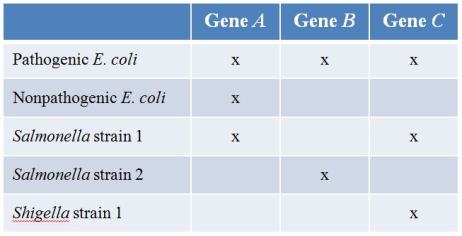 Which is the most likely conclusion about gene C?
 (Multiple Choice)
4.9/5 (70)
(70) Under which circumstance would a researcher most likely use Sanger sequencing instead of high-throughput sequencing?
(Multiple Choice)
4.8/5 (81)
(81) In the high-throughput sequencing method, DNA is heated to
(Multiple Choice)
4.9/5 (95)
(95) Pathogenic strains of E.coli often exchange genes with other pathogenic bacteria such as Salmonella and Shigella.Refer to the table showing which bacteria contain various genes.(Note: "x" denotes presence of the gene.) 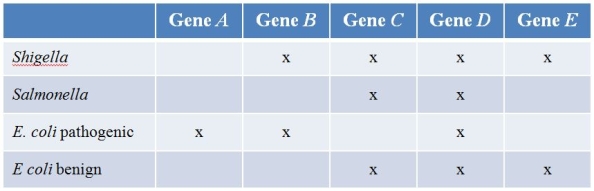 Which gene most likely got into pathogenic E.coli from the other pathogenic bacteria?
 (Multiple Choice)
4.9/5 (85)
(85) Refer to the table comparing the genomes of E.coli and S.cerevisiae. 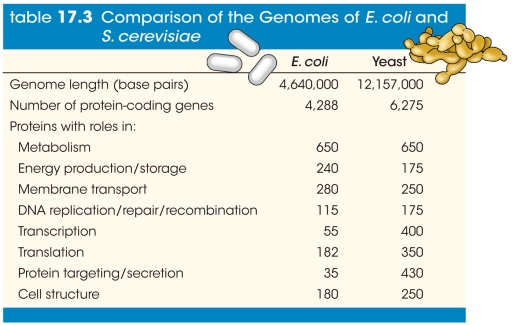 Which statement about the genomes of yeasts and nematodes is most likely to be true?
 (Multiple Choice)
4.9/5 (77)
(77) If the universal adapter sequence is 5′-GTCATTGCTTGCAATGTT-3′, which universal primer should be used for DNA sequencing?
(Multiple Choice)
4.8/5 (76)
(76) A researcher finds that individuals with a particular genotype metabolize a drug faster than average, and she uses this information to provide genotype-specific guidelines for dosages of the drug.This is an example of
(Multiple Choice)
4.8/5 (84)
(84) Craig Venter, a leader of one of the teams that sequenced the human genome, turned his attention to cataloging the microbial life of the oceans.His studies, which involve PCR amplification of microbial DNA and a sequencing of the PCR products, are part of a field of biology called
(Multiple Choice)
4.8/5 (79)
(79) When scientists described the sequences of the proteins of Haemophilus influenzae based on its DNA sequence, what did they find to be the major difference between noninfective strains and highly infective strains?
(Multiple Choice)
4.9/5 (84)
(84) Bacteria use colicins to kill other bacteria.Colicins are best described as
(Multiple Choice)
4.8/5 (86)
(86) Like SNPs, differences in patterns of genes when they are cut with restriction enzymes can be used to examine associations between genetic differences and traits (including disease risk).Refer to the diagram showing the DNA profiles at a hypothetical locus in a family in which some individuals develop high cholesterol.Immediately below the genetic patterns are the cholesterol levels of the corresponding individuals.(Note: Readings above 200 are generally considered borderline high cholesterol, and those above 240 are considered high cholesterol.) What inferences can we draw from these results? 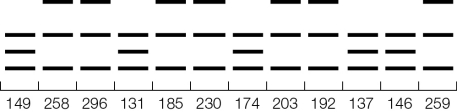
(Essay)
4.9/5 (83)
(83) Comparison of the genomes of prokaryotes and eukaryotes has revealed several differences.Which characteristic of genomes is the most similar in prokaryotes and eukaryotes?
(Multiple Choice)
4.8/5 (64)
(64) In which species or population would haplotype mapping be particularly challenging or practically impossible?
(Multiple Choice)
4.9/5 (87)
(87) 
Filters
- Essay(0)
- Multiple Choice(0)
- Short Answer(0)
- True False(0)
- Matching(0)