



 Chat with AI
Exam 17: Genomes

Exam 1: Studying Life246 Questions
Exam 2: Small Molecules and the Chemistry of Life246 Questions
Exam 3: Proteins, Carbohydrates, and Lipids246 Questions
Exam 4: Nucleic Acids and the Origin of Life246 Questions
Exam 5: Cells: the Working Units of Life248 Questions
Exam 6: Cell Membranes246 Questions
Exam 7: Cell Communication and Multicellularity246 Questions
Exam 8: Energy, Enzymes, and Metabolism246 Questions
Exam 9: Pathways That Harvest Chemical Energy246 Questions
Exam 10: Photosynthesis: Energy From Sunlight242 Questions
Exam 11: The Cell Cycle and Cell Division260 Questions
Exam 12: Inheritance, Genes, and Chromosomes250 Questions
Exam 13: Dna and Its Role in Heredity257 Questions
Exam 14: From Dna to Protein: Gene Expression252 Questions
Exam 15: Gene Mutation and Molecular Medicine251 Questions
Exam 16: Regulation of Gene Expression245 Questions
Exam 17: Genomes249 Questions
Exam 18: Recombinant Dna and Biotechnology243 Questions
Exam 20: Mechanisms of Evolution243 Questions
Exam 21: Reconstructing and Using Phylogenies246 Questions
Exam 22: Speciation247 Questions
Exam 23: Evolution of Genes and Genomes252 Questions
Exam 24: The History of Life on Earth246 Questions
Exam 25: Bacteria, Archaea, and Viruses262 Questions
Exam 26: The Origin and Diversification of Eukaryotes252 Questions
Exam 27: Plants Without Seeds: From Water to Land251 Questions
Exam 28: The Evolution of Seed Plants259 Questions
Exam 29: The Evolution and Diversity of Fungi261 Questions
Exam 30: Animal Origins and the Evolution of Body Plans248 Questions
Exam 31: Protostome Animals244 Questions
Exam 32: Deuterostome Animals246 Questions
Exam 33: The Plant Body243 Questions
Exam 34: Transport in Plants248 Questions
Exam 35: Plant Nutrition247 Questions
Exam 36: Regulation of Plant Growth246 Questions
Exam 37: Reproduction in Flowering Plants247 Questions
Exam 38: Plant Responses to Environmental Challenges246 Questions
Exam 39: Physiology, Homeostasis, and Temperature Regulation258 Questions
Exam 40: Animal Hormones249 Questions
Exam 41: Immunology: Animal Defense Systems265 Questions
Exam 42: Animal Reproduction261 Questions
Exam 43: Animal Development261 Questions
Exam 44: Neurons, Glia, and Nervous Systems250 Questions
Exam 45: Sensory Systems249 Questions
Exam 46: The Mammalian Nervous System: Structure and Higher Functions254 Questions
Exam 47: Musculoskeletal Systems259 Questions
Exam 48: Gas Exchange247 Questions
Exam 49: Circulatory Systems252 Questions
Exam 50: Nutrition, Digestion, and Absorption259 Questions
Exam 51: Salt and Water Balance and Nitrogen Excretion251 Questions
Exam 52: Animal Behavior249 Questions
Exam 53: The Physical Environment and Biogeography of Life248 Questions
Exam 54: Populations259 Questions
Exam 55: Species Interactions254 Questions
Exam 56: Communities247 Questions
Exam 57: Ecosystems238 Questions
Exam 58: A Changing Biosphere222 Questions
Select questions type


Refer to the table comparing the numbers of genes in a bacterium and a yeast for different functional categories. 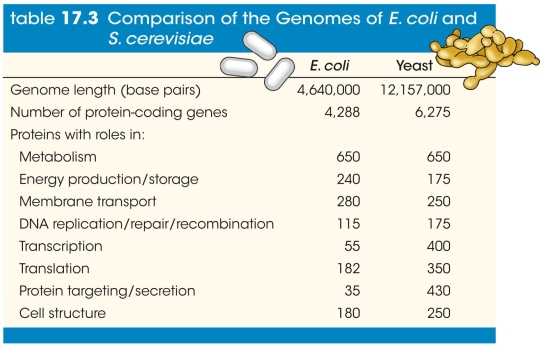 In what category does the bacterium have more genes? What does this feature suggest?
 (Essay)
4.8/5  (91)
(91) Which feature of an organism would make it more suitable as a model organism?
(Multiple Choice)
4.9/5 (87)
(87) The hypothetical antianxiety drug Epitome is inactive when taken, but it is activated by the rasputin enzyme a few hours after injection.Alleles 1 and 2 of the gene that encodes rasputin encode enzymes with similar activity levels.Individuals with one or both copies of allele 3, which is very rare, have much higher levels of enzyme activity.Individuals who have both copies of allele 4 have much lower levels of enzyme activity.Heterozygotes of allele 4 have normal levels of enzyme activity.The individuals who are most likely to experience negative side effects from Epitome are those whose genotypes have one copy of allele _______ and one copy of allele _______.
(Multiple Choice)
4.8/5 (98)
(98) Which type of moderately repetitive DNA would be least likely to change its location in the genome?
(Multiple Choice)
4.9/5 (91)
(91) Which is not used in functional genomics to identify the functions of genes?
(Multiple Choice)
4.7/5 (91)
(91) In which aspect of the genome would you expect the most variation among different plant species?
(Multiple Choice)
4.9/5 (82)
(82) Refer to the table.Pathogenic strains of E.coli often exchange genes with other pathogenic bacteria such as Salmonella and Shigella.(Note: "x" denotes presence of the gene.) 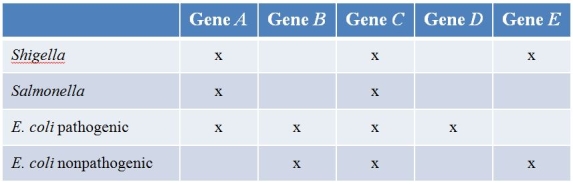 Which gene most likely got into pathogenic E.coli from the other pathogenic bacteria?
 (Multiple Choice)
4.9/5 (85)
(85) Refer to the hypothetical data set comparing the gene content of Salmonella and Shigella, of which all strains are pathogenic, and the pathogenic and nonpathogenic strains of E.coli.(Note: "x" denotes presence of the gene.) 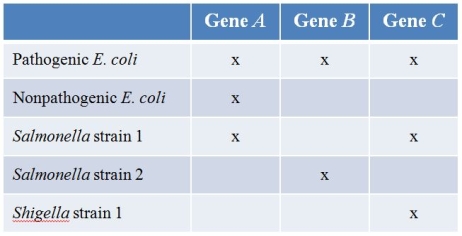 Which is the most likely conclusion about gene B?
 (Multiple Choice)
4.8/5 (74)
(74) A piece of DNA that is about 6,500 nucleotides long is found in 10 to 30 locations (depending on the individual) throughout the genome of a fish.It uses an RNA intermediate and is both transcribed and translated.This element is most likely a(n)
(Multiple Choice)
4.8/5 (90)
(90) A biologist is trying to locate the coding region of a gene, also known as a(n) _______.This region can usually be recognized by the presence of a start codon and a stop codon.
(Short Answer)
5.0/5 (79)
(79) A biologist is interested in finding genes that affect the likelihood of obtaining Parkinson's disease.An efficient way to find those genes would be _______ mapping.
(Short Answer)
4.8/5 (86)
(86) Which statement about the pathogenic strain O157:H7 of E.coli is true?
(Multiple Choice)
4.9/5 (65)
(65) Gorillas differ from humans at about 2 percent of the genome, considering just single nucleotide changes.Thus, in a haploid genome, how many SNPs are there between humans and gorillas?
(Multiple Choice)
4.7/5 (89)
(89) As organisms increase in complexity from yeasts to fruit flies to humans, the number of protein-coding genes in the genome increases _______ than the number of nucleotides, and the proportion of the genome that codes for proteins _______.
(Multiple Choice)
4.8/5 (83)
(83) If an animal were to lose mobility and become sessile, genes involved in which function would most likely be gained over evolutionary time?
(Multiple Choice)
4.8/5 (74)
(74) 
Filters
- Essay(0)
- Multiple Choice(0)
- Short Answer(0)
- True False(0)
- Matching(0)