



 Chat with AI
Exam 17: Genomes

Exam 1: Studying Life246 Questions
Exam 2: Small Molecules and the Chemistry of Life246 Questions
Exam 3: Proteins, Carbohydrates, and Lipids246 Questions
Exam 4: Nucleic Acids and the Origin of Life246 Questions
Exam 5: Cells: the Working Units of Life248 Questions
Exam 6: Cell Membranes246 Questions
Exam 7: Cell Communication and Multicellularity246 Questions
Exam 8: Energy, Enzymes, and Metabolism246 Questions
Exam 9: Pathways That Harvest Chemical Energy246 Questions
Exam 10: Photosynthesis: Energy From Sunlight242 Questions
Exam 11: The Cell Cycle and Cell Division260 Questions
Exam 12: Inheritance, Genes, and Chromosomes250 Questions
Exam 13: Dna and Its Role in Heredity257 Questions
Exam 14: From Dna to Protein: Gene Expression252 Questions
Exam 15: Gene Mutation and Molecular Medicine251 Questions
Exam 16: Regulation of Gene Expression245 Questions
Exam 17: Genomes249 Questions
Exam 18: Recombinant Dna and Biotechnology243 Questions
Exam 20: Mechanisms of Evolution243 Questions
Exam 21: Reconstructing and Using Phylogenies246 Questions
Exam 22: Speciation247 Questions
Exam 23: Evolution of Genes and Genomes252 Questions
Exam 24: The History of Life on Earth246 Questions
Exam 25: Bacteria, Archaea, and Viruses262 Questions
Exam 26: The Origin and Diversification of Eukaryotes252 Questions
Exam 27: Plants Without Seeds: From Water to Land251 Questions
Exam 28: The Evolution of Seed Plants259 Questions
Exam 29: The Evolution and Diversity of Fungi261 Questions
Exam 30: Animal Origins and the Evolution of Body Plans248 Questions
Exam 31: Protostome Animals244 Questions
Exam 32: Deuterostome Animals246 Questions
Exam 33: The Plant Body243 Questions
Exam 34: Transport in Plants248 Questions
Exam 35: Plant Nutrition247 Questions
Exam 36: Regulation of Plant Growth246 Questions
Exam 37: Reproduction in Flowering Plants247 Questions
Exam 38: Plant Responses to Environmental Challenges246 Questions
Exam 39: Physiology, Homeostasis, and Temperature Regulation258 Questions
Exam 40: Animal Hormones249 Questions
Exam 41: Immunology: Animal Defense Systems265 Questions
Exam 42: Animal Reproduction261 Questions
Exam 43: Animal Development261 Questions
Exam 44: Neurons, Glia, and Nervous Systems250 Questions
Exam 45: Sensory Systems249 Questions
Exam 46: The Mammalian Nervous System: Structure and Higher Functions254 Questions
Exam 47: Musculoskeletal Systems259 Questions
Exam 48: Gas Exchange247 Questions
Exam 49: Circulatory Systems252 Questions
Exam 50: Nutrition, Digestion, and Absorption259 Questions
Exam 51: Salt and Water Balance and Nitrogen Excretion251 Questions
Exam 52: Animal Behavior249 Questions
Exam 53: The Physical Environment and Biogeography of Life248 Questions
Exam 54: Populations259 Questions
Exam 55: Species Interactions254 Questions
Exam 56: Communities247 Questions
Exam 57: Ecosystems238 Questions
Exam 58: A Changing Biosphere222 Questions
Select questions type


Which field or approach is most likely to lead directly to a reduction in the negative side effects associated with a drug used to treat diabetes?
(Multiple Choice)
4.9/5  (68)
(68) A strand of DNA is 5′-CTGATC…AGTC-3′, with "…" representing many nucleotides.Its complement is _______.
(Short Answer)
5.0/5 (72)
(72) What is the biggest difference between the human genome and the genomes of model animal species such as Drosophila?
(Multiple Choice)
4.8/5 (80)
(80) Which statement comparing Caenorhabditis elegans and Drosophila melanogaster is true?
(Multiple Choice)
4.8/5 (85)
(85) Biologists have DNA from a prehistoric species of human.To make inferences about the ability of this species to speak, the sequence from the _______ gene would be most useful.
(Short Answer)
4.9/5 (79)
(79) Opsin genes are involved in vision.Which circumstance would most likely lead to the evolution of pseudogenes in the opsins of a salamander?
(Multiple Choice)
4.8/5 (70)
(70) The most striking difference between the genomes of E.coli and Saccharomyces cerevisiae is that the yeast genome contains many more genes devoted to
(Multiple Choice)
5.0/5 (79)
(79) What percentage of the human genome is DNA that codes for proteins?
(Multiple Choice)
4.9/5 (83)
(83) Refer to the figure showing high-throughput sequencing. 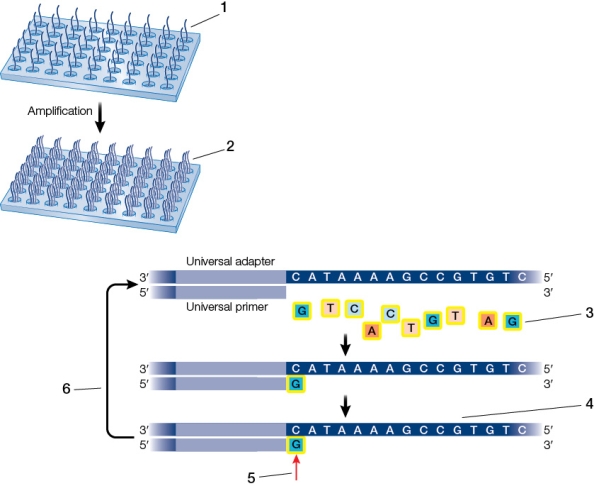 What is the purpose of the fluorescent tag added to the synthetic oligonucleotides in step 5?
 (Short Answer)
4.8/5 (86)
(86) Under which circumstances would metagenomic studies be more useful than traditional methods?
(Multiple Choice)
4.9/5 (93)
(93) Which explanation is currently thought to be the best reason why transposable elements are so prevalent in eukaryotic genomes?
(Multiple Choice)
4.9/5 (76)
(76) Refer to the table showing the number of genes in three bacteria (E.coli, Haemophilus influenzae, and Mycoplasma genitalium) for different functions. 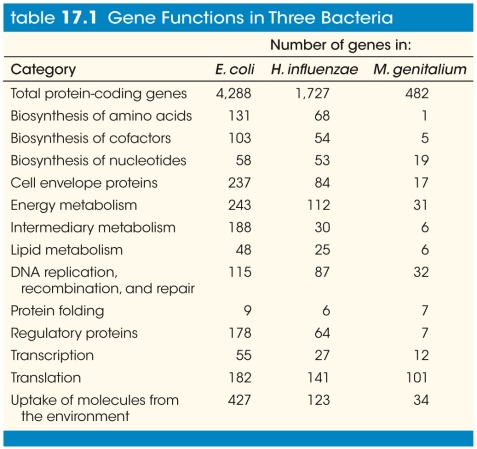 E.coli has about _______ times as many protein-coding genes and about _______ times as many regulatory proteins as does M.genitalium.
 (Multiple Choice)
4.7/5 (84)
(84) Soon after the sequence of Haemophilus influenzae was announced, two additional prokaryotic sequences were announced: the smaller Mycoplasma genitalium and the larger E.coli.Having multiple genomes permitted the beginning of
(Multiple Choice)
4.9/5 (73)
(73) Which characteristic is least likely to be useful when choosing the next "model" plant genome to study agriculturally important traits?
(Multiple Choice)
4.8/5 (76)
(76) If a mutation in a transposable element results in a change in its inverted repeat sequences, it is most likely that the element will
(Multiple Choice)
4.9/5 (93)
(93) The human genome encodes about _______ proteins as it has protein-coding genes.
(Multiple Choice)
4.9/5 (74)
(74) Which type of gene would you expect to be found in the widest (most encompassing) group of organisms?
(Multiple Choice)
4.9/5 (79)
(79) Refer to the figure showing a single gene coding for multiple proteins. 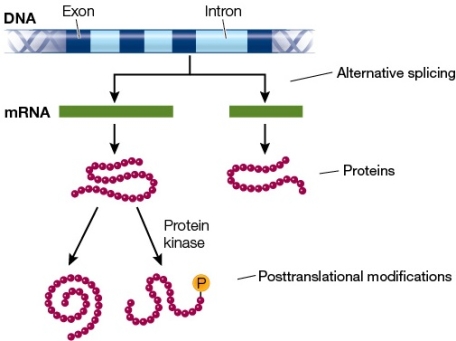 What technique would most likely be used in analysis of the protein variants that occur through the processes shown in the figure? What field uses this type of study?
 (Short Answer)
4.9/5 (78)
(78) A piece of DNA that is 3 kb in length is found in many locations throughout the genome.How would you decide whether this was a LINE or a DNA transposon?
(Multiple Choice)
4.9/5 (86)
(86) 
Filters
- Essay(0)
- Multiple Choice(0)
- Short Answer(0)
- True False(0)
- Matching(0)