



 Chat with AI
Exam 17: Genomes

Exam 1: Studying Life246 Questions
Exam 2: Small Molecules and the Chemistry of Life246 Questions
Exam 3: Proteins, Carbohydrates, and Lipids246 Questions
Exam 4: Nucleic Acids and the Origin of Life246 Questions
Exam 5: Cells: the Working Units of Life248 Questions
Exam 6: Cell Membranes246 Questions
Exam 7: Cell Communication and Multicellularity246 Questions
Exam 8: Energy, Enzymes, and Metabolism246 Questions
Exam 9: Pathways That Harvest Chemical Energy246 Questions
Exam 10: Photosynthesis: Energy From Sunlight242 Questions
Exam 11: The Cell Cycle and Cell Division260 Questions
Exam 12: Inheritance, Genes, and Chromosomes250 Questions
Exam 13: Dna and Its Role in Heredity257 Questions
Exam 14: From Dna to Protein: Gene Expression252 Questions
Exam 15: Gene Mutation and Molecular Medicine251 Questions
Exam 16: Regulation of Gene Expression245 Questions
Exam 17: Genomes249 Questions
Exam 18: Recombinant Dna and Biotechnology243 Questions
Exam 20: Mechanisms of Evolution243 Questions
Exam 21: Reconstructing and Using Phylogenies246 Questions
Exam 22: Speciation247 Questions
Exam 23: Evolution of Genes and Genomes252 Questions
Exam 24: The History of Life on Earth246 Questions
Exam 25: Bacteria, Archaea, and Viruses262 Questions
Exam 26: The Origin and Diversification of Eukaryotes252 Questions
Exam 27: Plants Without Seeds: From Water to Land251 Questions
Exam 28: The Evolution of Seed Plants259 Questions
Exam 29: The Evolution and Diversity of Fungi261 Questions
Exam 30: Animal Origins and the Evolution of Body Plans248 Questions
Exam 31: Protostome Animals244 Questions
Exam 32: Deuterostome Animals246 Questions
Exam 33: The Plant Body243 Questions
Exam 34: Transport in Plants248 Questions
Exam 35: Plant Nutrition247 Questions
Exam 36: Regulation of Plant Growth246 Questions
Exam 37: Reproduction in Flowering Plants247 Questions
Exam 38: Plant Responses to Environmental Challenges246 Questions
Exam 39: Physiology, Homeostasis, and Temperature Regulation258 Questions
Exam 40: Animal Hormones249 Questions
Exam 41: Immunology: Animal Defense Systems265 Questions
Exam 42: Animal Reproduction261 Questions
Exam 43: Animal Development261 Questions
Exam 44: Neurons, Glia, and Nervous Systems250 Questions
Exam 45: Sensory Systems249 Questions
Exam 46: The Mammalian Nervous System: Structure and Higher Functions254 Questions
Exam 47: Musculoskeletal Systems259 Questions
Exam 48: Gas Exchange247 Questions
Exam 49: Circulatory Systems252 Questions
Exam 50: Nutrition, Digestion, and Absorption259 Questions
Exam 51: Salt and Water Balance and Nitrogen Excretion251 Questions
Exam 52: Animal Behavior249 Questions
Exam 53: The Physical Environment and Biogeography of Life248 Questions
Exam 54: Populations259 Questions
Exam 55: Species Interactions254 Questions
Exam 56: Communities247 Questions
Exam 57: Ecosystems238 Questions
Exam 58: A Changing Biosphere222 Questions
Select questions type


Which of the following would not be required for determining the sequence of a 400 bp DNA fragment by the high-throughput sequencing method?
(Multiple Choice)
4.8/5  (85)
(85) A team of biologists is working on identifying the proteome and metabolome of Daphnia, a small crustacean.Why are these tasks more complex than defining its genome?
(Essay)
4.8/5 (77)
(77) An attack by a leaf-eating insect is most likely to change the _______ of a plant and is least likely to change the _______.
(Multiple Choice)
4.8/5 (91)
(91) The genomes of most animals contain multiple identical copies of genes for rRNAs
(Multiple Choice)
4.9/5 (82)
(82) Genomics researchers can construct longer sequence fragments from shorter ones because some of the shorter fragments have _______ sequences.
(Short Answer)
4.8/5 (89)
(89) A bacterial genome has been sequenced.Which would be the least likely finding?
(Multiple Choice)
4.9/5 (89)
(89) Biologists investigating the genetic basis of colon cancer susceptibility are using linked SNPs that are usually inherited as a unit.Such entities are known as _______.
(Short Answer)
4.8/5 (91)
(91) A study compares changes in the proteins produced in the reproductive tracts of female fruit flies after they have been inseminated by males of their same species and males of other species.In which field would such a study most likely be undertaken?
(Multiple Choice)
4.8/5 (58)
(58) Studies have found that a bacterium of the genus Buchnera has been living as a parasite of aphids for many millions of years.This bacterium lacks certain genes that are involved in the production of the cell wall found in other related bacteria.The field of biology in which such studies were carried out is called
(Multiple Choice)
4.7/5 (70)
(70) What is the major reason Arabidopsis thaliana is a widely used research organism among plant biologists?
(Multiple Choice)
4.9/5 (85)
(85) The sequence ATGCT is repeated between 50 and 75 times (depending on the individual chromosome) in a row on a chromosome.It is not transcribed.This is an example of
(Multiple Choice)
4.9/5 (77)
(77) Short tandem repeats, commonly used in DNA fingerprinting, are an example of
(Multiple Choice)
4.7/5 (78)
(78) Refer to the figure showing high-throughput sequencing. 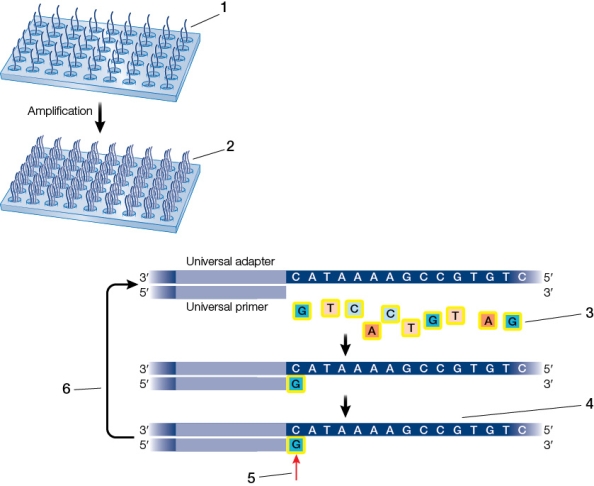 At which step does PCR take place?
 (Short Answer)
4.7/5 (83)
(83) Individuals whose genotype is GG at SNP 4 metabolize a drug faster than those with genotype AA at the SNP, with heterozygotes in the middle.Individuals with TT at SNP 6 metabolize the drug slower than those with AA at that SNP, with heterozygotes in the middle.Accordingly, individuals with AA at SNP 4 and _______ at SNP 6 would be expected to require the smallest doses of the drug.
(Short Answer)
4.8/5 (74)
(74) Refer to the hypothetical data set comparing the gene content of Salmonella and Shigella, of which all strains are pathogenic, and the pathogenic and nonpathogenic strains of E.coli.(Note: "x" denotes presence of the gene.) 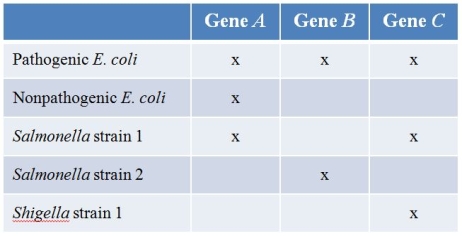 Which is the most likely conclusion about gene A?
 (Multiple Choice)
4.9/5 (82)
(82) The main distinction between LINEs and SINEs is that _______ sequences are translated.
(Short Answer)
4.8/5 (73)
(73) Individuals are genotyped AA, AG, or GG at an SNP that affects several aspects of metabolism.They are also given two drugs.Refer to the table showing the amounts of the drugs (in percent of optimal dose) remaining in individuals after 12 hours. 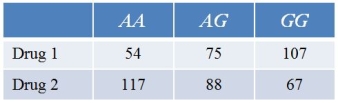 Individuals of genotype GG would on average require a _______ dose of drug 1 and a larger dose of drug 2 than individuals of genotype AA.
 (Short Answer)
4.8/5 (80)
(80) Which technique or tool listed below is best suited to determining the minimal genome of a free-living bacterium?
(Multiple Choice)
4.9/5 (89)
(89) 
Filters
- Essay(0)
- Multiple Choice(0)
- Short Answer(0)
- True False(0)
- Matching(0)