



 Chat with AI
Exam 2: Small Molecules and the Chemistry of Life

Exam 1: Studying Life246 Questions
Exam 2: Small Molecules and the Chemistry of Life246 Questions
Exam 3: Proteins, Carbohydrates, and Lipids246 Questions
Exam 4: Nucleic Acids and the Origin of Life246 Questions
Exam 5: Cells: the Working Units of Life248 Questions
Exam 6: Cell Membranes246 Questions
Exam 7: Cell Communication and Multicellularity246 Questions
Exam 8: Energy, Enzymes, and Metabolism246 Questions
Exam 9: Pathways That Harvest Chemical Energy246 Questions
Exam 10: Photosynthesis: Energy From Sunlight242 Questions
Exam 11: The Cell Cycle and Cell Division260 Questions
Exam 12: Inheritance, Genes, and Chromosomes250 Questions
Exam 13: Dna and Its Role in Heredity257 Questions
Exam 14: From Dna to Protein: Gene Expression252 Questions
Exam 15: Gene Mutation and Molecular Medicine251 Questions
Exam 16: Regulation of Gene Expression245 Questions
Exam 17: Genomes249 Questions
Exam 18: Recombinant Dna and Biotechnology243 Questions
Exam 20: Mechanisms of Evolution243 Questions
Exam 21: Reconstructing and Using Phylogenies246 Questions
Exam 22: Speciation247 Questions
Exam 23: Evolution of Genes and Genomes252 Questions
Exam 24: The History of Life on Earth246 Questions
Exam 25: Bacteria, Archaea, and Viruses262 Questions
Exam 26: The Origin and Diversification of Eukaryotes252 Questions
Exam 27: Plants Without Seeds: From Water to Land251 Questions
Exam 28: The Evolution of Seed Plants259 Questions
Exam 29: The Evolution and Diversity of Fungi261 Questions
Exam 30: Animal Origins and the Evolution of Body Plans248 Questions
Exam 31: Protostome Animals244 Questions
Exam 32: Deuterostome Animals246 Questions
Exam 33: The Plant Body243 Questions
Exam 34: Transport in Plants248 Questions
Exam 35: Plant Nutrition247 Questions
Exam 36: Regulation of Plant Growth246 Questions
Exam 37: Reproduction in Flowering Plants247 Questions
Exam 38: Plant Responses to Environmental Challenges246 Questions
Exam 39: Physiology, Homeostasis, and Temperature Regulation258 Questions
Exam 40: Animal Hormones249 Questions
Exam 41: Immunology: Animal Defense Systems265 Questions
Exam 42: Animal Reproduction261 Questions
Exam 43: Animal Development261 Questions
Exam 44: Neurons, Glia, and Nervous Systems250 Questions
Exam 45: Sensory Systems249 Questions
Exam 46: The Mammalian Nervous System: Structure and Higher Functions254 Questions
Exam 47: Musculoskeletal Systems259 Questions
Exam 48: Gas Exchange247 Questions
Exam 49: Circulatory Systems252 Questions
Exam 50: Nutrition, Digestion, and Absorption259 Questions
Exam 51: Salt and Water Balance and Nitrogen Excretion251 Questions
Exam 52: Animal Behavior249 Questions
Exam 53: The Physical Environment and Biogeography of Life248 Questions
Exam 54: Populations259 Questions
Exam 55: Species Interactions254 Questions
Exam 56: Communities247 Questions
Exam 57: Ecosystems238 Questions
Exam 58: A Changing Biosphere222 Questions
Select questions type


Which atom usually has the greatest number of covalent bonds with other atoms?

Free
(Multiple Choice)
5.0/5  (67)
(67) Correct Answer: Verified
A
Which observation makes a strong case that the study of water and its properties is relevant to the study of structural biology?
Free
(Multiple Choice)
4.9/5 (84)
(84) Correct Answer:Verified
VerifiedB
Consider the following statement: Most biochemical reactions take place in aqueous solutions.This statement is
Free
(Multiple Choice)
4.9/5 (82)
(82) Correct Answer:Verified
VerifiedA
Which property of water contributes most to the ability of fish in lakes to survive very cold winters?
(Multiple Choice)
4.8/5 (86)
(86) Refer to the figure below. 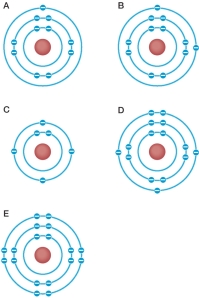 Which diagrams show atoms that will lose electrons to form a stable ion? List all that apply.
 (Short Answer)
5.0/5 (82)
(82) Hydrocarbons are _______ and _______, whereas salts are _______ and _______.
(Multiple Choice)
4.9/5 (76)
(76) Some reactions, such as the decomposition of nitroglycerin in dynamite, release large amounts of energy in the form of heat.Others, such as those taking place inside cells, release much smaller amounts of heat.Which statement is true about these reactions?
(Multiple Choice)
4.8/5 (72)
(72) The electronegativity of an atom is a relative measure of the
(Multiple Choice)
4.8/5 (65)
(65) The mass of a proton serves as the standard unit of measure for 1 Da.A _______ also has a mass of about 1 Da.
(Short Answer)
4.8/5 (95)
(95) Refer to the figures below. 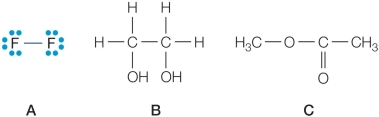 Which compound would have a higher heat of vaporization than water, and why?
 (Multiple Choice)
4.9/5 (87)
(87) Refer to the table below. 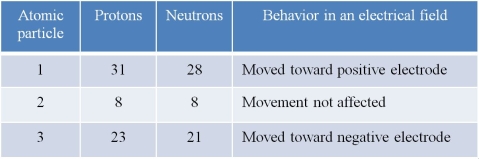 The table shows a summary of information about atomic particles under study in a physics lab.What could explain why two of the particles were affected by the electrical field while one particle remained unaffected?
 (Multiple Choice)
4.8/5 (93)
(93) Of the statements below, which best explains why the study of water is relevant to the study of living organisms?
(Multiple Choice)
4.7/5 (74)
(74) To determine the number of molecules in a teaspoon of sugar, you have to know
(Multiple Choice)
5.0/5 (73)
(73) The number of protons in a neutral atom equals the number of
(Multiple Choice)
4.9/5 (83)
(83) Vertebrate animals rely on movement of sodium ions in and out of nerve cells to transmit nerve impulses.Which property of water is relevant to this function, and why?
(Multiple Choice)
4.7/5 (81)
(81) An aqueous solution with a mixture of a _______ acid and its corresponding _______ is called a(n) _______.
(Multiple Choice)
5.0/5 (82)
(82) Which set of numbers correctly balances the chemical equation below, describing the combustion of hexane?
2 CXHY + 19 O2 Z CO2 + 14 H2O + energy
(Multiple Choice)
4.9/5 (87)
(87) 
Filters
- Essay(0)
- Multiple Choice(0)
- Short Answer(0)
- True False(0)
- Matching(0)