



 Chat with AI
Exam 2: Small Molecules and the Chemistry of Life

Exam 1: Studying Life246 Questions
Exam 2: Small Molecules and the Chemistry of Life246 Questions
Exam 3: Proteins, Carbohydrates, and Lipids246 Questions
Exam 4: Nucleic Acids and the Origin of Life246 Questions
Exam 5: Cells: the Working Units of Life248 Questions
Exam 6: Cell Membranes246 Questions
Exam 7: Cell Communication and Multicellularity246 Questions
Exam 8: Energy, Enzymes, and Metabolism246 Questions
Exam 9: Pathways That Harvest Chemical Energy246 Questions
Exam 10: Photosynthesis: Energy From Sunlight242 Questions
Exam 11: The Cell Cycle and Cell Division260 Questions
Exam 12: Inheritance, Genes, and Chromosomes250 Questions
Exam 13: Dna and Its Role in Heredity257 Questions
Exam 14: From Dna to Protein: Gene Expression252 Questions
Exam 15: Gene Mutation and Molecular Medicine251 Questions
Exam 16: Regulation of Gene Expression245 Questions
Exam 17: Genomes249 Questions
Exam 18: Recombinant Dna and Biotechnology243 Questions
Exam 20: Mechanisms of Evolution243 Questions
Exam 21: Reconstructing and Using Phylogenies246 Questions
Exam 22: Speciation247 Questions
Exam 23: Evolution of Genes and Genomes252 Questions
Exam 24: The History of Life on Earth246 Questions
Exam 25: Bacteria, Archaea, and Viruses262 Questions
Exam 26: The Origin and Diversification of Eukaryotes252 Questions
Exam 27: Plants Without Seeds: From Water to Land251 Questions
Exam 28: The Evolution of Seed Plants259 Questions
Exam 29: The Evolution and Diversity of Fungi261 Questions
Exam 30: Animal Origins and the Evolution of Body Plans248 Questions
Exam 31: Protostome Animals244 Questions
Exam 32: Deuterostome Animals246 Questions
Exam 33: The Plant Body243 Questions
Exam 34: Transport in Plants248 Questions
Exam 35: Plant Nutrition247 Questions
Exam 36: Regulation of Plant Growth246 Questions
Exam 37: Reproduction in Flowering Plants247 Questions
Exam 38: Plant Responses to Environmental Challenges246 Questions
Exam 39: Physiology, Homeostasis, and Temperature Regulation258 Questions
Exam 40: Animal Hormones249 Questions
Exam 41: Immunology: Animal Defense Systems265 Questions
Exam 42: Animal Reproduction261 Questions
Exam 43: Animal Development261 Questions
Exam 44: Neurons, Glia, and Nervous Systems250 Questions
Exam 45: Sensory Systems249 Questions
Exam 46: The Mammalian Nervous System: Structure and Higher Functions254 Questions
Exam 47: Musculoskeletal Systems259 Questions
Exam 48: Gas Exchange247 Questions
Exam 49: Circulatory Systems252 Questions
Exam 50: Nutrition, Digestion, and Absorption259 Questions
Exam 51: Salt and Water Balance and Nitrogen Excretion251 Questions
Exam 52: Animal Behavior249 Questions
Exam 53: The Physical Environment and Biogeography of Life248 Questions
Exam 54: Populations259 Questions
Exam 55: Species Interactions254 Questions
Exam 56: Communities247 Questions
Exam 57: Ecosystems238 Questions
Exam 58: A Changing Biosphere222 Questions
Select questions type


When a chemical reaction occurs, changes in the form of _______ occur, which represents the capacity of the reaction to _______.
(Multiple Choice)
4.9/5  (82)
(82) Refer to the figure below. 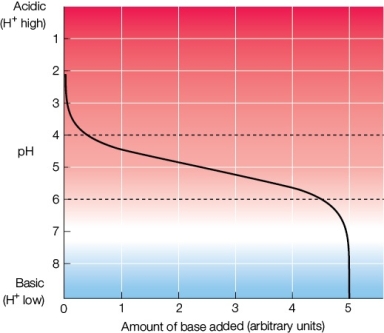 Which part of the diagram has the largest H+ change per unit of base added?
 (Multiple Choice)
4.9/5 (70)
(70) Horses sweat heavily during high-intensity activities.This physiological response takes advantage of which property of water?
(Multiple Choice)
4.8/5 (78)
(78) Which substance is predicted to have a greater heat capacity per mole than water?
(Multiple Choice)
4.9/5 (63)
(63) Refer to the table below. 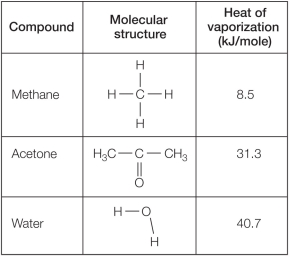 Which statement explains reasons for differences in the heat of vaporization for these compounds?
 (Multiple Choice)
4.7/5 (88)
(88) A _______ bond forms when there is an attraction between a partial positive charge on a hydrogen atom involved in a polar covalent bond and a partial negative charge on a nearby electronegative atom.
(Short Answer)
4.9/5 (77)
(77) Many desert plants have thick waxy cuticles that cover leaf and stem surfaces exposed to the environment.Many also have deep root systems that extend far below ground.These adaptations are critical to plant survival in the desert because _______ is the most abundant compound found in plant cells and plants need special features to maintain its abundance in their tissues.
(Short Answer)
4.8/5 (79)
(79) A chemist measures the masses of two substances separately, then combines them in a reaction flask and heats the mixture.After several minutes, the chemist cools the flask and measures the mass of the contents.The final mass of the contents is less than the sum of the masses of the two substances placed in the flask before heating.Which statement provides a possible explanation for this observation?
(Multiple Choice)
4.8/5 (69)
(69) Refer to the figure below showing part of the periodic table. 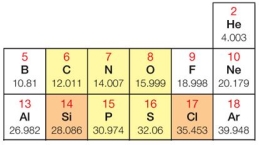 What are the names of the elements that have complete outer shells?
 (Short Answer)
4.9/5 (86)
(86) Because it is the most abundant compound present in the bodies of living organisms, _______ is an important compound whose properties are essential to the study of biology.
(Short Answer)
4.9/5 (76)
(76) A covalent bond is formed by the sharing of _______ between atoms, whereas an ionic bond is formed by the _______.
(Multiple Choice)
4.8/5 (77)
(77) Which experimental procedure could be used to provide evidence that living organisms are dynamic systems?
(Multiple Choice)
4.8/5 (83)
(83) Refer to the figures below. 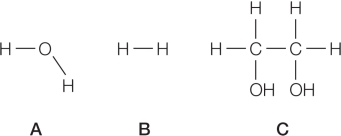 The correct ranking of these compounds in order of lowest to highest heat capacity per mole of compound is B < A < C.Which property would most likely be responsible for this trend?
 (Multiple Choice)
4.9/5 (71)
(71) If carbon dioxide has a molecular weight of approximately 44, then 0.25 moles of carbon dioxide has
(Multiple Choice)
4.8/5 (77)
(77) In the summer, ice is used to cool beverages primarily because it
(Multiple Choice)
4.8/5 (82)
(82) Which statement about spiders illustrates the importance of van der Waals forces in biology?
(Multiple Choice)
4.8/5 (82)
(82) Consider two scenarios: (1) a living cell metabolizes glucose to carbon dioxide and water, and (2) a pan of water boils on a stove.Which statement correctly compares these scenarios?
(Multiple Choice)
4.9/5 (83)
(83) Some frog species lay their eggs in shallow waters.After fertilization, the embryos develop into tadpoles that require an aquatic environment until they develop into adults.This can be challenging in shallow waters, especially in regions where the daytime temperatures can reach the upper 90s in Fahrenheit degrees.Which two properties of water are most responsible for improving the odds of tadpole survival in these shallow waters on hot days?
(Multiple Choice)
4.8/5 (91)
(91) 
Filters
- Essay(0)
- Multiple Choice(0)
- Short Answer(0)
- True False(0)
- Matching(0)