



 Chat with AI
Exam 2: Small Molecules and the Chemistry of Life

Exam 1: Studying Life246 Questions
Exam 2: Small Molecules and the Chemistry of Life246 Questions
Exam 3: Proteins, Carbohydrates, and Lipids246 Questions
Exam 4: Nucleic Acids and the Origin of Life246 Questions
Exam 5: Cells: the Working Units of Life248 Questions
Exam 6: Cell Membranes246 Questions
Exam 7: Cell Communication and Multicellularity246 Questions
Exam 8: Energy, Enzymes, and Metabolism246 Questions
Exam 9: Pathways That Harvest Chemical Energy246 Questions
Exam 10: Photosynthesis: Energy From Sunlight242 Questions
Exam 11: The Cell Cycle and Cell Division260 Questions
Exam 12: Inheritance, Genes, and Chromosomes250 Questions
Exam 13: Dna and Its Role in Heredity257 Questions
Exam 14: From Dna to Protein: Gene Expression252 Questions
Exam 15: Gene Mutation and Molecular Medicine251 Questions
Exam 16: Regulation of Gene Expression245 Questions
Exam 17: Genomes249 Questions
Exam 18: Recombinant Dna and Biotechnology243 Questions
Exam 20: Mechanisms of Evolution243 Questions
Exam 21: Reconstructing and Using Phylogenies246 Questions
Exam 22: Speciation247 Questions
Exam 23: Evolution of Genes and Genomes252 Questions
Exam 24: The History of Life on Earth246 Questions
Exam 25: Bacteria, Archaea, and Viruses262 Questions
Exam 26: The Origin and Diversification of Eukaryotes252 Questions
Exam 27: Plants Without Seeds: From Water to Land251 Questions
Exam 28: The Evolution of Seed Plants259 Questions
Exam 29: The Evolution and Diversity of Fungi261 Questions
Exam 30: Animal Origins and the Evolution of Body Plans248 Questions
Exam 31: Protostome Animals244 Questions
Exam 32: Deuterostome Animals246 Questions
Exam 33: The Plant Body243 Questions
Exam 34: Transport in Plants248 Questions
Exam 35: Plant Nutrition247 Questions
Exam 36: Regulation of Plant Growth246 Questions
Exam 37: Reproduction in Flowering Plants247 Questions
Exam 38: Plant Responses to Environmental Challenges246 Questions
Exam 39: Physiology, Homeostasis, and Temperature Regulation258 Questions
Exam 40: Animal Hormones249 Questions
Exam 41: Immunology: Animal Defense Systems265 Questions
Exam 42: Animal Reproduction261 Questions
Exam 43: Animal Development261 Questions
Exam 44: Neurons, Glia, and Nervous Systems250 Questions
Exam 45: Sensory Systems249 Questions
Exam 46: The Mammalian Nervous System: Structure and Higher Functions254 Questions
Exam 47: Musculoskeletal Systems259 Questions
Exam 48: Gas Exchange247 Questions
Exam 49: Circulatory Systems252 Questions
Exam 50: Nutrition, Digestion, and Absorption259 Questions
Exam 51: Salt and Water Balance and Nitrogen Excretion251 Questions
Exam 52: Animal Behavior249 Questions
Exam 53: The Physical Environment and Biogeography of Life248 Questions
Exam 54: Populations259 Questions
Exam 55: Species Interactions254 Questions
Exam 56: Communities247 Questions
Exam 57: Ecosystems238 Questions
Exam 58: A Changing Biosphere222 Questions
Select questions type


Cholesterol is a lipid most often found in cell membranes.It is composed primarily of carbon and hydrogen atoms and has the following chemical formula: C27H46O.Based on this information, one would expect cholesterol to be
(Multiple Choice)
4.9/5  (70)
(70) Which observation illustrates how water's heat of vaporization affects living organisms?
(Multiple Choice)
4.9/5 (81)
(81) Refer to the table below. 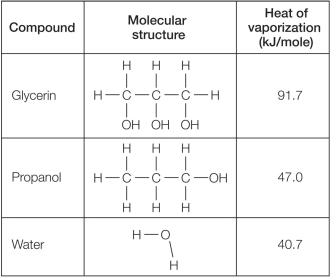 Which statement explains reasons for differences in the heat of vaporization for these compounds?
 (Multiple Choice)
4.8/5 (82)
(82) Which of the elements listed below requires two additional electrons to fill the outermost electron shell?
(Multiple Choice)
5.0/5 (88)
(88) Refer to the figure below. 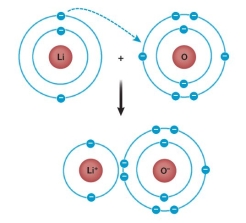 Does this figure accurately show how the ionic compound lithium oxide forms?
 (Multiple Choice)
4.8/5 (61)
(61) Refer to the balanced chemical equation below.
C3H8 + 5 O2 4 H2O + 3 CO2
Which statement correctly describes this reaction?
(Multiple Choice)
4.8/5 (77)
(77) Covalent bond formation depends on the ability of atoms to _______ other atoms.
(Multiple Choice)
4.8/5 (89)
(89) Oxygen, which has an electronegativity of 3.5, will have a stronger attraction for _______ compared with carbon, which has an electronegativity of 2.5.
(Short Answer)
4.8/5 (75)
(75) Refer to the balanced chemical equation below.
2 H2O + 572 kJ 2 H2 + O2
According to the information given, the energy supplied for this reaction is stored in the chemical _______ of the products.
(Short Answer)
4.9/5 (89)
(89) How many electrons occupy the orbital in the first energy level of an oxygen atom?
(Multiple Choice)
4.8/5 (57)
(57) Refer to the figure below.  A living cell carries out this chemical reaction in many steps with a very small release of heat.The same chemical reaction can be carried out in one step in a chemistry lab using special equipment with the release of a very large amount of heat.Which statement related to this observation is correct?
 (Multiple Choice)
4.8/5 (75)
(75) Water is a polar molecule.This property contributes to cohesion and surface tension.Sketch five water molecules, and indicate how hydrogen bonding between molecules contributes to cohesion and surface tension.Be sure to include appropriate covalent bonds in each molecule.
(Essay)
5.0/5 (81)
(81) Refer to the table below, which shows the percentage abundance of elements by mass in five different samples. 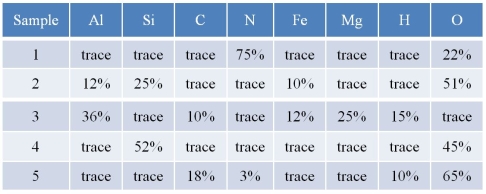 Which sample was taken from a living organism?
 (Multiple Choice)
5.0/5 (83)
(83) When exposed to extreme heat, the human body relies on _______ to absorb excess calories of heat and maintain normal body temperature.
(Multiple Choice)
4.8/5 (90)
(90) Vegetable oil is composed of long-chain hydrocarbon molecules.Vegetable oil and water do not mix but form separate layers.Which statement describes the interactions between molecules in this case?
(Multiple Choice)
4.7/5 (70)
(70) 
Filters
- Essay(0)
- Multiple Choice(0)
- Short Answer(0)
- True False(0)
- Matching(0)