



 Chat with AI
Exam 2: Small Molecules and the Chemistry of Life

Exam 1: Studying Life246 Questions
Exam 2: Small Molecules and the Chemistry of Life246 Questions
Exam 3: Proteins, Carbohydrates, and Lipids246 Questions
Exam 4: Nucleic Acids and the Origin of Life246 Questions
Exam 5: Cells: the Working Units of Life248 Questions
Exam 6: Cell Membranes246 Questions
Exam 7: Cell Communication and Multicellularity246 Questions
Exam 8: Energy, Enzymes, and Metabolism246 Questions
Exam 9: Pathways That Harvest Chemical Energy246 Questions
Exam 10: Photosynthesis: Energy From Sunlight242 Questions
Exam 11: The Cell Cycle and Cell Division260 Questions
Exam 12: Inheritance, Genes, and Chromosomes250 Questions
Exam 13: Dna and Its Role in Heredity257 Questions
Exam 14: From Dna to Protein: Gene Expression252 Questions
Exam 15: Gene Mutation and Molecular Medicine251 Questions
Exam 16: Regulation of Gene Expression245 Questions
Exam 17: Genomes249 Questions
Exam 18: Recombinant Dna and Biotechnology243 Questions
Exam 20: Mechanisms of Evolution243 Questions
Exam 21: Reconstructing and Using Phylogenies246 Questions
Exam 22: Speciation247 Questions
Exam 23: Evolution of Genes and Genomes252 Questions
Exam 24: The History of Life on Earth246 Questions
Exam 25: Bacteria, Archaea, and Viruses262 Questions
Exam 26: The Origin and Diversification of Eukaryotes252 Questions
Exam 27: Plants Without Seeds: From Water to Land251 Questions
Exam 28: The Evolution of Seed Plants259 Questions
Exam 29: The Evolution and Diversity of Fungi261 Questions
Exam 30: Animal Origins and the Evolution of Body Plans248 Questions
Exam 31: Protostome Animals244 Questions
Exam 32: Deuterostome Animals246 Questions
Exam 33: The Plant Body243 Questions
Exam 34: Transport in Plants248 Questions
Exam 35: Plant Nutrition247 Questions
Exam 36: Regulation of Plant Growth246 Questions
Exam 37: Reproduction in Flowering Plants247 Questions
Exam 38: Plant Responses to Environmental Challenges246 Questions
Exam 39: Physiology, Homeostasis, and Temperature Regulation258 Questions
Exam 40: Animal Hormones249 Questions
Exam 41: Immunology: Animal Defense Systems265 Questions
Exam 42: Animal Reproduction261 Questions
Exam 43: Animal Development261 Questions
Exam 44: Neurons, Glia, and Nervous Systems250 Questions
Exam 45: Sensory Systems249 Questions
Exam 46: The Mammalian Nervous System: Structure and Higher Functions254 Questions
Exam 47: Musculoskeletal Systems259 Questions
Exam 48: Gas Exchange247 Questions
Exam 49: Circulatory Systems252 Questions
Exam 50: Nutrition, Digestion, and Absorption259 Questions
Exam 51: Salt and Water Balance and Nitrogen Excretion251 Questions
Exam 52: Animal Behavior249 Questions
Exam 53: The Physical Environment and Biogeography of Life248 Questions
Exam 54: Populations259 Questions
Exam 55: Species Interactions254 Questions
Exam 56: Communities247 Questions
Exam 57: Ecosystems238 Questions
Exam 58: A Changing Biosphere222 Questions
Select questions type


A molecule contains five atoms and has a molecular weight of 85 g per mole.The atoms are of elements with atomic numbers 1, 6, and 17.Which molecular structure could represent this molecule?
(Multiple Choice)
4.7/5  (66)
(66) Refer to the table below. 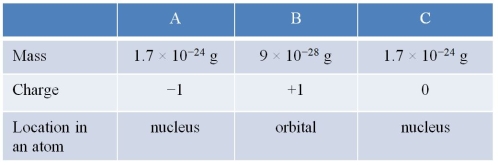 What change would make the table accurate?
 (Multiple Choice)
4.8/5 (74)
(74) Refer to the table and three diagrams below. 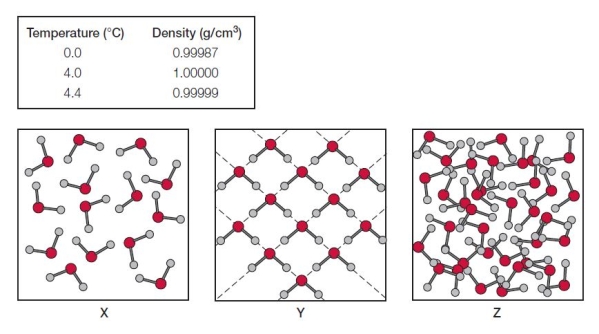 How can the diagrams be used to justify the density measurements of water at the different temperatures given?
 (Multiple Choice)
4.8/5 (85)
(85) Refer to the figure below. 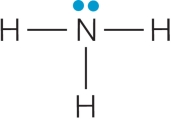 The figure shows the molecular structure of ammonia.Would you expect liquid ammonia to have a heat capacity similar to that of water or very different from that of water? Explain your reasoning.
 (Essay)
4.8/5 (75)
(75) Drawings of hydrogen, deuterium, and tritium would contain different numbers of
(Multiple Choice)
4.9/5 (67)
(67) Blood contains bicarbonate ions and carbonic acid and prevents significant changes in pH in the body because they act as _______.
(Short Answer)
4.8/5 (72)
(72) Of the different types of chemical bonds, the strongest bond in biological systems is the _______ bond.
(Short Answer)
4.8/5 (89)
(89) Pharmaceutical chemists use radioisotopic labeling to study how long a drug stays in a test animal and how the drug is metabolized.Explain why radioactive isotopes are useful for these types of studies.
(Essay)
4.9/5 (78)
(78) Carbonic acid and sodium bicarbonate act as buffers in the blood.When a small amount of acid is added to this buffer, the H+ ions are used up as they combine with the bicarbonate ions.When this happens, the pH of the blood
(Multiple Choice)
4.8/5 (76)
(76) Nitrogen-14 and nitrogen-15 are isotopes.Nitrogen-15 is used to determine protein structure.Which of the following is true?
(Multiple Choice)
5.0/5 (75)
(75) Which particles determine how an atom interacts with other atoms?
(Multiple Choice)
4.9/5 (83)
(83)  ?
Which pair of atoms would be expected to have similar chemical properties?
(Multiple Choice)
4.8/5 (74)
(74) The figures below have all been used to represent a water molecule.Which could best be used to explain why water is polar?
(Multiple Choice)
4.9/5 (87)
(87) Why is the pH of a 0.1 M solution of acetic acid in water higher than that of a 0.1 M solution of HCl in water?
(Multiple Choice)
4.8/5 (92)
(92) Which statement best explains how atoms change partners when propane combusts?
(Multiple Choice)
4.9/5 (82)
(82) Which compound containing 1H, 12C, and/or 16O has the greatest number of molecules in a sample with a mass of 2 g?
(Multiple Choice)
4.9/5 (72)
(72) Which statement comparing a solution of lemon juice (pH ~2) to a solution of tomato juice (pH ~4) is true?
(Multiple Choice)
4.8/5 (83)
(83) In a hydrogen molecule, the two atoms are held together by
(Multiple Choice)
4.8/5 (74)
(74) 
Filters
- Essay(0)
- Multiple Choice(0)
- Short Answer(0)
- True False(0)
- Matching(0)