



 Chat with AI
Exam 22: Speciation

Exam 1: Studying Life246 Questions
Exam 2: Small Molecules and the Chemistry of Life246 Questions
Exam 3: Proteins, Carbohydrates, and Lipids246 Questions
Exam 4: Nucleic Acids and the Origin of Life246 Questions
Exam 5: Cells: the Working Units of Life248 Questions
Exam 6: Cell Membranes246 Questions
Exam 7: Cell Communication and Multicellularity246 Questions
Exam 8: Energy, Enzymes, and Metabolism246 Questions
Exam 9: Pathways That Harvest Chemical Energy246 Questions
Exam 10: Photosynthesis: Energy From Sunlight242 Questions
Exam 11: The Cell Cycle and Cell Division260 Questions
Exam 12: Inheritance, Genes, and Chromosomes250 Questions
Exam 13: Dna and Its Role in Heredity257 Questions
Exam 14: From Dna to Protein: Gene Expression252 Questions
Exam 15: Gene Mutation and Molecular Medicine251 Questions
Exam 16: Regulation of Gene Expression245 Questions
Exam 17: Genomes249 Questions
Exam 18: Recombinant Dna and Biotechnology243 Questions
Exam 20: Mechanisms of Evolution243 Questions
Exam 21: Reconstructing and Using Phylogenies246 Questions
Exam 22: Speciation247 Questions
Exam 23: Evolution of Genes and Genomes252 Questions
Exam 24: The History of Life on Earth246 Questions
Exam 25: Bacteria, Archaea, and Viruses262 Questions
Exam 26: The Origin and Diversification of Eukaryotes252 Questions
Exam 27: Plants Without Seeds: From Water to Land251 Questions
Exam 28: The Evolution of Seed Plants259 Questions
Exam 29: The Evolution and Diversity of Fungi261 Questions
Exam 30: Animal Origins and the Evolution of Body Plans248 Questions
Exam 31: Protostome Animals244 Questions
Exam 32: Deuterostome Animals246 Questions
Exam 33: The Plant Body243 Questions
Exam 34: Transport in Plants248 Questions
Exam 35: Plant Nutrition247 Questions
Exam 36: Regulation of Plant Growth246 Questions
Exam 37: Reproduction in Flowering Plants247 Questions
Exam 38: Plant Responses to Environmental Challenges246 Questions
Exam 39: Physiology, Homeostasis, and Temperature Regulation258 Questions
Exam 40: Animal Hormones249 Questions
Exam 41: Immunology: Animal Defense Systems265 Questions
Exam 42: Animal Reproduction261 Questions
Exam 43: Animal Development261 Questions
Exam 44: Neurons, Glia, and Nervous Systems250 Questions
Exam 45: Sensory Systems249 Questions
Exam 46: The Mammalian Nervous System: Structure and Higher Functions254 Questions
Exam 47: Musculoskeletal Systems259 Questions
Exam 48: Gas Exchange247 Questions
Exam 49: Circulatory Systems252 Questions
Exam 50: Nutrition, Digestion, and Absorption259 Questions
Exam 51: Salt and Water Balance and Nitrogen Excretion251 Questions
Exam 52: Animal Behavior249 Questions
Exam 53: The Physical Environment and Biogeography of Life248 Questions
Exam 54: Populations259 Questions
Exam 55: Species Interactions254 Questions
Exam 56: Communities247 Questions
Exam 57: Ecosystems238 Questions
Exam 58: A Changing Biosphere222 Questions
Select questions type


Which process or event was required for sympatric speciation in the apple maggot fly?

Free
(Multiple Choice)
4.8/5  (83)
(83) Correct Answer: Verified
C
Two populations of annelids (worms) live in distinct areas and on different soil types.Researchers are interested as to whether the populations have acquired different types of reproductive isolation.Which method would be best to determine whether two populations exhibited gametic isolation?
Free
(Multiple Choice)
4.9/5 (82)
(82) Correct Answer:Verified
VerifiedD
Linnaeus developed the binominal classification system of nomenclature and classified organisms based on a(n) _______ species concept.
Free
(Short Answer)
5.0/5 (80)
(80) Correct Answer:Verified
Verifiedmorphological
A species of dragonfly arises within the same range where the parent populations are located.This is most likely an example of
(Multiple Choice)
4.9/5 (81)
(81) An evolutionary biologist makes decisions about whether to classify different salmon populations as separate species based on their phylogenies.This biologist is most likely employing the _______ species concept.
(Short Answer)
4.9/5 (73)
(73) Drosophila pseudoobscura and D.persimilis are two fly species that live in the western United States.The smaller geographic range of D.persimilis is enclosed within the range of D.pseudoobscura.Research shows that D.pseudoobscura taken from areas that overlap with D.persimilis are less likely to mate with D.persimilis than are the D.pseudoobscura flies from populations that do not come into contact D.persimilis.What is the most likely explanation for these results?
(Multiple Choice)
4.9/5 (81)
(81) What is the expected ploidy level of an F1 hybrid offspring of an octaploid father and a diploid mother?
(Multiple Choice)
4.9/5 (86)
(86) Which ranking correctly indicates the expected rate of speciation, from highest to lowest, of plants pollinated by wind, by animals that are generalist pollinators, and by animals that are specialist pollinators?
(Multiple Choice)
4.9/5 (84)
(84) In the eastern United States, populations of the white-footed mouse, Peromyscus leucopus, can be found almost continuously from Maine to Georgia.Even though individuals from the Maine and Georgia populations never come into contact, they could still be considered part of the same species under the _______ species concept because they can potentially interbreed.
(Short Answer)
4.8/5 (77)
(77) Refer to the diagram below showing the first steps in speciation. 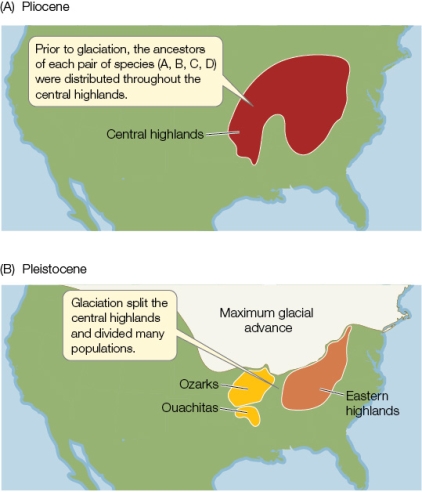 What type of speciation is represented in the diagram? What, if any, barriers are present.
 (Short Answer)
4.8/5 (74)
(74) The morphological species concept, used by Linnaeus to describe and name thousands of species, can be problematic for many reasons.Which is not one of its limitations?
(Multiple Choice)
4.8/5 (81)
(81) Refer to the table. 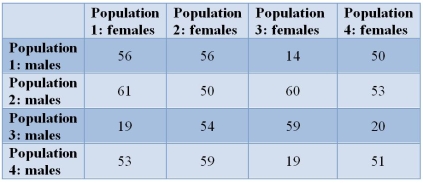 Certain populations of a copepod (a planktonic crustacean) may be reproductively isolated, even though females will mate with any male.Here, three females from one of the populations are placed with three males from another population.The diagonals represent crosses made between males and females of the same population.The numbers of offspring produced are listed in the table.Which cross shows reproductive isolation?
 (Multiple Choice)
4.9/5 (79)
(79) Species of lacewings apparently evolved reproductive isolation without geographical isolation.This is an example of _______ speciation.
(Short Answer)
4.8/5 (81)
(81) The vegetable we know as the potato resulted from naturally occurring genome doubling within one species.In other words, the potato has twice as many chromosomes as the ancestor it was derived from.The potato could therefore be described as being the result of the process known as
(Multiple Choice)
4.9/5 (83)
(83) Refer to the table. 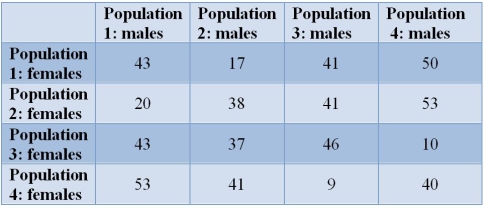 Certain populations of a copepod (a planktonic crustacean) may be reproductively isolated, even though females will mate with any male.Here, three females from one of the populations are placed with three males from another population.The diagonals represent crosses made between males and females of the same population.The numbers of offspring produced are listed in the table.Population 3 shows reproductive isolation with Population(s) _______.(Enter as many as there are.If the population does not show reproductive isolation with any of the other populations, write in zero).
 (Short Answer)
4.8/5 (76)
(76) When the most recent glacial period ended, ice sheets that had covered most of Canada retreated, and landscapes were opened up for plants and animals to colonize.In British Columbia, rivers and lakes were colonized by small fish called three-spined sticklebacks about 15,000 years ago.They swam upstream and became relatively isolated populations, each in their own small lake, separated by streams from other lakes.In each of at least six lakes in which they have been studied, there are species pairs; one species swimming close under the surface, snatching insects, the other swimming near the bottom, eating small crustaceans in the mud.This appears to be an example in which _______ may have led to rapid speciation.
(Multiple Choice)
4.7/5 (82)
(82) Refer to the figure showing speciation by centric fusion. 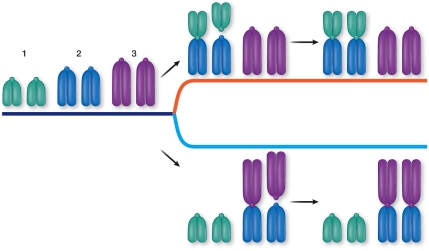 Which statement about the figure is false?
 (Multiple Choice)
4.9/5 (86)
(86) An evolutionary biologist makes decisions about whether to consider three different populations of damselflies as separate species, based on observations of the individuals with which these damselflies will mate.All combinations of these populations are able to mate with one another and all combinations produced offspring.This biologist is most likely employing _______ species concept.
(Short Answer)
4.8/5 (77)
(77) 
Filters
- Essay(0)
- Multiple Choice(0)
- Short Answer(0)
- True False(0)
- Matching(0)