



 Chat with AI
Exam 22: Speciation

Exam 1: Studying Life246 Questions
Exam 2: Small Molecules and the Chemistry of Life246 Questions
Exam 3: Proteins, Carbohydrates, and Lipids246 Questions
Exam 4: Nucleic Acids and the Origin of Life246 Questions
Exam 5: Cells: the Working Units of Life248 Questions
Exam 6: Cell Membranes246 Questions
Exam 7: Cell Communication and Multicellularity246 Questions
Exam 8: Energy, Enzymes, and Metabolism246 Questions
Exam 9: Pathways That Harvest Chemical Energy246 Questions
Exam 10: Photosynthesis: Energy From Sunlight242 Questions
Exam 11: The Cell Cycle and Cell Division260 Questions
Exam 12: Inheritance, Genes, and Chromosomes250 Questions
Exam 13: Dna and Its Role in Heredity257 Questions
Exam 14: From Dna to Protein: Gene Expression252 Questions
Exam 15: Gene Mutation and Molecular Medicine251 Questions
Exam 16: Regulation of Gene Expression245 Questions
Exam 17: Genomes249 Questions
Exam 18: Recombinant Dna and Biotechnology243 Questions
Exam 20: Mechanisms of Evolution243 Questions
Exam 21: Reconstructing and Using Phylogenies246 Questions
Exam 22: Speciation247 Questions
Exam 23: Evolution of Genes and Genomes252 Questions
Exam 24: The History of Life on Earth246 Questions
Exam 25: Bacteria, Archaea, and Viruses262 Questions
Exam 26: The Origin and Diversification of Eukaryotes252 Questions
Exam 27: Plants Without Seeds: From Water to Land251 Questions
Exam 28: The Evolution of Seed Plants259 Questions
Exam 29: The Evolution and Diversity of Fungi261 Questions
Exam 30: Animal Origins and the Evolution of Body Plans248 Questions
Exam 31: Protostome Animals244 Questions
Exam 32: Deuterostome Animals246 Questions
Exam 33: The Plant Body243 Questions
Exam 34: Transport in Plants248 Questions
Exam 35: Plant Nutrition247 Questions
Exam 36: Regulation of Plant Growth246 Questions
Exam 37: Reproduction in Flowering Plants247 Questions
Exam 38: Plant Responses to Environmental Challenges246 Questions
Exam 39: Physiology, Homeostasis, and Temperature Regulation258 Questions
Exam 40: Animal Hormones249 Questions
Exam 41: Immunology: Animal Defense Systems265 Questions
Exam 42: Animal Reproduction261 Questions
Exam 43: Animal Development261 Questions
Exam 44: Neurons, Glia, and Nervous Systems250 Questions
Exam 45: Sensory Systems249 Questions
Exam 46: The Mammalian Nervous System: Structure and Higher Functions254 Questions
Exam 47: Musculoskeletal Systems259 Questions
Exam 48: Gas Exchange247 Questions
Exam 49: Circulatory Systems252 Questions
Exam 50: Nutrition, Digestion, and Absorption259 Questions
Exam 51: Salt and Water Balance and Nitrogen Excretion251 Questions
Exam 52: Animal Behavior249 Questions
Exam 53: The Physical Environment and Biogeography of Life248 Questions
Exam 54: Populations259 Questions
Exam 55: Species Interactions254 Questions
Exam 56: Communities247 Questions
Exam 57: Ecosystems238 Questions
Exam 58: A Changing Biosphere222 Questions
Select questions type


Refer to the table. 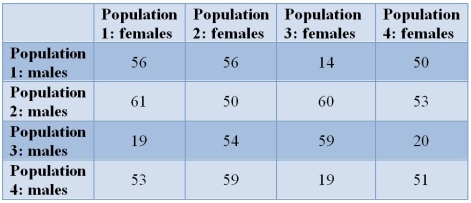 Certain populations of a copepod (a planktonic crustacean) may be reproductively isolated, even though females will mate with any male.Here, three females from one of the populations are placed with three males from another population.The diagonals represent crosses made between males and females of the same population.The numbers of offspring produced are listed in the table.In the crosses with reproductive isolation, what type of reproductive isolation exists?
 (Multiple Choice)
4.8/5  (88)
(88) Which mechanism can lead to selection against hybridization?
(Multiple Choice)
4.9/5 (75)
(75) Which example best illustrates temporal reproductive isolation?
(Multiple Choice)
4.9/5 (82)
(82) Two species of three-spined stickleback fish have been found together in five different lakes.The larger bottom-dwelling species feeds on large prey close to shore.A surface-dwelling species feeds on small plankton in open water.DNA analysis shows that the two species in each lake are more closely related to each other than they are to any of the other species in the lakes.However, they are reproductively isolated.These two species are likely to have arisen due to
(Multiple Choice)
4.8/5 (76)
(76) On the Galápagos Islands, some species of Darwin's finches have large bills capable of cracking hard nuts and seeds, some have smaller beaks useful for catching insects, and one has a beak capable of using tools to extract insects from within the bark of trees.In 1977, the Galápagos had abnormally low rainfall, and seed plants produced small crops.The population of seed-eating finches fell 85%.Large birds, especially males with strong beaks, survived disproportionately well because they were able to crack large seeds.This scenario suggests that rapid speciation in finches on the Galápagos Islands was facilitated by
(Multiple Choice)
4.8/5 (84)
(84) Polyploidy can result in complete reproductive isolation in a minimum of _______ generation(s).
(Multiple Choice)
4.8/5 (89)
(89) Divergent centric fusions can be barriers to reproduction in F1 hybrids because
(Multiple Choice)
5.0/5 (79)
(79) The biological species concept means that species arise when
(Multiple Choice)
4.9/5 (85)
(85) When differences in the shapes of reproductive organs between the males of one species and the females of the other lead to incompatibility, the species are said to be exhibiting _______ isolation.
(Short Answer)
4.9/5 (81)
(81) Which is a key distinction between allopatric and non-polyploid sympatric speciation?
(Multiple Choice)
4.9/5 (80)
(80) In the western United States, populations of an annual plant can be found almost continuously from San Diego to Seattle.Even though individuals from the San Diego and Seattle populations never come into contact, they can still be considered part of the same species under the ________ species concept because they can potentially interbreed.
(Multiple Choice)
5.0/5 (72)
(72) Which factor or process does the Dobzhansky-Muller model of speciation necessarily require?
(Multiple Choice)
4.8/5 (72)
(72) Molecular genetic analysis shows that a turtle hybrid zone contains mainly F1 individuals with a few backcross individuals.What can you infer from this?
(Multiple Choice)
4.9/5 (76)
(76) The genes F and G act in accordance with the Dobzhansky-Muller model leading to sterility in hybrids between two species of monkeyflowers.Any combination of the F1 and the G2 alleles causes hybrids to be sterile.Based on the Dobzhansky-Muller model, which genotype should have high fitness?
(Multiple Choice)
4.8/5 (79)
(79) A hybrid zone between two species of butterflies contains individuals with widely varying genotypes, ranging from those matching both parental species to those with varying proportions of genes from the parental species.From this information one can infer that
(Multiple Choice)
4.7/5 (82)
(82) Silene is a genus of plants in the Caryophyllaceae.Many species of this plant have separate male and female individuals.Two species meet at a hybrid zone.What change would most likely cause the hybrid zone to become wider?
(Multiple Choice)
4.8/5 (75)
(75) Discuss the conditions on the Galápagos Islands that led to the evolution of the birds known as Darwin's finches.
(Essay)
4.8/5 (79)
(79) Which type of reproductive isolating mechanisms would most likely arise from the coevolution of male and female reproductive organs in two sympatric populations of insects?
(Multiple Choice)
5.0/5 (81)
(81) 
Filters
- Essay(0)
- Multiple Choice(0)
- Short Answer(0)
- True False(0)
- Matching(0)