



 Chat with AI
Exam 22: Speciation

Exam 1: Studying Life246 Questions
Exam 2: Small Molecules and the Chemistry of Life246 Questions
Exam 3: Proteins, Carbohydrates, and Lipids246 Questions
Exam 4: Nucleic Acids and the Origin of Life246 Questions
Exam 5: Cells: the Working Units of Life248 Questions
Exam 6: Cell Membranes246 Questions
Exam 7: Cell Communication and Multicellularity246 Questions
Exam 8: Energy, Enzymes, and Metabolism246 Questions
Exam 9: Pathways That Harvest Chemical Energy246 Questions
Exam 10: Photosynthesis: Energy From Sunlight242 Questions
Exam 11: The Cell Cycle and Cell Division260 Questions
Exam 12: Inheritance, Genes, and Chromosomes250 Questions
Exam 13: Dna and Its Role in Heredity257 Questions
Exam 14: From Dna to Protein: Gene Expression252 Questions
Exam 15: Gene Mutation and Molecular Medicine251 Questions
Exam 16: Regulation of Gene Expression245 Questions
Exam 17: Genomes249 Questions
Exam 18: Recombinant Dna and Biotechnology243 Questions
Exam 20: Mechanisms of Evolution243 Questions
Exam 21: Reconstructing and Using Phylogenies246 Questions
Exam 22: Speciation247 Questions
Exam 23: Evolution of Genes and Genomes252 Questions
Exam 24: The History of Life on Earth246 Questions
Exam 25: Bacteria, Archaea, and Viruses262 Questions
Exam 26: The Origin and Diversification of Eukaryotes252 Questions
Exam 27: Plants Without Seeds: From Water to Land251 Questions
Exam 28: The Evolution of Seed Plants259 Questions
Exam 29: The Evolution and Diversity of Fungi261 Questions
Exam 30: Animal Origins and the Evolution of Body Plans248 Questions
Exam 31: Protostome Animals244 Questions
Exam 32: Deuterostome Animals246 Questions
Exam 33: The Plant Body243 Questions
Exam 34: Transport in Plants248 Questions
Exam 35: Plant Nutrition247 Questions
Exam 36: Regulation of Plant Growth246 Questions
Exam 37: Reproduction in Flowering Plants247 Questions
Exam 38: Plant Responses to Environmental Challenges246 Questions
Exam 39: Physiology, Homeostasis, and Temperature Regulation258 Questions
Exam 40: Animal Hormones249 Questions
Exam 41: Immunology: Animal Defense Systems265 Questions
Exam 42: Animal Reproduction261 Questions
Exam 43: Animal Development261 Questions
Exam 44: Neurons, Glia, and Nervous Systems250 Questions
Exam 45: Sensory Systems249 Questions
Exam 46: The Mammalian Nervous System: Structure and Higher Functions254 Questions
Exam 47: Musculoskeletal Systems259 Questions
Exam 48: Gas Exchange247 Questions
Exam 49: Circulatory Systems252 Questions
Exam 50: Nutrition, Digestion, and Absorption259 Questions
Exam 51: Salt and Water Balance and Nitrogen Excretion251 Questions
Exam 52: Animal Behavior249 Questions
Exam 53: The Physical Environment and Biogeography of Life248 Questions
Exam 54: Populations259 Questions
Exam 55: Species Interactions254 Questions
Exam 56: Communities247 Questions
Exam 57: Ecosystems238 Questions
Exam 58: A Changing Biosphere222 Questions
Select questions type


The genetic changes in the Dobzhansky-Muller model can be structural changes as well as nucleotide changes.Studies from _______ best support this claim.
(Multiple Choice)
4.9/5  (86)
(86) Refer to the table. 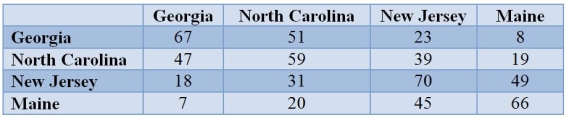 (In the table, the origin of the males is in the rows and the origin of the females is in the columns.)
In the eastern United States, populations of the white-footed mouse, Peromyscus leucopus, can be found almost continuously from Maine to Georgia.Suppose populations going south to north from Georgia, North Carolina, New Jersey, and Maine were collected.These populations were then crossed and the number of F1 hybrids that were viable and fertile were obtained as show in the table.Would these data change your mind about whether this is one species? Explain in terms of reproductive isolation, noting the type of isolation that is involved, if any.
(In the table, the origin of the males is in the rows and the origin of the females is in the columns.)
In the eastern United States, populations of the white-footed mouse, Peromyscus leucopus, can be found almost continuously from Maine to Georgia.Suppose populations going south to north from Georgia, North Carolina, New Jersey, and Maine were collected.These populations were then crossed and the number of F1 hybrids that were viable and fertile were obtained as show in the table.Would these data change your mind about whether this is one species? Explain in terms of reproductive isolation, noting the type of isolation that is involved, if any. (Essay)
4.7/5 (84)
(84) In breeding sage grouse, males display for females in a mating arena called a lek.Females tend to prefer a small number of males, leading to highly skewed mating success for a few promiscuous males and reduced genetic variability in the population as a whole.In 2000, a new species of sage grouse (called Gunnison's Sage-Grouse) was declared.Relatively rapid speciation in sage grouse could have arisen because of
(Multiple Choice)
4.8/5 (69)
(69) Refer to the figure. 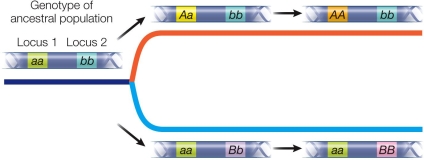 The figure shows the Dobzhansky-Muller model of the evolution of reproductive isolation.The F1 hybrids between the species at the end of this process have reduced fitness.Which genotype has high fitness?
 (Multiple Choice)
4.7/5 (71)
(71) The evolution of chromosomal rearrangements in Rhogeessa bats supports the role of _______ in speciation.
(Multiple Choice)
4.9/5 (88)
(88) You are a biologist going to an island that few scientists have studied.You will most likely be able to first distinguish new species based on the _______ species concept.Having a computer and rudimentary lab permits you to analyze DNA samples collected and compare them with known species.This will allow you to also make inferences about species based on a _______ species concept.
(Multiple Choice)
4.9/5 (73)
(73) Silene is a genus of plants in the Caryophyllaceae.Many species of this plant have separate male and female individuals.Two populations may have evolved reproductive isolation.Which method would best determine if they exhibit temporal isolation?
(Multiple Choice)
4.9/5 (81)
(81) Refer to the figure 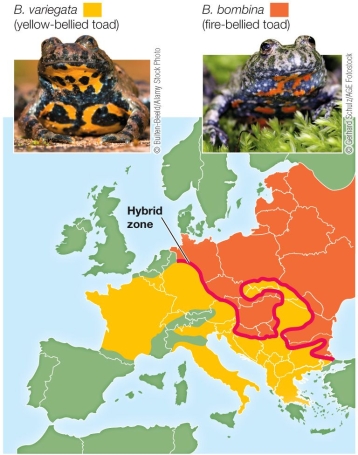 The figure shows two species, a fire-bellied toad and yellow-bellied toad, which occupy different areas of Europe.A small area of overlap between these regions constitutes a hybrid zone.If individuals from the two populations overcome prezygotic reproductive barriers, additional postzygotic barriers may prevent the formation of stable hybrids.Identify two reasons why the hybrid zone between B.bombina and B.variegata is so narrow.What would likely happen if the hybrids became somewhat more fit?
 (Essay)
4.8/5 (81)
(81) The wheat that we commonly eat is hexaploid, derived from a cross between two distinct species, one a diploid and one a tetraploid.This is an example of
(Multiple Choice)
4.8/5 (77)
(77) The genes F and G act in accordance with the Dobzhansky-Muller model, leading to sterility in hybrids between two species of monkeyflowers.Any combination of the F1 and the G2 alleles causes hybrids to be sterile.Based on the Dobzhansky-Muller model, which genotype was the ancestor of the two species unlikely to have?
(Multiple Choice)
4.8/5 (83)
(83) In what way is reproductive isolation generally related to genetic divergence between newly forming species?
(Multiple Choice)
4.8/5 (73)
(73) Refer to the figure. 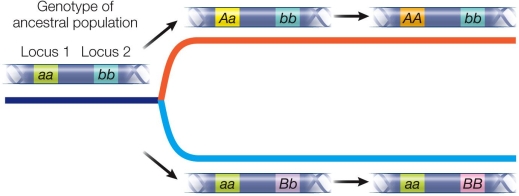 The figure shows the Dobzhansky-Muller model of the evolution of reproductive isolation.The F1 hybrids between the species at the end of this process have reduced fitness.
Does the genotype aaBb have reduced fitness? Explain.
The figure shows the Dobzhansky-Muller model of the evolution of reproductive isolation.The F1 hybrids between the species at the end of this process have reduced fitness.
Does the genotype aaBb have reduced fitness? Explain. (Essay)
4.8/5 (78)
(78) Refer to the figure showing the Dobzhansky-Muller model of the evolution of reproductive isolation. 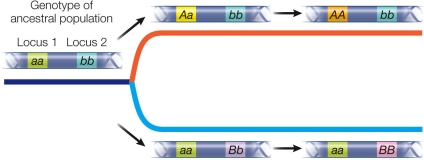 The F1 hybrids between the species at the end of this process have reduced fitness.From this, we can conclude that
 (Multiple Choice)
5.0/5 (72)
(72) Refer to the table. 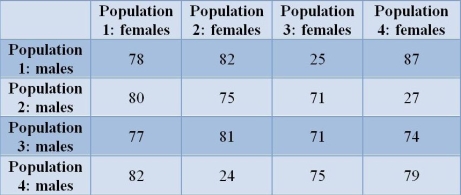 Certain populations of a copepod (a planktonic crustacean) may be reproductively isolated, even though females will mate with any male.Here three females from one of the populations are placed with three males from another.The diagonals represent crosses made between males and females of the same population.The numbers of offspring produced are listed in the table.Population 4 shows reproductive isolation from population _______.
 (Short Answer)
4.8/5 (76)
(76) Refer to the table. 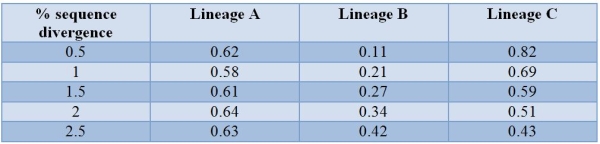 The relationship between genetic divergence (in sequence divergence) and the extent of reproductive isolation is plotted for three lineages of frogs.Reproductive isolation is measured on a scale ranging from zero representing no isolation to 1 representing complete isolation.Reproductive isolation is accumulating more or less linearly with genetic distance in lineage _______.
 (Short Answer)
4.8/5 (63)
(63) Refer to the figure. 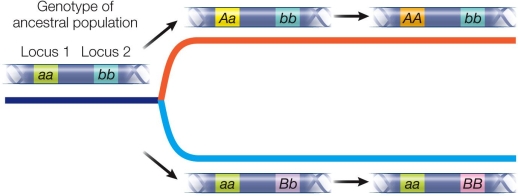 The figure shows the Dobzhansky-Muller model of the evolution of reproductive isolation.The F1 hybrids between the species at the end of this process have reduced fitness.Does the genotype AaBB have reduced fitness? Explain.
 (Essay)
4.8/5 (86)
(86) Ginkgo trees grow in Asia and North America and thus are divided into two groups that are geographically separated.Mayr's framing of the biological species concept would classify these populations as belonging to the same species because they
(Multiple Choice)
4.8/5 (71)
(71) Hawaiian honeycreepers (birds), consisting of 50 species, some of which are now extinct, represent a much more diverse lineage than Hawaiian thrushes.Honey creepers have a remarkable variation in bill morphology, whereas Hawaiian thrushes exhibit far less morphological variation.Bill morphology is strongly linked to the resources available for these birds to eat.This suggests that _______ in honey creepers may have occurred as a result of _______.
(Multiple Choice)
4.8/5 (78)
(78) 
Filters
- Essay(0)
- Multiple Choice(0)
- Short Answer(0)
- True False(0)
- Matching(0)