



 Chat with AI
Exam 22: Speciation

Exam 1: Studying Life246 Questions
Exam 2: Small Molecules and the Chemistry of Life246 Questions
Exam 3: Proteins, Carbohydrates, and Lipids246 Questions
Exam 4: Nucleic Acids and the Origin of Life246 Questions
Exam 5: Cells: the Working Units of Life248 Questions
Exam 6: Cell Membranes246 Questions
Exam 7: Cell Communication and Multicellularity246 Questions
Exam 8: Energy, Enzymes, and Metabolism246 Questions
Exam 9: Pathways That Harvest Chemical Energy246 Questions
Exam 10: Photosynthesis: Energy From Sunlight242 Questions
Exam 11: The Cell Cycle and Cell Division260 Questions
Exam 12: Inheritance, Genes, and Chromosomes250 Questions
Exam 13: Dna and Its Role in Heredity257 Questions
Exam 14: From Dna to Protein: Gene Expression252 Questions
Exam 15: Gene Mutation and Molecular Medicine251 Questions
Exam 16: Regulation of Gene Expression245 Questions
Exam 17: Genomes249 Questions
Exam 18: Recombinant Dna and Biotechnology243 Questions
Exam 20: Mechanisms of Evolution243 Questions
Exam 21: Reconstructing and Using Phylogenies246 Questions
Exam 22: Speciation247 Questions
Exam 23: Evolution of Genes and Genomes252 Questions
Exam 24: The History of Life on Earth246 Questions
Exam 25: Bacteria, Archaea, and Viruses262 Questions
Exam 26: The Origin and Diversification of Eukaryotes252 Questions
Exam 27: Plants Without Seeds: From Water to Land251 Questions
Exam 28: The Evolution of Seed Plants259 Questions
Exam 29: The Evolution and Diversity of Fungi261 Questions
Exam 30: Animal Origins and the Evolution of Body Plans248 Questions
Exam 31: Protostome Animals244 Questions
Exam 32: Deuterostome Animals246 Questions
Exam 33: The Plant Body243 Questions
Exam 34: Transport in Plants248 Questions
Exam 35: Plant Nutrition247 Questions
Exam 36: Regulation of Plant Growth246 Questions
Exam 37: Reproduction in Flowering Plants247 Questions
Exam 38: Plant Responses to Environmental Challenges246 Questions
Exam 39: Physiology, Homeostasis, and Temperature Regulation258 Questions
Exam 40: Animal Hormones249 Questions
Exam 41: Immunology: Animal Defense Systems265 Questions
Exam 42: Animal Reproduction261 Questions
Exam 43: Animal Development261 Questions
Exam 44: Neurons, Glia, and Nervous Systems250 Questions
Exam 45: Sensory Systems249 Questions
Exam 46: The Mammalian Nervous System: Structure and Higher Functions254 Questions
Exam 47: Musculoskeletal Systems259 Questions
Exam 48: Gas Exchange247 Questions
Exam 49: Circulatory Systems252 Questions
Exam 50: Nutrition, Digestion, and Absorption259 Questions
Exam 51: Salt and Water Balance and Nitrogen Excretion251 Questions
Exam 52: Animal Behavior249 Questions
Exam 53: The Physical Environment and Biogeography of Life248 Questions
Exam 54: Populations259 Questions
Exam 55: Species Interactions254 Questions
Exam 56: Communities247 Questions
Exam 57: Ecosystems238 Questions
Exam 58: A Changing Biosphere222 Questions
Select questions type


Herbivorous bugs typically specialize on eating one or a few closely related species of plants, whereas predatory bugs tend to feed on many different species of insects.If there is a high diversity of potential host plants, we would expect to find
(Multiple Choice)
4.9/5  (81)
(81) The morphology and natural history of a common and widely distributed butterfly was observed over a 25-year period in Costa Rica.Recent DNA barcoding (DNA sequence analysis) showed that what was once thought to be a single species is actually a complex of at least 10 species.Though caterpillars of these species eat different food plants and have somewhat different habitat preferences than their adult forms, their morphological differences are subtle.These butterflies would be considered _______ species.
(Short Answer)
4.7/5 (84)
(84) Two different species of three-spined stickleback fish have been found together in each of five different lakes.Within the same lakes, the larger bottom-dwelling species with a large mouth feeds on large prey close to shore.A smaller surface-dwelling species feeds on small plankton in open water.DNA analysis shows that the two species in each lake are more closely related to each other than they are to any of the other species in the lakes.However, they are reproductively isolated.The habitat specialization of these species is consistent with which prezygotic mechanism that can lead to speciation?
(Multiple Choice)
5.0/5 (72)
(72) The Isthmus of Panama cut off gene flow between Atlantic and Pacific populations of a species of fish.The cessation of gene flow led to the accumulation of genetic differences between the populations, which then led to reproductive isolation.Now, Atlantic and Pacific populations of this fish are separate species that cannot interbreed, even if they were again to come into contact with each other.The process described here is that of
(Multiple Choice)
4.8/5 (84)
(84) Platyfish with spots have an X-linked gene that produces the spots.All platyfish have an autosomal repressor that inhibits the expression of the spot-producing gene.The closely related swordtail lacks both the spot-producing gene and the repressor.In backcrosses between these two species, some hybrids receive the spot-producing gene, but not the repressor.These individuals can develop malignant tumors, because the expression of the spot-producing gene is not properly regulated.This appears to be an example of
(Multiple Choice)
4.8/5 (87)
(87) Refer to the table. 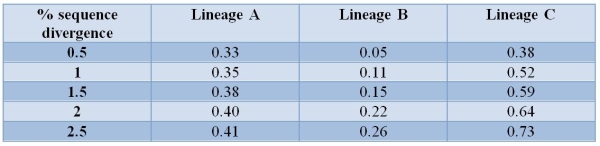 The relationship between genetic divergence (in sequence divergence) and the extent of reproductive isolation is plotted for three lineages of frogs.Reproductive isolation is measured on a scale ranging from zero representing no isolation, to 1 representing complete isolation.What would be the likely amount of reproductive isolation of frogs in lineage B that have diverged by 4 percent in DNA sequence based on the observed data?
 (Multiple Choice)
4.9/5 (94)
(94) Refer to the table. 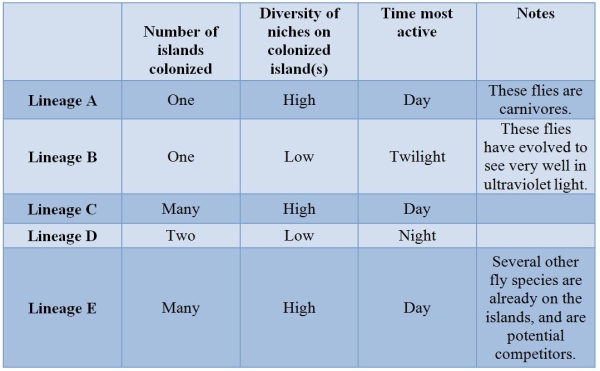 The table shows five lineages of flies and provides some information on the areas that they have colonized and other notes on their biology.In which lineage would you expect an adaptive radiation to be most likely?
 (Multiple Choice)
4.7/5 (74)
(74) An evolutionary biologist makes decisions about whether to consider three different populations of copepods as separate species based on observations of the individuals with which these copepods will mate.All combinations of these populations are able to mate with one another, but none of the combinations produce viable offspring.This biologist is most likely employing the _______ species concept, and based on the application of this species concept to these results, there are most likely _______ species of copepods present.
(Multiple Choice)
4.9/5 (74)
(74) Even trained biologists have difficulty telling females of Drosophila melanogaster and D.sechellia apart, yet these species are reproductively isolated.Thus, these species are considered _______ species.
(Multiple Choice)
5.0/5 (78)
(78) Which situation would most likely pose a major difficulty for applying the biological species concept?
(Multiple Choice)
4.7/5 (84)
(84) Studies with Rhogeessa bats show that the Dobzhansky-Muller model
(Multiple Choice)
4.8/5 (86)
(86) The C and the D loci interact in a Dobzhansky-Muller incompatibility, in which any combination of the C1 allele and the D1 allele would have reduced viability.If the parental populations are C0C0/D0D0 and C1C1/D0D0, the genotype of the hybrids would be _______, and would have high viability.
(Short Answer)
4.9/5 (86)
(86) Despite inhabiting overlapping ranges, the western spotted skunk and the eastern spotted skunk do not interbreed.One reason is that the western species breeds in early fall and the eastern species breeds in late winter to early spring.This is an example of _______ isolation.
(Multiple Choice)
4.8/5 (73)
(73) Which condition is most likely to lead to allopatric speciation?
(Multiple Choice)
4.7/5 (83)
(83) A tetraploid fish is generated by autopolyploidy.Its haploid number is 27.It should thus have _______ chromosomes.
(Short Answer)
4.9/5 (81)
(81) The strengthening of prezygotic barriers between two incipient species by natural selection is known as _______.
(Short Answer)
4.8/5 (82)
(82) The classification of organisms based on appearance alone is known as the _______ species concept.
(Multiple Choice)
4.8/5 (78)
(78) 
Filters
- Essay(0)
- Multiple Choice(0)
- Short Answer(0)
- True False(0)
- Matching(0)