



 Chat with AI
Exam 22: Speciation

Exam 1: Studying Life246 Questions
Exam 2: Small Molecules and the Chemistry of Life246 Questions
Exam 3: Proteins, Carbohydrates, and Lipids246 Questions
Exam 4: Nucleic Acids and the Origin of Life246 Questions
Exam 5: Cells: the Working Units of Life248 Questions
Exam 6: Cell Membranes246 Questions
Exam 7: Cell Communication and Multicellularity246 Questions
Exam 8: Energy, Enzymes, and Metabolism246 Questions
Exam 9: Pathways That Harvest Chemical Energy246 Questions
Exam 10: Photosynthesis: Energy From Sunlight242 Questions
Exam 11: The Cell Cycle and Cell Division260 Questions
Exam 12: Inheritance, Genes, and Chromosomes250 Questions
Exam 13: Dna and Its Role in Heredity257 Questions
Exam 14: From Dna to Protein: Gene Expression252 Questions
Exam 15: Gene Mutation and Molecular Medicine251 Questions
Exam 16: Regulation of Gene Expression245 Questions
Exam 17: Genomes249 Questions
Exam 18: Recombinant Dna and Biotechnology243 Questions
Exam 20: Mechanisms of Evolution243 Questions
Exam 21: Reconstructing and Using Phylogenies246 Questions
Exam 22: Speciation247 Questions
Exam 23: Evolution of Genes and Genomes252 Questions
Exam 24: The History of Life on Earth246 Questions
Exam 25: Bacteria, Archaea, and Viruses262 Questions
Exam 26: The Origin and Diversification of Eukaryotes252 Questions
Exam 27: Plants Without Seeds: From Water to Land251 Questions
Exam 28: The Evolution of Seed Plants259 Questions
Exam 29: The Evolution and Diversity of Fungi261 Questions
Exam 30: Animal Origins and the Evolution of Body Plans248 Questions
Exam 31: Protostome Animals244 Questions
Exam 32: Deuterostome Animals246 Questions
Exam 33: The Plant Body243 Questions
Exam 34: Transport in Plants248 Questions
Exam 35: Plant Nutrition247 Questions
Exam 36: Regulation of Plant Growth246 Questions
Exam 37: Reproduction in Flowering Plants247 Questions
Exam 38: Plant Responses to Environmental Challenges246 Questions
Exam 39: Physiology, Homeostasis, and Temperature Regulation258 Questions
Exam 40: Animal Hormones249 Questions
Exam 41: Immunology: Animal Defense Systems265 Questions
Exam 42: Animal Reproduction261 Questions
Exam 43: Animal Development261 Questions
Exam 44: Neurons, Glia, and Nervous Systems250 Questions
Exam 45: Sensory Systems249 Questions
Exam 46: The Mammalian Nervous System: Structure and Higher Functions254 Questions
Exam 47: Musculoskeletal Systems259 Questions
Exam 48: Gas Exchange247 Questions
Exam 49: Circulatory Systems252 Questions
Exam 50: Nutrition, Digestion, and Absorption259 Questions
Exam 51: Salt and Water Balance and Nitrogen Excretion251 Questions
Exam 52: Animal Behavior249 Questions
Exam 53: The Physical Environment and Biogeography of Life248 Questions
Exam 54: Populations259 Questions
Exam 55: Species Interactions254 Questions
Exam 56: Communities247 Questions
Exam 57: Ecosystems238 Questions
Exam 58: A Changing Biosphere222 Questions
Select questions type


The wheat that we commonly eat is hexaploid, derived from a cross between two distinct species, one a diploid and one a tetraploid.The diploid wheat has 14 chromosomes.How many chromosomes does the hexaploid wheat have?
(Multiple Choice)
4.8/5  (86)
(86) The different finch species in the phylogeny shown in the 22.8 of the textbook have all evolved on islands of the Galápagos archipelago within the past 3 million years.Molecular clock analysis (see Chapter 23) has been used to determine the dates of the various speciation events in the phylogeny.Geological techniques for dating rock samples (see Chapter 24) have been used to determine the ages of the various Galápagos islands.The table shows the number of species of Darwin's finches and the number of islands that have existed in the archipelago at several times during the past 4 million years. 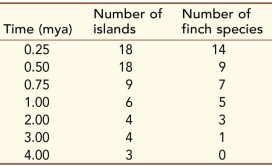 Plot the number of species of Darwin's finches and the number of islands in the Galápagos archipelago (dependent variables) against time (independent variable).
Are the data consistent with the hypothesis that isolation of populations on newly formed islands is related to speciation in this group of birds? Why or why not?
Plot the number of species of Darwin's finches and the number of islands in the Galápagos archipelago (dependent variables) against time (independent variable).
Are the data consistent with the hypothesis that isolation of populations on newly formed islands is related to speciation in this group of birds? Why or why not? (Essay)
4.7/5 (98)
(98) Which example best illustrates behavioral reproductive isolation?
(Multiple Choice)
4.8/5 (94)
(94) Refer to the table. 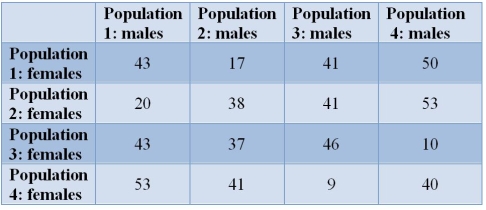 Certain populations of a copepod (a planktonic crustacean) may be reproductively isolated, even though females will mate with any male.Here, three females from one of the populations are placed with three males from another population.The diagonals represent crosses made between males and females of the same population.The numbers of offspring produced are listed in the table.The populations are exhibiting _______ zygotic isolation.
 (Short Answer)
4.9/5 (79)
(79) Which condition is unlikely to lead to allopatric speciation?
(Multiple Choice)
4.8/5 (71)
(71) Refer to the table. 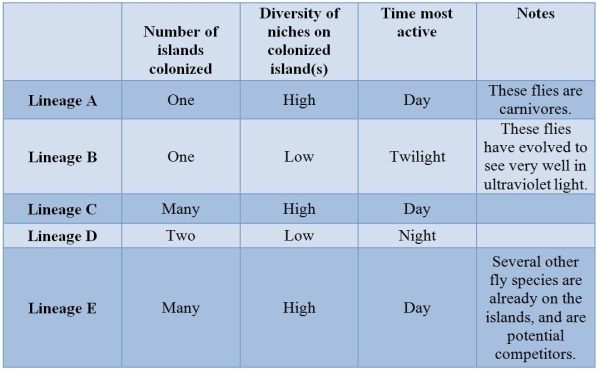 The table shows five lineages of flies and provides some information on the areas that they have colonized and other notes on their biology.Which of the following is most likely?
 (Multiple Choice)
4.8/5 (86)
(86) A field contains two related species of flowering plants.Species A has a diploid chromosome number of 10, and species B has a diploid chromosome number of 16.If a third species arises as a result of hybridization between A and B, how many chromosomes will it have?
(Multiple Choice)
4.9/5 (76)
(76) Refer to the figure. 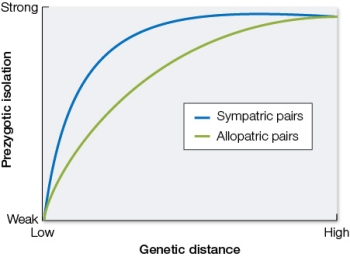 Drosophila species that have been crossed with each other allow evolutionary biologists to make general inferences about their evolution.The figure shows the relationship between prezygotic reproductive isolation and genetic distance for both allopatric and sympatric pairs.What is the likely explanation for the patterns observed in the graph?
 (Short Answer)
4.9/5 (95)
(95) Silverswords had no tree and shrub competitors prior to recent human ecological disturbance to the Hawaiian Islands.Descended from a tarweed ancestor that evolved in an environment with many tree and shrub species, its arrival on the islands represented a(n) _______because of a(n)_______.
(Multiple Choice)
4.8/5 (75)
(75) For which reason would we expect rapid speciation to occur among animals with complex, sexually selected behavior patterns?
(Multiple Choice)
4.7/5 (71)
(71) Which of the following is a major limitation of the morphological species concept?
(Multiple Choice)
4.9/5 (82)
(82) Two closely related beetles are in the same location.They exhibit reproductive isolation, and they are both diploid.Biologists are arguing about which is more likely, that they evolved via sympatric or allopatric speciation.What statement presents the best argument?
(Multiple Choice)
4.8/5 (71)
(71) Two populations of snails are allopatric, living in areas that have different soil compositions.The snails are not very mobile.Researchers are interested in whether the populations have acquired different types of reproductive isolation.Which would best determine if they are undergoing have mechanical isolation?
(Multiple Choice)
4.7/5 (86)
(86) Two populations of annelids (worms) live in distinct areas and on different soil types.Researchers are interested as to whether the populations have acquired different types of reproductive isolation.Which method would be best to determine whether two populations exhibited temporal isolation?
(Multiple Choice)
4.8/5 (88)
(88) One major category of reproductive isolating barriers, known as _______ isolating mechanisms, operates before fertilization.
(Short Answer)
4.8/5 (78)
(78) A tetraploid fish is generated by autopolyploidy.Its haploid number is 35.It should thus have _______ chromosomes.
(Short Answer)
4.7/5 (81)
(81) Which event would likely lead to an increase in speciation rate?
(Multiple Choice)
4.8/5 (72)
(72) Which of the following scenarios is not an example of mechanical reproductive isolation?
(Multiple Choice)
4.9/5 (80)
(80) An African genus of plant has large flowers pollinated by wind.In the neotropics, the same genus has a much larger number of species, with pollination occurring by orchid bees and many different species of hummingbirds.In both regions, the plants have hermaphroditic flowers.This may be an example of how _______ can lead to rapid speciation.
(Multiple Choice)
4.9/5 (78)
(78) 
Filters
- Essay(0)
- Multiple Choice(0)
- Short Answer(0)
- True False(0)
- Matching(0)