



 Chat with AI
Exam 22: Speciation

Exam 1: Studying Life246 Questions
Exam 2: Small Molecules and the Chemistry of Life246 Questions
Exam 3: Proteins, Carbohydrates, and Lipids246 Questions
Exam 4: Nucleic Acids and the Origin of Life246 Questions
Exam 5: Cells: the Working Units of Life248 Questions
Exam 6: Cell Membranes246 Questions
Exam 7: Cell Communication and Multicellularity246 Questions
Exam 8: Energy, Enzymes, and Metabolism246 Questions
Exam 9: Pathways That Harvest Chemical Energy246 Questions
Exam 10: Photosynthesis: Energy From Sunlight242 Questions
Exam 11: The Cell Cycle and Cell Division260 Questions
Exam 12: Inheritance, Genes, and Chromosomes250 Questions
Exam 13: Dna and Its Role in Heredity257 Questions
Exam 14: From Dna to Protein: Gene Expression252 Questions
Exam 15: Gene Mutation and Molecular Medicine251 Questions
Exam 16: Regulation of Gene Expression245 Questions
Exam 17: Genomes249 Questions
Exam 18: Recombinant Dna and Biotechnology243 Questions
Exam 20: Mechanisms of Evolution243 Questions
Exam 21: Reconstructing and Using Phylogenies246 Questions
Exam 22: Speciation247 Questions
Exam 23: Evolution of Genes and Genomes252 Questions
Exam 24: The History of Life on Earth246 Questions
Exam 25: Bacteria, Archaea, and Viruses262 Questions
Exam 26: The Origin and Diversification of Eukaryotes252 Questions
Exam 27: Plants Without Seeds: From Water to Land251 Questions
Exam 28: The Evolution of Seed Plants259 Questions
Exam 29: The Evolution and Diversity of Fungi261 Questions
Exam 30: Animal Origins and the Evolution of Body Plans248 Questions
Exam 31: Protostome Animals244 Questions
Exam 32: Deuterostome Animals246 Questions
Exam 33: The Plant Body243 Questions
Exam 34: Transport in Plants248 Questions
Exam 35: Plant Nutrition247 Questions
Exam 36: Regulation of Plant Growth246 Questions
Exam 37: Reproduction in Flowering Plants247 Questions
Exam 38: Plant Responses to Environmental Challenges246 Questions
Exam 39: Physiology, Homeostasis, and Temperature Regulation258 Questions
Exam 40: Animal Hormones249 Questions
Exam 41: Immunology: Animal Defense Systems265 Questions
Exam 42: Animal Reproduction261 Questions
Exam 43: Animal Development261 Questions
Exam 44: Neurons, Glia, and Nervous Systems250 Questions
Exam 45: Sensory Systems249 Questions
Exam 46: The Mammalian Nervous System: Structure and Higher Functions254 Questions
Exam 47: Musculoskeletal Systems259 Questions
Exam 48: Gas Exchange247 Questions
Exam 49: Circulatory Systems252 Questions
Exam 50: Nutrition, Digestion, and Absorption259 Questions
Exam 51: Salt and Water Balance and Nitrogen Excretion251 Questions
Exam 52: Animal Behavior249 Questions
Exam 53: The Physical Environment and Biogeography of Life248 Questions
Exam 54: Populations259 Questions
Exam 55: Species Interactions254 Questions
Exam 56: Communities247 Questions
Exam 57: Ecosystems238 Questions
Exam 58: A Changing Biosphere222 Questions
Select questions type


Polyploidy that arises from a combining of the chromosomes of two different species is known as _______.
(Short Answer)
4.8/5  (78)
(78) The different finch species in the phylogeny shown in the 22.8 of the textbook have all evolved on islands of the Galápagos archipelago within the past 3 million years.Molecular clock analysis (see Chapter 23) has been used to determine the dates of the various speciation events in the phylogeny.Geological techniques for dating rock samples (see Chapter 24) have been used to determine the ages of the various Galápagos islands.The table shows the number of species of Darwin's finches and the number of islands that have existed in the archipelago at several times during the past 4 million years. 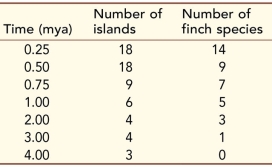 If no more islands form in the Galápagos archipelago, do you think that speciation by geographic isolation will continue to occur among Darwin's finches? Why or why not? What additional data could you collect to test your hypothesis (without waiting to see if speciation occurs)?
 (Essay)
4.9/5 (76)
(76) What is the most likely sequence of events in allopatric speciation?
(Multiple Choice)
4.9/5 (81)
(81) Except in cases of polyploidy, sympatric speciation usually requires the action of _______ selection.
(Short Answer)
4.9/5 (89)
(89) Refer to the table showing the relationship between prezygotic reproductive isolation and genetic distance for both allopatric and sympatric pairs. 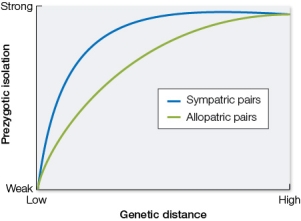 Drosophila species that have been crossed with each other allow evolutionary biologists to make general inferences about their evolution.Species pairs that are sympatric accumulate more prezygotic reproductive isolation at a faster rate than those that are allopatric.There is no such effect on postzygotic reproductive isolation: sympatric and allopatric pairs accumulate postzygotic isolation at the same rate.What is the likely explanation for the patterns observed?
 (Multiple Choice)
4.9/5 (71)
(71) Refer to the figure. 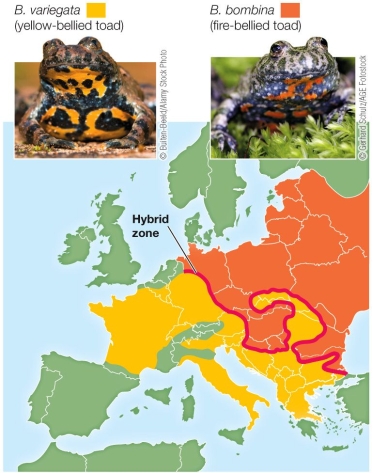 The figure shows two species, a fire-bellied toad and yellow-bellied toad, which occupy different areas of Europe.A small area of overlap between these regions constitutes a hybrid zone.If individuals from the two populations overcome prezygotic reproductive barriers, additional postzygotic barriers may prevent the formation of stable hybrids.Based on this data, which statement is true?
 (Multiple Choice)
4.8/5 (75)
(75) Suppose two species of morning glories are reproductively isolated because their flowers bloom at different times.This would be an example of _______ isolation, which is a form of prezygotic isolation.
(Short Answer)
4.8/5 (85)
(85) Which characteristic is least likely to be used to determine the difference between two cryptic species of Hyla treefrogs?
(Multiple Choice)
4.9/5 (82)
(82) Females of the species Drosophila pseudoobscura respond less well to courtship signals from males of their close relative D.persimilis than they do to those of males of their own species.This is an example of
(Multiple Choice)
4.8/5 (68)
(68) You begin a study of colorful spiders on the Hawaiian islands of Oahu, Molokai, Maui, and Hawaii.Examining only their appearance, you discover that populations on these four islands share most anatomical features but have a variety of patterns on their abdomens.Without any further information, you might conclude that these populations are different species, on the basis of which species concept?
(Multiple Choice)
4.8/5 (76)
(76) A fly is separating into two different groups-one that lays eggs on cherries and one that lays eggs on apples.The two types of flies, which are found in the same locality, prefer to mate with their own type.This fly species is most likely demonstrating
(Multiple Choice)
4.8/5 (80)
(80) Which of the following examples does not illustrate possible routes to behavioral reproductive isolation?
(Multiple Choice)
4.7/5 (62)
(62) The original host of apple maggot fly in North America was hawthorn, but it has since evolved to live on apple.This is an example of the early stages of _______ speciation.
(Short Answer)
4.9/5 (70)
(70) When hybrid offspring in amphibians are at a fitness disadvantage and reinforcement does not take place, what event or process is likely to occur?
(Multiple Choice)
4.9/5 (89)
(89) Two closely related beetles are in the same location.They exhibit reproductive isolation, and they are both diploid.Biologists are arguing about which is more likely, that they evolved via sympatric or allopatric speciation.Which statement presents the best argument for what is occurring?
(Multiple Choice)
4.9/5 (75)
(75) Of the three species concepts, the application of the _______ species concept is most likely to be constrained by computational power.
(Short Answer)
4.8/5 (81)
(81) The sperm of species A dies when it comes in contact with the female reproductive tract of species B.This is an example of the phenomenon known as
(Multiple Choice)
4.9/5 (73)
(73) Rank the following isolating mechanisms with respect to their time of occurrence in the life cycle, from earliest to latest.
(Multiple Choice)
4.8/5 (77)
(77) In 1928, a Russian plant geneticist crossed cabbage (Brassica) with radish (Raphanus).Fusion of gametes produced mostly infertile hybrids, but a few fertile plants contained a complete set of cabbage (n = 9) and radish (n = 9) chromosomes (n = 18).Fusion of their gametes in turn produced fertile 36-chromosome plants with cabbage-like roots and radish-like leaves.These plants could interbreed, but not with cabbage or radish ancestors.Production of this species, which can also occur naturally, is called
(Multiple Choice)
4.8/5 (77)
(77) 
Filters
- Essay(0)
- Multiple Choice(0)
- Short Answer(0)
- True False(0)
- Matching(0)