



 Chat with AI
Exam 22: Speciation

Exam 1: Studying Life246 Questions
Exam 2: Small Molecules and the Chemistry of Life246 Questions
Exam 3: Proteins, Carbohydrates, and Lipids246 Questions
Exam 4: Nucleic Acids and the Origin of Life246 Questions
Exam 5: Cells: the Working Units of Life248 Questions
Exam 6: Cell Membranes246 Questions
Exam 7: Cell Communication and Multicellularity246 Questions
Exam 8: Energy, Enzymes, and Metabolism246 Questions
Exam 9: Pathways That Harvest Chemical Energy246 Questions
Exam 10: Photosynthesis: Energy From Sunlight242 Questions
Exam 11: The Cell Cycle and Cell Division260 Questions
Exam 12: Inheritance, Genes, and Chromosomes250 Questions
Exam 13: Dna and Its Role in Heredity257 Questions
Exam 14: From Dna to Protein: Gene Expression252 Questions
Exam 15: Gene Mutation and Molecular Medicine251 Questions
Exam 16: Regulation of Gene Expression245 Questions
Exam 17: Genomes249 Questions
Exam 18: Recombinant Dna and Biotechnology243 Questions
Exam 20: Mechanisms of Evolution243 Questions
Exam 21: Reconstructing and Using Phylogenies246 Questions
Exam 22: Speciation247 Questions
Exam 23: Evolution of Genes and Genomes252 Questions
Exam 24: The History of Life on Earth246 Questions
Exam 25: Bacteria, Archaea, and Viruses262 Questions
Exam 26: The Origin and Diversification of Eukaryotes252 Questions
Exam 27: Plants Without Seeds: From Water to Land251 Questions
Exam 28: The Evolution of Seed Plants259 Questions
Exam 29: The Evolution and Diversity of Fungi261 Questions
Exam 30: Animal Origins and the Evolution of Body Plans248 Questions
Exam 31: Protostome Animals244 Questions
Exam 32: Deuterostome Animals246 Questions
Exam 33: The Plant Body243 Questions
Exam 34: Transport in Plants248 Questions
Exam 35: Plant Nutrition247 Questions
Exam 36: Regulation of Plant Growth246 Questions
Exam 37: Reproduction in Flowering Plants247 Questions
Exam 38: Plant Responses to Environmental Challenges246 Questions
Exam 39: Physiology, Homeostasis, and Temperature Regulation258 Questions
Exam 40: Animal Hormones249 Questions
Exam 41: Immunology: Animal Defense Systems265 Questions
Exam 42: Animal Reproduction261 Questions
Exam 43: Animal Development261 Questions
Exam 44: Neurons, Glia, and Nervous Systems250 Questions
Exam 45: Sensory Systems249 Questions
Exam 46: The Mammalian Nervous System: Structure and Higher Functions254 Questions
Exam 47: Musculoskeletal Systems259 Questions
Exam 48: Gas Exchange247 Questions
Exam 49: Circulatory Systems252 Questions
Exam 50: Nutrition, Digestion, and Absorption259 Questions
Exam 51: Salt and Water Balance and Nitrogen Excretion251 Questions
Exam 52: Animal Behavior249 Questions
Exam 53: The Physical Environment and Biogeography of Life248 Questions
Exam 54: Populations259 Questions
Exam 55: Species Interactions254 Questions
Exam 56: Communities247 Questions
Exam 57: Ecosystems238 Questions
Exam 58: A Changing Biosphere222 Questions
Select questions type


Under what circumstance would applications of the lineage species concept most face limitations?
(Multiple Choice)
4.8/5  (84)
(84) Geographical isolation is strongly associated with the phenomenon known as
(Multiple Choice)
4.8/5 (70)
(70) Which statement about the Dobzhansky-Muller model of speciation statement is false?
(Multiple Choice)
4.9/5 (82)
(82) If allopatric speciation is the most prevalent mode of speciation, what do you predict about the geographic distributions of many closely related species? Would the mobility of the species affect this conclusion?
(Essay)
4.9/5 (67)
(67) Which of the following is not a possible prezygotic mechanisms preventing hybridization?
(Multiple Choice)
4.9/5 (79)
(79) The dominant mode of speciation in most groups of mobile animals is
(Multiple Choice)
4.8/5 (80)
(80) In terms of their reproductive capacity, mules, which are hybrids between horses and donkeys, are a classic demonstration of hybrid _______.
(Short Answer)
4.8/5 (83)
(83) A field contains two related species of flowering plants.Species A has a diploid chromosome number of 16, and species B has a diploid chromosome number of 18.If a third species arises as a result of hybridization between A and B, how many chromosomes will it have?
(Multiple Choice)
4.8/5 (86)
(86) Hybrid offspring between two species of grasshoppers are at a significant fitness disadvantage compared with the pure species.The two species continue to hybridize at low to moderate levels and reinforcement does not take place.A likely event is thus the formation of a _______.
(Short Answer)
4.9/5 (82)
(82) Refer to the table. 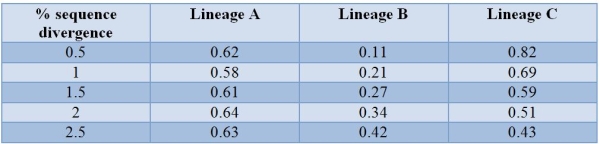 The relationship between genetic divergence (in sequence divergence) and the extent of reproductive isolation is plotted for three lineages of frogs.Reproductive isolation is measured on a scale ranging from zero representing no isolation to one representing complete isolation.What would be the likely amount of reproductive isolation of frogs in lineage B that have diverged by 4 percent in DNA sequence based on the observed data?
 (Multiple Choice)
4.9/5 (83)
(83) In Levin's studies of reinforcement in Phlox, what result would have challenged the notion that reinforcement is occurring in the system?
(Multiple Choice)
4.7/5 (70)
(70) In Darwin's finches, differences in the shapes and sizes of the _______ are usually the most distinctive distinguishing feature of different species.
(Short Answer)
4.9/5 (99)
(99) Aquilegia formosa (columbine) flowers are normally pendant and pollinated by hummingbirds.A related species, A.pubescens, has flowers that are normally upright and pollinated by hawkmoths.Studies in which the flowers of A.formosa were turned upright and those of A.pubescens were turned downward showed that
(Multiple Choice)
4.8/5 (88)
(88) In the case of the Rhogeessa bats, different _______ of chromosomes interact in accordance with the Dobzhansky-Muller model to cause reproductive isolation.
(Short Answer)
4.8/5 (90)
(90) The content of most standard field guides to identification of organisms reflects _______ species concept.
(Multiple Choice)
4.9/5 (79)
(79) Which scenario describes a possible route to speciation by habitat isolation?
(Multiple Choice)
4.9/5 (80)
(80) Suppose allopatric speciation is the most prevalent mode of speciation.Under this condition, you would you expect many closely related species not to be found adjacent to one another
(Multiple Choice)
4.7/5 (78)
(78) 
Filters
- Essay(0)
- Multiple Choice(0)
- Short Answer(0)
- True False(0)
- Matching(0)