



 Chat with AI
Exam 22: Speciation

Exam 1: Studying Life246 Questions
Exam 2: Small Molecules and the Chemistry of Life246 Questions
Exam 3: Proteins, Carbohydrates, and Lipids246 Questions
Exam 4: Nucleic Acids and the Origin of Life246 Questions
Exam 5: Cells: the Working Units of Life248 Questions
Exam 6: Cell Membranes246 Questions
Exam 7: Cell Communication and Multicellularity246 Questions
Exam 8: Energy, Enzymes, and Metabolism246 Questions
Exam 9: Pathways That Harvest Chemical Energy246 Questions
Exam 10: Photosynthesis: Energy From Sunlight242 Questions
Exam 11: The Cell Cycle and Cell Division260 Questions
Exam 12: Inheritance, Genes, and Chromosomes250 Questions
Exam 13: Dna and Its Role in Heredity257 Questions
Exam 14: From Dna to Protein: Gene Expression252 Questions
Exam 15: Gene Mutation and Molecular Medicine251 Questions
Exam 16: Regulation of Gene Expression245 Questions
Exam 17: Genomes249 Questions
Exam 18: Recombinant Dna and Biotechnology243 Questions
Exam 20: Mechanisms of Evolution243 Questions
Exam 21: Reconstructing and Using Phylogenies246 Questions
Exam 22: Speciation247 Questions
Exam 23: Evolution of Genes and Genomes252 Questions
Exam 24: The History of Life on Earth246 Questions
Exam 25: Bacteria, Archaea, and Viruses262 Questions
Exam 26: The Origin and Diversification of Eukaryotes252 Questions
Exam 27: Plants Without Seeds: From Water to Land251 Questions
Exam 28: The Evolution of Seed Plants259 Questions
Exam 29: The Evolution and Diversity of Fungi261 Questions
Exam 30: Animal Origins and the Evolution of Body Plans248 Questions
Exam 31: Protostome Animals244 Questions
Exam 32: Deuterostome Animals246 Questions
Exam 33: The Plant Body243 Questions
Exam 34: Transport in Plants248 Questions
Exam 35: Plant Nutrition247 Questions
Exam 36: Regulation of Plant Growth246 Questions
Exam 37: Reproduction in Flowering Plants247 Questions
Exam 38: Plant Responses to Environmental Challenges246 Questions
Exam 39: Physiology, Homeostasis, and Temperature Regulation258 Questions
Exam 40: Animal Hormones249 Questions
Exam 41: Immunology: Animal Defense Systems265 Questions
Exam 42: Animal Reproduction261 Questions
Exam 43: Animal Development261 Questions
Exam 44: Neurons, Glia, and Nervous Systems250 Questions
Exam 45: Sensory Systems249 Questions
Exam 46: The Mammalian Nervous System: Structure and Higher Functions254 Questions
Exam 47: Musculoskeletal Systems259 Questions
Exam 48: Gas Exchange247 Questions
Exam 49: Circulatory Systems252 Questions
Exam 50: Nutrition, Digestion, and Absorption259 Questions
Exam 51: Salt and Water Balance and Nitrogen Excretion251 Questions
Exam 52: Animal Behavior249 Questions
Exam 53: The Physical Environment and Biogeography of Life248 Questions
Exam 54: Populations259 Questions
Exam 55: Species Interactions254 Questions
Exam 56: Communities247 Questions
Exam 57: Ecosystems238 Questions
Exam 58: A Changing Biosphere222 Questions
Select questions type


Females of the beetle species Tribolium castaneum can readily mate with T.freemani.If these females mate with males of both their own species and males of T.freemani, nearly all of their offspring are pure species T.castaneum, with very few hybrids.This occurs because the sperm of T.castaneum blocks the sperm of T.freemani within the reproductive tract of the T.castaneum female.This is an example of _______ isolation, which is a form of prezygotic isolation.
(Short Answer)
4.8/5  (73)
(73) Speciation rates in plants are _______ in animal-pollinated plants than in wind-pollinated plants.
(Short Answer)
4.9/5 (72)
(72) The genes F and G act in accordance with the Dobzhansky-Muller model leading to sterility in hybrids between two species of monkeyflowers.Any combination of the F2 and the G1 alleles causes hybrids to be sterile.Based on the Dobzhansky-Muller model, which genotype should have high fitness?
(Multiple Choice)
4.8/5 (75)
(75) Populations of beetles from different localities in Europe are possible cryptic species.How would one determine whether they are cryptic species based on the biological species concept?
(Multiple Choice)
4.9/5 (89)
(89) The sterile offspring (mules) produced by horses breeding with donkeys exemplify
(Multiple Choice)
4.8/5 (76)
(76) What is the primary reason that there are so many species of land snails in the Hawaiian Islands?
(Multiple Choice)
4.9/5 (78)
(78) In an area of Europe where the fire-bellied toad overlaps and breeds with the yellow-bellied toad, hybrid offspring exhibit abnormalities such as misshapen mouths, fused vertebrae, and reduced numbers of vertebrae.Hybrid survival is not zero, but low compared with purebred individuals.Nevertheless, hybridization between these species is believed to have occurred at this location for centuries.This scenario describes an example of
(Multiple Choice)
4.8/5 (74)
(74) Hybridization between two species of diploid plants resulted in a tetraploid.One has a haploid number of 14 chromosomes and the other has a haploid number of 17 chromosomes.The resulting plant came about via _______ polyploidy.
(Short Answer)
4.7/5 (84)
(84) Which statement about the Dobzhansky-Muller model of speciation is false?
(Multiple Choice)
4.7/5 (71)
(71) Suppose that two populations that were once isolated come into contact.Which result would not be likely?
(Multiple Choice)
4.8/5 (84)
(84) Which of the following is a postzygotic isolating mechanism?
(Multiple Choice)
5.0/5 (86)
(86) Sexual dimorphism may be associated with a higher rate of speciation in some organisms because
(Multiple Choice)
4.8/5 (75)
(75) Certain populations of a copepod (a planktonic crustacean) may be reproductively isolated, even though females will mate with any male.Here, three females from one of the populations are placed with three males from another population.The diagonals represent crosses made between males and females of the same population.The numbers of offspring produced are listed in the table. 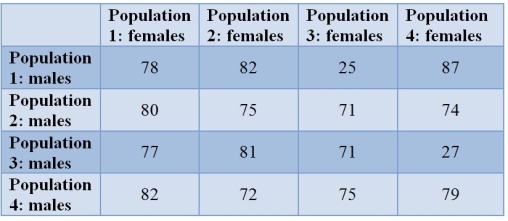 Which cross shows reproductive isolation?
 (Multiple Choice)
4.9/5 (82)
(82) Two species of crickets have partially overlapping ranges, in which hybrids are never found.Individuals-whether taken from overlapping areas or from non-overlapping areas-will rarely mate in the lab, because the females reject the songs sung by males of the other species.Of the few hybrids that are produced in lab crosses, all have low viability.Based on the information given, which statement is true?
(Multiple Choice)
4.8/5 (82)
(82) Darwin's finches are thought to have evolved as a result of allopatric speciation.This is mainly based on the observation that
(Multiple Choice)
4.9/5 (70)
(70) What is the critical distinction between allopolyploidy and autopolyploidy?
(Multiple Choice)
4.9/5 (83)
(83) The biological species concept does not apply to which group of organisms?
(Multiple Choice)
4.8/5 (83)
(83) Which situation is least likely to lead to geographic isolation and allopatric speciation?
(Multiple Choice)
4.9/5 (74)
(74) 
Filters
- Essay(0)
- Multiple Choice(0)
- Short Answer(0)
- True False(0)
- Matching(0)