



 Chat with AI
Exam 8: Energy, Enzymes, and Metabolism

Exam 1: Studying Life246 Questions
Exam 2: Small Molecules and the Chemistry of Life246 Questions
Exam 3: Proteins, Carbohydrates, and Lipids246 Questions
Exam 4: Nucleic Acids and the Origin of Life246 Questions
Exam 5: Cells: the Working Units of Life248 Questions
Exam 6: Cell Membranes246 Questions
Exam 7: Cell Communication and Multicellularity246 Questions
Exam 8: Energy, Enzymes, and Metabolism246 Questions
Exam 9: Pathways That Harvest Chemical Energy246 Questions
Exam 10: Photosynthesis: Energy From Sunlight242 Questions
Exam 11: The Cell Cycle and Cell Division260 Questions
Exam 12: Inheritance, Genes, and Chromosomes250 Questions
Exam 13: Dna and Its Role in Heredity257 Questions
Exam 14: From Dna to Protein: Gene Expression252 Questions
Exam 15: Gene Mutation and Molecular Medicine251 Questions
Exam 16: Regulation of Gene Expression245 Questions
Exam 17: Genomes249 Questions
Exam 18: Recombinant Dna and Biotechnology243 Questions
Exam 20: Mechanisms of Evolution243 Questions
Exam 21: Reconstructing and Using Phylogenies246 Questions
Exam 22: Speciation247 Questions
Exam 23: Evolution of Genes and Genomes252 Questions
Exam 24: The History of Life on Earth246 Questions
Exam 25: Bacteria, Archaea, and Viruses262 Questions
Exam 26: The Origin and Diversification of Eukaryotes252 Questions
Exam 27: Plants Without Seeds: From Water to Land251 Questions
Exam 28: The Evolution of Seed Plants259 Questions
Exam 29: The Evolution and Diversity of Fungi261 Questions
Exam 30: Animal Origins and the Evolution of Body Plans248 Questions
Exam 31: Protostome Animals244 Questions
Exam 32: Deuterostome Animals246 Questions
Exam 33: The Plant Body243 Questions
Exam 34: Transport in Plants248 Questions
Exam 35: Plant Nutrition247 Questions
Exam 36: Regulation of Plant Growth246 Questions
Exam 37: Reproduction in Flowering Plants247 Questions
Exam 38: Plant Responses to Environmental Challenges246 Questions
Exam 39: Physiology, Homeostasis, and Temperature Regulation258 Questions
Exam 40: Animal Hormones249 Questions
Exam 41: Immunology: Animal Defense Systems265 Questions
Exam 42: Animal Reproduction261 Questions
Exam 43: Animal Development261 Questions
Exam 44: Neurons, Glia, and Nervous Systems250 Questions
Exam 45: Sensory Systems249 Questions
Exam 46: The Mammalian Nervous System: Structure and Higher Functions254 Questions
Exam 47: Musculoskeletal Systems259 Questions
Exam 48: Gas Exchange247 Questions
Exam 49: Circulatory Systems252 Questions
Exam 50: Nutrition, Digestion, and Absorption259 Questions
Exam 51: Salt and Water Balance and Nitrogen Excretion251 Questions
Exam 52: Animal Behavior249 Questions
Exam 53: The Physical Environment and Biogeography of Life248 Questions
Exam 54: Populations259 Questions
Exam 55: Species Interactions254 Questions
Exam 56: Communities247 Questions
Exam 57: Ecosystems238 Questions
Exam 58: A Changing Biosphere222 Questions
Select questions type


Refer to the diagram below showing the activity of several enzymes at varying pH levels. 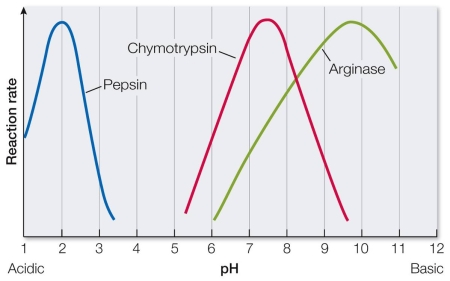 Based on the diagram, achieving the maximum rate of both chymotrypsin and arginase activity in the same reaction would require a pH of about
Free
(Multiple Choice)
4.8/5  (79)
(79) Correct Answer: Verified
D
The energy currency of cells is
Free
(Multiple Choice)
4.9/5 (79)
(79) Correct Answer:Verified
VerifiedD
Which enzymes are most likely to not be affected by an increase in temperature?
(Multiple Choice)
4.9/5 (84)
(84) You are given a solution in which a biochemical reaction is occurring, and you are unsure whether G is positive or negative.You suspect that the reaction might make use of the ATP to ADP + Pi energy-coupling system.To test whether it uses this system, and to determine whether the reaction is exergonic or endergonic, you would add _______.If the reaction _______, you would conclude that it is _______.
(Multiple Choice)
4.7/5 (68)
(68) -lactamase is an enzyme that catalyzes the hydrolysis of the antibiotic penicillin.Infrared spectra taken of penicillin free in solution and penicillin bound to the active site of the enzyme have revealed that certain bonds are stretched to a greater extent when penicillin is bound to the enzyme.Explain how this observation relates to the concept of enzyme-induced strain.
(Essay)
4.8/5 (77)
(77) Refer to the table below. 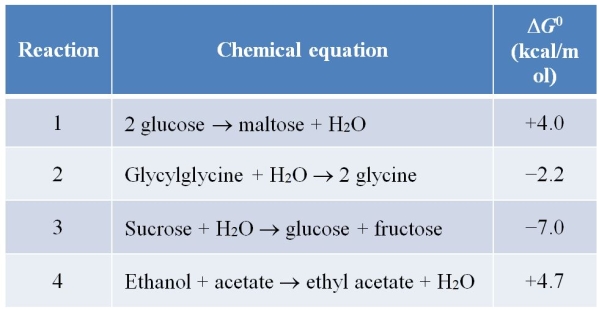 Predict which reactions are most likely to be coupled to ATP hydrolysis in a cell.
 (Multiple Choice)
5.0/5 (77)
(77) The breaking down of molecules in a living system is known as _______.
(Short Answer)
4.9/5 (85)
(85) During photosynthesis, plants use light energy to synthesize sugars, using the carbon in carbon dioxide.They do not make new energy in this process; they merely convert it from light energy to chemical energy.Photosynthesis is thus an illustration of
(Multiple Choice)
5.0/5 (81)
(81) The formation of covalent bonds between active site side chains and the substrate is an example of _______ catalysis, whereas the transfer of protons between active site side chains and the substrate is an example of _______ catalysis.
(Multiple Choice)
4.9/5 (80)
(80) Refer to the figures below showing changes in free energy for two reactions that are coupled together in a metabolic pathway. 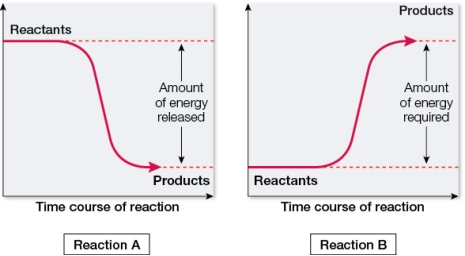 ATP hydrolysis is an example of reaction A that is coupled to reaction B in order to provide it with sufficient _______ to allow the reaction to occur.
 (Short Answer)
5.0/5 (70)
(70) Discuss the meaning of the term "thermodynamics," and explain how biological systems and thermodynamics are related.
(Essay)
4.9/5 (80)
(80) The conversion of glucose to glucose 6-phosphate is an enzyme-catalyzed reaction.During this reaction, the enzyme hexokinase folds around the substrates to bring reactive side chains from the active site into alignment with the substrates.This change in hexokinase is an example of
(Multiple Choice)
4.9/5 (59)
(59) Refer to the table below. 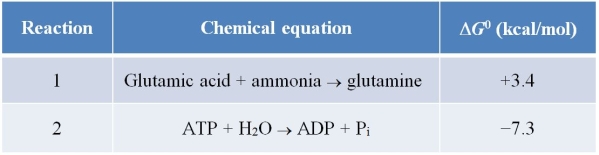 In a cell, these two reactions are coupled.Explain what that means and the benefit of having the reactions coupled.Include a diagram in your explanation.
 (Essay)
4.9/5 (77)
(77) Which statement can be used as evidence that living systems obey the first law of thermodynamics?
(Multiple Choice)
4.8/5 (73)
(73) 
Filters
- Essay(0)
- Multiple Choice(0)
- Short Answer(0)
- True False(0)
- Matching(0)