



 Chat with AI
Exam 8: Energy, Enzymes, and Metabolism

Exam 1: Studying Life246 Questions
Exam 2: Small Molecules and the Chemistry of Life246 Questions
Exam 3: Proteins, Carbohydrates, and Lipids246 Questions
Exam 4: Nucleic Acids and the Origin of Life246 Questions
Exam 5: Cells: the Working Units of Life248 Questions
Exam 6: Cell Membranes246 Questions
Exam 7: Cell Communication and Multicellularity246 Questions
Exam 8: Energy, Enzymes, and Metabolism246 Questions
Exam 9: Pathways That Harvest Chemical Energy246 Questions
Exam 10: Photosynthesis: Energy From Sunlight242 Questions
Exam 11: The Cell Cycle and Cell Division260 Questions
Exam 12: Inheritance, Genes, and Chromosomes250 Questions
Exam 13: Dna and Its Role in Heredity257 Questions
Exam 14: From Dna to Protein: Gene Expression252 Questions
Exam 15: Gene Mutation and Molecular Medicine251 Questions
Exam 16: Regulation of Gene Expression245 Questions
Exam 17: Genomes249 Questions
Exam 18: Recombinant Dna and Biotechnology243 Questions
Exam 20: Mechanisms of Evolution243 Questions
Exam 21: Reconstructing and Using Phylogenies246 Questions
Exam 22: Speciation247 Questions
Exam 23: Evolution of Genes and Genomes252 Questions
Exam 24: The History of Life on Earth246 Questions
Exam 25: Bacteria, Archaea, and Viruses262 Questions
Exam 26: The Origin and Diversification of Eukaryotes252 Questions
Exam 27: Plants Without Seeds: From Water to Land251 Questions
Exam 28: The Evolution of Seed Plants259 Questions
Exam 29: The Evolution and Diversity of Fungi261 Questions
Exam 30: Animal Origins and the Evolution of Body Plans248 Questions
Exam 31: Protostome Animals244 Questions
Exam 32: Deuterostome Animals246 Questions
Exam 33: The Plant Body243 Questions
Exam 34: Transport in Plants248 Questions
Exam 35: Plant Nutrition247 Questions
Exam 36: Regulation of Plant Growth246 Questions
Exam 37: Reproduction in Flowering Plants247 Questions
Exam 38: Plant Responses to Environmental Challenges246 Questions
Exam 39: Physiology, Homeostasis, and Temperature Regulation258 Questions
Exam 40: Animal Hormones249 Questions
Exam 41: Immunology: Animal Defense Systems265 Questions
Exam 42: Animal Reproduction261 Questions
Exam 43: Animal Development261 Questions
Exam 44: Neurons, Glia, and Nervous Systems250 Questions
Exam 45: Sensory Systems249 Questions
Exam 46: The Mammalian Nervous System: Structure and Higher Functions254 Questions
Exam 47: Musculoskeletal Systems259 Questions
Exam 48: Gas Exchange247 Questions
Exam 49: Circulatory Systems252 Questions
Exam 50: Nutrition, Digestion, and Absorption259 Questions
Exam 51: Salt and Water Balance and Nitrogen Excretion251 Questions
Exam 52: Animal Behavior249 Questions
Exam 53: The Physical Environment and Biogeography of Life248 Questions
Exam 54: Populations259 Questions
Exam 55: Species Interactions254 Questions
Exam 56: Communities247 Questions
Exam 57: Ecosystems238 Questions
Exam 58: A Changing Biosphere222 Questions
Select questions type


The hydrolysis of sucrose into glucose and fructose by the enzyme sucrase
(Multiple Choice)
4.8/5  (71)
(71) Refer to the figure below. 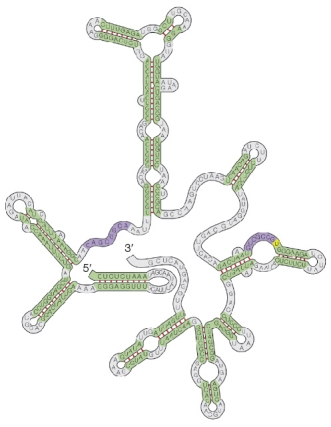 This figure shows an example of a biological molecule that can function as an enzyme.This type of enzyme is called a ribozyme because it consists of a molecule of _______.
 (Short Answer)
4.8/5 (83)
(83) Refer to the table below. 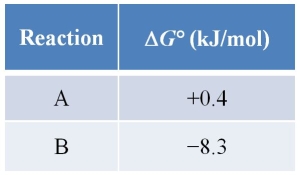 Information about two reactions is provided.From this information, it can be stated that reaction _______ is exergonic because its G° is _______.
 (Short Answer)
4.8/5 (87)
(87) Which statement regarding allosterically regulated enzymes is valid?
(Multiple Choice)
4.8/5 (84)
(84) Refer to the figure and table below. 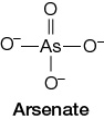
 A student is constructing a table that lists poisons whose mechanisms of action involve enzyme inhibition. She will put a checkmark in any column that characterizes a compound's mode of inhibition.Arsenate acts to inhibit many enzymes that use ATP as a coenzyme.To complete this row in the table the student should check the box(es) under _______.
 (Short Answer)
4.8/5 (79)
(79) The enzymes catalase and malate dehydrogenase are both classified as oxidoreductases.Catalase has a heme group present at its catalytic site, whereas malate dehydrogenase has no bound cofactors or prosthetic groups and uses NAD+ as a coenzyme.What can you infer about these two enzymes?
(Multiple Choice)
4.9/5 (72)
(72) Refer to the table below listing facts about the compound oligomycin. 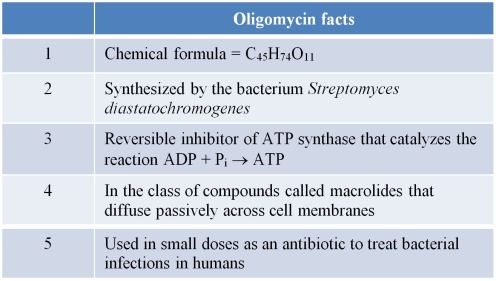 Which two facts taken together support the claim that cells convert the chemical energy of ATP into other forms of energy?
 (Multiple Choice)
4.7/5 (86)
(86) Glyceraldehyde 3-phosphate dehydrogenase catalyzes the reaction between glyceraldehyde 3-phosphate, NAD+, and phosphate ion to form 1,3-bisphosphoglycerate and NADH.Under certain conditions, a permanently radiolabeled enzyme intermediate forms if 14C-glyceraldehyde 3-phosphate and NAD+ are used as substrates and phosphate is left out of the reaction mix.The radiolabeled molecule is linked to a cysteine side chain of the enzyme.This result suggests that this enzyme uses _______ as a catalytic mechanism.
(Short Answer)
4.7/5 (68)
(68) Refer to the table below. 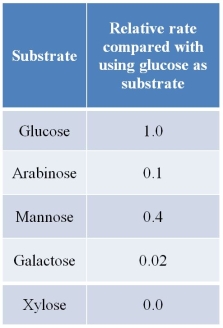 Hexokinase catalyzes the reaction between glucose and ATP to form glucose 6-phosphate and ADP.The table summarizes results of experiments using purified hexokinase.In the experiments, different sugars were substituted for glucose, and the rate of each catalytic reaction was measured and divided by the rate of reaction using glucose as substrate.These data provide evidence for which general statement that has been made about enzymes?
 (Multiple Choice)
4.8/5 (74)
(74) Many enzymes require small nonprotein molecules for a reaction to occur.These molecules temporarily bind to and then are released from the substrate before participating in other reactions.These types of molecules are called
(Multiple Choice)
4.9/5 (74)
(74) The breakdown of carbohydrates in a cell could provide a source of energy used in
(Multiple Choice)
4.8/5 (88)
(88) Which part of an enzyme molecule may function as a direct participant in the chemical reaction it catalyzes?
(Multiple Choice)
4.9/5 (77)
(77) Refer to the figure below.  This is an important equilibrium system in aquatic environments, particularly in the oceans.Which statement correctly describes a reaction of this system in response to an environmental change?
 (Multiple Choice)
4.9/5 (77)
(77) Plot free energy versus the time course of an endergonic reaction, and do the same for an exergonic reaction.Include the activation energy on both plots.Label Ea and G on both graphs.
(Essay)
4.8/5 (79)
(79) Refer to the graph below. 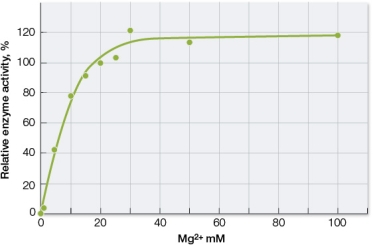 The graph shows data collected using a purified enzyme to catalyze a reaction.Magnesium ion likely functions as a _______ in this reaction.
 (Short Answer)
5.0/5 (75)
(75) Heat, light, electricity, and motion are all examples of _______ energy.
(Short Answer)
4.9/5 (84)
(84) 
Filters
- Essay(0)
- Multiple Choice(0)
- Short Answer(0)
- True False(0)
- Matching(0)