



 Chat with AI
Exam 8: Energy, Enzymes, and Metabolism

Exam 1: Studying Life246 Questions
Exam 2: Small Molecules and the Chemistry of Life246 Questions
Exam 3: Proteins, Carbohydrates, and Lipids246 Questions
Exam 4: Nucleic Acids and the Origin of Life246 Questions
Exam 5: Cells: the Working Units of Life248 Questions
Exam 6: Cell Membranes246 Questions
Exam 7: Cell Communication and Multicellularity246 Questions
Exam 8: Energy, Enzymes, and Metabolism246 Questions
Exam 9: Pathways That Harvest Chemical Energy246 Questions
Exam 10: Photosynthesis: Energy From Sunlight242 Questions
Exam 11: The Cell Cycle and Cell Division260 Questions
Exam 12: Inheritance, Genes, and Chromosomes250 Questions
Exam 13: Dna and Its Role in Heredity257 Questions
Exam 14: From Dna to Protein: Gene Expression252 Questions
Exam 15: Gene Mutation and Molecular Medicine251 Questions
Exam 16: Regulation of Gene Expression245 Questions
Exam 17: Genomes249 Questions
Exam 18: Recombinant Dna and Biotechnology243 Questions
Exam 20: Mechanisms of Evolution243 Questions
Exam 21: Reconstructing and Using Phylogenies246 Questions
Exam 22: Speciation247 Questions
Exam 23: Evolution of Genes and Genomes252 Questions
Exam 24: The History of Life on Earth246 Questions
Exam 25: Bacteria, Archaea, and Viruses262 Questions
Exam 26: The Origin and Diversification of Eukaryotes252 Questions
Exam 27: Plants Without Seeds: From Water to Land251 Questions
Exam 28: The Evolution of Seed Plants259 Questions
Exam 29: The Evolution and Diversity of Fungi261 Questions
Exam 30: Animal Origins and the Evolution of Body Plans248 Questions
Exam 31: Protostome Animals244 Questions
Exam 32: Deuterostome Animals246 Questions
Exam 33: The Plant Body243 Questions
Exam 34: Transport in Plants248 Questions
Exam 35: Plant Nutrition247 Questions
Exam 36: Regulation of Plant Growth246 Questions
Exam 37: Reproduction in Flowering Plants247 Questions
Exam 38: Plant Responses to Environmental Challenges246 Questions
Exam 39: Physiology, Homeostasis, and Temperature Regulation258 Questions
Exam 40: Animal Hormones249 Questions
Exam 41: Immunology: Animal Defense Systems265 Questions
Exam 42: Animal Reproduction261 Questions
Exam 43: Animal Development261 Questions
Exam 44: Neurons, Glia, and Nervous Systems250 Questions
Exam 45: Sensory Systems249 Questions
Exam 46: The Mammalian Nervous System: Structure and Higher Functions254 Questions
Exam 47: Musculoskeletal Systems259 Questions
Exam 48: Gas Exchange247 Questions
Exam 49: Circulatory Systems252 Questions
Exam 50: Nutrition, Digestion, and Absorption259 Questions
Exam 51: Salt and Water Balance and Nitrogen Excretion251 Questions
Exam 52: Animal Behavior249 Questions
Exam 53: The Physical Environment and Biogeography of Life248 Questions
Exam 54: Populations259 Questions
Exam 55: Species Interactions254 Questions
Exam 56: Communities247 Questions
Exam 57: Ecosystems238 Questions
Exam 58: A Changing Biosphere222 Questions
Select questions type


Refer to the graph below. 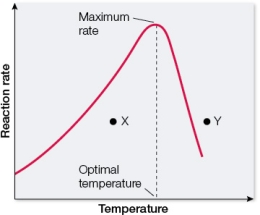 This graph shows the change in the rate of a reaction catalyzed by an enzyme as temperature is increased.At point _______, the low activity is due to denaturation of the enzyme, whereas at point _______, the low activity is due to low kinetic energies of the substrate and enzyme molecules in solution.
 (Short Answer)
4.9/5  (89)
(89) A readily reversible reaction, in which reactants and products have almost equal free energies, is indicated by a
(Multiple Choice)
4.9/5 (71)
(71) You are working with an enzyme and wish to determine its saturation point.You note that the reaction rate increases slowly at first, then increases dramatically over a narrow range of substrate concentrations, and then levels off, creating a sigmoid reaction curve.It is likely that this enzyme is regulated by
(Multiple Choice)
4.9/5 (78)
(78) A biochemist generates an enzyme activity curve for an unknown enzyme.The curve is shown below. 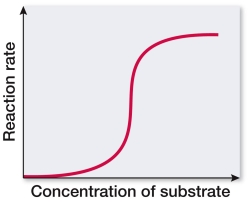 Which statement best explains the shape of this curve?
 (Multiple Choice)
5.0/5 (67)
(67) Refer to the figure below. 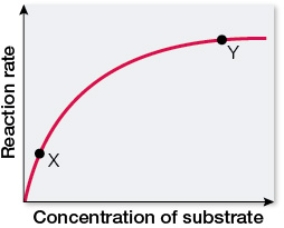 The graph was constructed from reaction-rate data collected using a constant amount of purified enzyme and increasing concentrations of substrate.Under conditions at point X, the graph indicates that the reaction rate changed dramatically when just a small increase in substrate concentration was made.Under conditions at point Y, the reaction rate changed very little with the same increase in substrate concentration.Explain why.
 (Essay)
4.8/5 (84)
(84) Some enzymes cause chemical bonds in their substrates to become stretched as the substrate binds to the active site.This change is called
(Multiple Choice)
4.9/5 (75)
(75) Refer to the figure below. 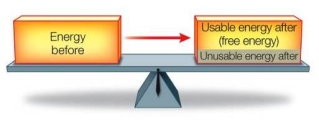 This figure illustrates the _______, which applies to all energy transformations in the universe, including all biological transformations.
 (Short Answer)
4.7/5 (87)
(87) The enzyme -amylase increases the rate at which starch is broken down into smaller oligosaccharides by _______ of the reaction.
(Multiple Choice)
4.8/5 (89)
(89) Which term describes the high-energy state that two substrates must form before the reaction can proceed?
(Multiple Choice)
4.8/5 (83)
(83) Refer to the figure below.  The figure shows the metabolic conversions between metabolite X and metabolite Y in a cell.Each direction of this conversion is catalyzed by a different enzyme.Explain how this arrangement enables shifts in the flux of molecules in different metabolic directions, depending on the needs of the cell.
 (Essay)
5.0/5 (84)
(84) In the presence of alcohol dehydrogenase, the rate of reduction of acetaldehyde to ethanol increases as the concentration of acetaldehyde increases.Eventually, the rate of the reaction reaches a maximum, at which point further increases in the concentration of acetaldehyde have no effect.Why?
(Multiple Choice)
4.9/5 (72)
(72) Which type of inhibitor can be overcome completely by the addition of more substrate?
(Multiple Choice)
4.9/5 (93)
(93) The graph of enzyme activity versus substrate concentration for an enzyme has a sigmoidal (S-shaped) appearance.Such an activity curve indicates which type of enzyme?
(Multiple Choice)
4.9/5 (78)
(78) An enzyme is found to be inhibited by a molecule that has a very different shape and size than either of the enzyme's two substrates.Moreover, the inhibitory molecule can bind to the enzyme in the absence of the substrates, and when it does bind, the molecule causes the enzyme to dissociate from a four-part quaternary structure to a two-part structure.What type of inhibitor is the molecule?
(Multiple Choice)
4.9/5 (93)
(93) To be metabolized, glucose must be converted to glucose 6-phosphate.However, the phosphorylation of glucose to form glucose 6-phosphate is endergonic with a positive G.How do cells circumvent this problem?
(Multiple Choice)
4.8/5 (80)
(80) Refer to the figure below. 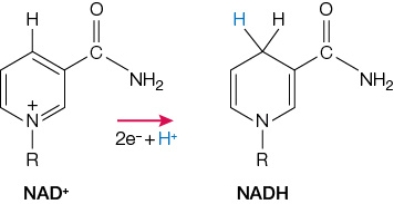 NAD+ functions as a coenzyme in many enzyme-catalyzed reactions.The changes that take place in this coenzyme are the same for all of these reactions and are illustrated in the figure.It is likely that, in these reactions, NAD+
 (Multiple Choice)
4.8/5 (87)
(87) You observe an enzymatic reaction that exhibits a standard relationship between reaction rate and substrate concentration as it converts substrate B to product C.When you add compound A, the creation of product C comes to a complete stop.You add large quantities of substrate B but still are unable to create product C in the presence of compound A.Compound A is therefore most likely a
(Multiple Choice)
4.9/5 (75)
(75) The enzyme glucose oxidase binds the six-carbon sugar glucose and catalyzes its conversion to glucono-1,5-lactone.Mannose is also a six-carbon sugar, but glucose oxidase cannot bind mannose.The specificity of glucose oxidase is based on the
(Multiple Choice)
4.8/5 (87)
(87) In thermodynamic terms, water held back by a dam represents _______ energy.
(Multiple Choice)
4.9/5 (87)
(87) The five reactions listed are catalyzed by enzymes in a cell.Which reaction is catalyzed by an oxidoreductase?
(Multiple Choice)
4.8/5 (86)
(86) 
Filters
- Essay(0)
- Multiple Choice(0)
- Short Answer(0)
- True False(0)
- Matching(0)