



 Chat with AI
Exam 8: Energy, Enzymes, and Metabolism

Exam 1: Studying Life246 Questions
Exam 2: Small Molecules and the Chemistry of Life246 Questions
Exam 3: Proteins, Carbohydrates, and Lipids246 Questions
Exam 4: Nucleic Acids and the Origin of Life246 Questions
Exam 5: Cells: the Working Units of Life248 Questions
Exam 6: Cell Membranes246 Questions
Exam 7: Cell Communication and Multicellularity246 Questions
Exam 8: Energy, Enzymes, and Metabolism246 Questions
Exam 9: Pathways That Harvest Chemical Energy246 Questions
Exam 10: Photosynthesis: Energy From Sunlight242 Questions
Exam 11: The Cell Cycle and Cell Division260 Questions
Exam 12: Inheritance, Genes, and Chromosomes250 Questions
Exam 13: Dna and Its Role in Heredity257 Questions
Exam 14: From Dna to Protein: Gene Expression252 Questions
Exam 15: Gene Mutation and Molecular Medicine251 Questions
Exam 16: Regulation of Gene Expression245 Questions
Exam 17: Genomes249 Questions
Exam 18: Recombinant Dna and Biotechnology243 Questions
Exam 20: Mechanisms of Evolution243 Questions
Exam 21: Reconstructing and Using Phylogenies246 Questions
Exam 22: Speciation247 Questions
Exam 23: Evolution of Genes and Genomes252 Questions
Exam 24: The History of Life on Earth246 Questions
Exam 25: Bacteria, Archaea, and Viruses262 Questions
Exam 26: The Origin and Diversification of Eukaryotes252 Questions
Exam 27: Plants Without Seeds: From Water to Land251 Questions
Exam 28: The Evolution of Seed Plants259 Questions
Exam 29: The Evolution and Diversity of Fungi261 Questions
Exam 30: Animal Origins and the Evolution of Body Plans248 Questions
Exam 31: Protostome Animals244 Questions
Exam 32: Deuterostome Animals246 Questions
Exam 33: The Plant Body243 Questions
Exam 34: Transport in Plants248 Questions
Exam 35: Plant Nutrition247 Questions
Exam 36: Regulation of Plant Growth246 Questions
Exam 37: Reproduction in Flowering Plants247 Questions
Exam 38: Plant Responses to Environmental Challenges246 Questions
Exam 39: Physiology, Homeostasis, and Temperature Regulation258 Questions
Exam 40: Animal Hormones249 Questions
Exam 41: Immunology: Animal Defense Systems265 Questions
Exam 42: Animal Reproduction261 Questions
Exam 43: Animal Development261 Questions
Exam 44: Neurons, Glia, and Nervous Systems250 Questions
Exam 45: Sensory Systems249 Questions
Exam 46: The Mammalian Nervous System: Structure and Higher Functions254 Questions
Exam 47: Musculoskeletal Systems259 Questions
Exam 48: Gas Exchange247 Questions
Exam 49: Circulatory Systems252 Questions
Exam 50: Nutrition, Digestion, and Absorption259 Questions
Exam 51: Salt and Water Balance and Nitrogen Excretion251 Questions
Exam 52: Animal Behavior249 Questions
Exam 53: The Physical Environment and Biogeography of Life248 Questions
Exam 54: Populations259 Questions
Exam 55: Species Interactions254 Questions
Exam 56: Communities247 Questions
Exam 57: Ecosystems238 Questions
Exam 58: A Changing Biosphere222 Questions
Select questions type


Which is an example of an enzyme using substrate orientation as a mechanism for lowering the activation energy of a reaction?
(Multiple Choice)
4.8/5  (88)
(88) Which series best summarizes the relative energies of the different stages of an endergonic chemical reaction?
(Multiple Choice)
4.9/5 (75)
(75) What is the order in which the following molecules would be produced if phosphate ions were removed from ATP one at a time?
(Multiple Choice)
4.8/5 (77)
(77) Which of the following could we infer about a chemical reaction with a large positive change in entropy (S) as the reaction proceeds and no corresponding change in enthalpy (H)?
(Multiple Choice)
4.9/5 (79)
(79) Refer to the figure below. 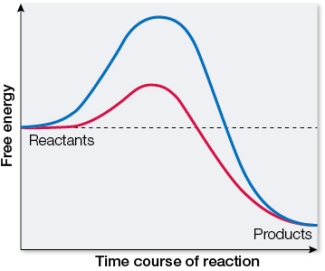 This graph shows the change in free energy for the same reaction with and without a catalyst.Which tracing represents the catalyzed reaction and why?
 (Multiple Choice)
4.8/5 (85)
(85) In which sequence does the form of energy change as a person sees a friend and waves hello?
(Multiple Choice)
4.8/5 (77)
(77) Refer to the table below. 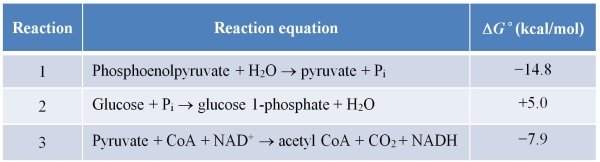 The hydrolysis of one mole of ATP to ADP and inorganic phosphate is accompanied by the release of 7.3 kcal of energy.Some biological transformations are coupled to ATP hydrolysis.Reaction _______ is an example of a biological transformation that could be coupled to ATP hydrolysis.
 (Short Answer)
4.9/5 (84)
(84) How do competitive and noncompetitive enzyme inhibitors differ from each other?
(Multiple Choice)
4.7/5 (83)
(83) The addition of the competitive inhibitor mevinolin slows the reaction HMG-CoA mevalonate, which is catalyzed by the enzyme HMG-CoA reductase.In order to overcome the effects of mevinolin and increase the rate of the reaction, you would
(Multiple Choice)
4.9/5 (76)
(76) The phosphorylation of glucose to glucose 6-phosphate has a G of +4.0 kcal/mol.If hexokinase is added to speed up the rate of this reaction, the G will
(Multiple Choice)
4.9/5 (80)
(80) Refer to the graph below. 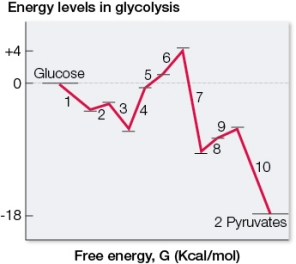 Ten sequential reactions take place in cells during glycolysis.The graph shows the relative free energies of each chemical intermediate relative to glucose, the starting reactant in glycolysis.Based on the information shown in the graph, reactions numbered _______ are all possibilities for reactions that might be coupled to the reaction in which ATP is hydrolyzed.
 (Short Answer)
4.9/5 (85)
(85) You make a solution of glucose 1-phosphate and allow it to isomerize to form glucose 6-phosphate.Eventually, you have an equilibrium mixture of the two isomers.What can you do to increase the concentration of glucose 6-phosphate in the solution?
(Multiple Choice)
4.8/5 (83)
(83) Refer to the figure below, which shows the reaction between fumarate and water to produce malate. 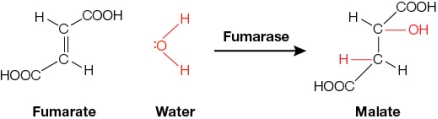 Fumarase is the enzyme that catalyzes this reaction in cells.Which statement can be used as evidence that orientation of reactant molecules is part of the function of fumarase as a catalyst?
 (Multiple Choice)
5.0/5 (78)
(78) Some kinases can affect the activity of an enzyme by the addition of phosphate groups, which can then be removed, much like an "on/off" switch.These modifications are an example of
(Multiple Choice)
5.0/5 (77)
(77) Suppose that, in a closed system, there is an input of energy as 1 kJ of light.The light energy is converted to glucose, then ATP, and finally to mechanical energy.Which statement about the amount of mechanical energy available is true?
(Multiple Choice)
4.9/5 (70)
(70) When an enzyme is heated until its three-dimensional structure is destroyed, the enzyme is said to be _______.
(Short Answer)
4.8/5 (88)
(88) Where is the chemical energy that is used to drive endergonic reactions contained in a molecule of ATP?
(Multiple Choice)
4.8/5 (96)
(96) The synthesis of the enzyme lipase would be classified as anabolic because
(Multiple Choice)
4.9/5 (69)
(69) Refer to the table below. 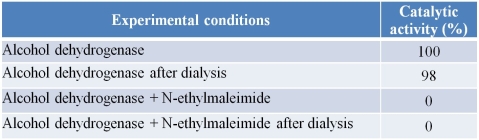 The enzyme alcohol dehydrogenase was purified from yeast cells.It was then dialyzed against a buffer solution, which means that it was placed inside a bag consisting of a semipermeable membrane that allowed small molecules and ions to pass through, but not the enzyme.The enzyme was removed from the dialysis bag, incubated with the compound N-ethylmaleimide, and then dialyzed a second time.At each step, the enzyme's catalytic activity was measured and expressed as a percentage of its original activity shown in the table.Which statement expresses a valid conclusion that can be made based on these results?
 (Multiple Choice)
4.9/5 (65)
(65) 
Filters
- Essay(0)
- Multiple Choice(0)
- Short Answer(0)
- True False(0)
- Matching(0)