



 Chat with AI
Exam 8: Energy, Enzymes, and Metabolism

Exam 1: Studying Life246 Questions
Exam 2: Small Molecules and the Chemistry of Life246 Questions
Exam 3: Proteins, Carbohydrates, and Lipids246 Questions
Exam 4: Nucleic Acids and the Origin of Life246 Questions
Exam 5: Cells: the Working Units of Life248 Questions
Exam 6: Cell Membranes246 Questions
Exam 7: Cell Communication and Multicellularity246 Questions
Exam 8: Energy, Enzymes, and Metabolism246 Questions
Exam 9: Pathways That Harvest Chemical Energy246 Questions
Exam 10: Photosynthesis: Energy From Sunlight242 Questions
Exam 11: The Cell Cycle and Cell Division260 Questions
Exam 12: Inheritance, Genes, and Chromosomes250 Questions
Exam 13: Dna and Its Role in Heredity257 Questions
Exam 14: From Dna to Protein: Gene Expression252 Questions
Exam 15: Gene Mutation and Molecular Medicine251 Questions
Exam 16: Regulation of Gene Expression245 Questions
Exam 17: Genomes249 Questions
Exam 18: Recombinant Dna and Biotechnology243 Questions
Exam 20: Mechanisms of Evolution243 Questions
Exam 21: Reconstructing and Using Phylogenies246 Questions
Exam 22: Speciation247 Questions
Exam 23: Evolution of Genes and Genomes252 Questions
Exam 24: The History of Life on Earth246 Questions
Exam 25: Bacteria, Archaea, and Viruses262 Questions
Exam 26: The Origin and Diversification of Eukaryotes252 Questions
Exam 27: Plants Without Seeds: From Water to Land251 Questions
Exam 28: The Evolution of Seed Plants259 Questions
Exam 29: The Evolution and Diversity of Fungi261 Questions
Exam 30: Animal Origins and the Evolution of Body Plans248 Questions
Exam 31: Protostome Animals244 Questions
Exam 32: Deuterostome Animals246 Questions
Exam 33: The Plant Body243 Questions
Exam 34: Transport in Plants248 Questions
Exam 35: Plant Nutrition247 Questions
Exam 36: Regulation of Plant Growth246 Questions
Exam 37: Reproduction in Flowering Plants247 Questions
Exam 38: Plant Responses to Environmental Challenges246 Questions
Exam 39: Physiology, Homeostasis, and Temperature Regulation258 Questions
Exam 40: Animal Hormones249 Questions
Exam 41: Immunology: Animal Defense Systems265 Questions
Exam 42: Animal Reproduction261 Questions
Exam 43: Animal Development261 Questions
Exam 44: Neurons, Glia, and Nervous Systems250 Questions
Exam 45: Sensory Systems249 Questions
Exam 46: The Mammalian Nervous System: Structure and Higher Functions254 Questions
Exam 47: Musculoskeletal Systems259 Questions
Exam 48: Gas Exchange247 Questions
Exam 49: Circulatory Systems252 Questions
Exam 50: Nutrition, Digestion, and Absorption259 Questions
Exam 51: Salt and Water Balance and Nitrogen Excretion251 Questions
Exam 52: Animal Behavior249 Questions
Exam 53: The Physical Environment and Biogeography of Life248 Questions
Exam 54: Populations259 Questions
Exam 55: Species Interactions254 Questions
Exam 56: Communities247 Questions
Exam 57: Ecosystems238 Questions
Exam 58: A Changing Biosphere222 Questions
Select questions type


Computer-based models aimed at simulating the different biochemical pathways in a cell are frequently used in
(Multiple Choice)
4.7/5  (72)
(72) Refer to the figure below. 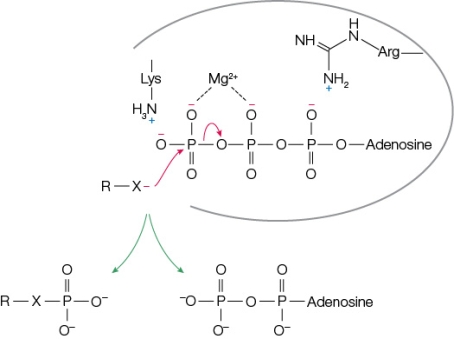 Hexokinase catalyzes the reaction between glucose and ATP to form glucose 6-phosphate and ADP.The figure shows how the active site of hexokinase orients ATP for attack by glucose during the reaction.In the absence of enzyme, this reaction would be much slower because there would be a _______ number of orientations of the two substrates compared with the number of orientations provided by the enzyme.
 (Short Answer)
4.9/5 (79)
(79) Refer to the figure and table below. 
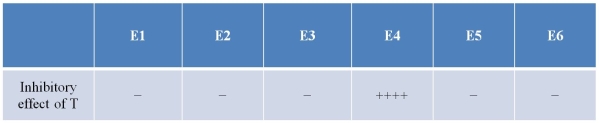 The figure shows a metabolic pathway catalyzed by a series of enzymes labeled with numbers.The metabolite T was tested for inhibitory effects on each enzyme in the pathway, and the results are summarized in the table.The extent of inhibition is indicated by the number of plus signs.Lack of inhibition is indicated by a minus sign.Which statement gives a valid conclusion from these results?
 (Multiple Choice)
4.9/5 (80)
(80) Refer to the figure below.  This cellular reaction is catalyzed by the enzyme triosephosphate isomerase.At equilibrium, the ratio of dihydroxyacetone phosphate to glyceraldehyde phosphate is 24:1.What changes in conditions in the cell will cause changes in the direction of flux through this reaction? Give two changes, one that will cause a change in flux in the forward direction, and a second that will cause change in the reverse direction.
 (Essay)
5.0/5 (71)
(71) Refer to the expression below.  The enzyme alcohol dehydrogenase catalyzes this reaction in cells.The enzyme uses the coenzyme NAD+ in the reaction.Not shown are details about the active site, which contains a zinc ion that functions as a cofactor.How do the roles of cofactor and coenzyme compare in this particular case?
 (Multiple Choice)
4.9/5 (68)
(68) The process that involves an end product acting as an inhibitor of an earlier step in a metabolic pathway is called
(Multiple Choice)
4.9/5 (89)
(89) In cells, multiple biochemical pathways are all interconnected and often run simultaneously.Which components determine the direction of flow through these diverse pathways?
(Multiple Choice)
4.7/5 (78)
(78) Refer to the figure below.  The enzyme catalyzing this reaction would be classified in the group of enzymes known as _______.
 (Short Answer)
4.7/5 (76)
(76) An effector molecule that binds to a site on an enzyme other than the active site and causes a conformational change in the enzyme is termed a(n) _______ regulator.
(Multiple Choice)
4.9/5 (86)
(86) End products of biosynthetic pathways often act to block the initial step in that pathway.This phenomenon is called
(Multiple Choice)
4.8/5 (73)
(73) The activity of an enzyme was examined in the laboratory as it catalyzed the formation of a product molecule, B, from a substrate, A.This reaction was carried out in an aqueous solution consisting of water and copper sulfate at a pH of 7.While attempting to repeat the experiment, a biochemist uses a solution of pure distilled water (pH = 7) and observes that the rate of formation of B has decreased dramatically.Which is a possible explanation for this result?
(Multiple Choice)
4.9/5 (86)
(86) Which type of reaction is used to break down ATP into ADP and Pi?
(Multiple Choice)
4.8/5 (76)
(76) Knowing the change in free energy (G) of a reaction tells us
(Multiple Choice)
4.9/5 (76)
(76) Which statement about the exergonic hydrolysis of maltose to glucose is true?
(Multiple Choice)
4.8/5 (80)
(80) ATP can phosphorylate many different molecules.This means that ATP can
(Multiple Choice)
4.9/5 (93)
(93) Phosphofructokinase catalyzes the first reaction in a pathway that commits the product to proceed through glycolysis, often called the first commitment step in glycolysis.Phosphofructokinase is also regulated so that the cell can quickly respond to its energy needs.Given this background information about phosphofructokinase, what is the most likely mode of inactivation of this enzyme when the cell needs to slow down or turn off glycolysis?
(Multiple Choice)
4.7/5 (81)
(81) 
Filters
- Essay(0)
- Multiple Choice(0)
- Short Answer(0)
- True False(0)
- Matching(0)