



 Chat with AI
Exam 8: Energy, Enzymes, and Metabolism

Exam 1: Studying Life246 Questions
Exam 2: Small Molecules and the Chemistry of Life246 Questions
Exam 3: Proteins, Carbohydrates, and Lipids246 Questions
Exam 4: Nucleic Acids and the Origin of Life246 Questions
Exam 5: Cells: the Working Units of Life248 Questions
Exam 6: Cell Membranes246 Questions
Exam 7: Cell Communication and Multicellularity246 Questions
Exam 8: Energy, Enzymes, and Metabolism246 Questions
Exam 9: Pathways That Harvest Chemical Energy246 Questions
Exam 10: Photosynthesis: Energy From Sunlight242 Questions
Exam 11: The Cell Cycle and Cell Division260 Questions
Exam 12: Inheritance, Genes, and Chromosomes250 Questions
Exam 13: Dna and Its Role in Heredity257 Questions
Exam 14: From Dna to Protein: Gene Expression252 Questions
Exam 15: Gene Mutation and Molecular Medicine251 Questions
Exam 16: Regulation of Gene Expression245 Questions
Exam 17: Genomes249 Questions
Exam 18: Recombinant Dna and Biotechnology243 Questions
Exam 20: Mechanisms of Evolution243 Questions
Exam 21: Reconstructing and Using Phylogenies246 Questions
Exam 22: Speciation247 Questions
Exam 23: Evolution of Genes and Genomes252 Questions
Exam 24: The History of Life on Earth246 Questions
Exam 25: Bacteria, Archaea, and Viruses262 Questions
Exam 26: The Origin and Diversification of Eukaryotes252 Questions
Exam 27: Plants Without Seeds: From Water to Land251 Questions
Exam 28: The Evolution of Seed Plants259 Questions
Exam 29: The Evolution and Diversity of Fungi261 Questions
Exam 30: Animal Origins and the Evolution of Body Plans248 Questions
Exam 31: Protostome Animals244 Questions
Exam 32: Deuterostome Animals246 Questions
Exam 33: The Plant Body243 Questions
Exam 34: Transport in Plants248 Questions
Exam 35: Plant Nutrition247 Questions
Exam 36: Regulation of Plant Growth246 Questions
Exam 37: Reproduction in Flowering Plants247 Questions
Exam 38: Plant Responses to Environmental Challenges246 Questions
Exam 39: Physiology, Homeostasis, and Temperature Regulation258 Questions
Exam 40: Animal Hormones249 Questions
Exam 41: Immunology: Animal Defense Systems265 Questions
Exam 42: Animal Reproduction261 Questions
Exam 43: Animal Development261 Questions
Exam 44: Neurons, Glia, and Nervous Systems250 Questions
Exam 45: Sensory Systems249 Questions
Exam 46: The Mammalian Nervous System: Structure and Higher Functions254 Questions
Exam 47: Musculoskeletal Systems259 Questions
Exam 48: Gas Exchange247 Questions
Exam 49: Circulatory Systems252 Questions
Exam 50: Nutrition, Digestion, and Absorption259 Questions
Exam 51: Salt and Water Balance and Nitrogen Excretion251 Questions
Exam 52: Animal Behavior249 Questions
Exam 53: The Physical Environment and Biogeography of Life248 Questions
Exam 54: Populations259 Questions
Exam 55: Species Interactions254 Questions
Exam 56: Communities247 Questions
Exam 57: Ecosystems238 Questions
Exam 58: A Changing Biosphere222 Questions
Select questions type


What features of an enzyme's active site allow it to recognize and bind a substrate?
(Multiple Choice)
4.8/5  (91)
(91) It is estimated that approximately 90 percent of energy that passes between levels in a food web is lost at each level.Explain the first law of thermodynamics, and discuss why this apparent loss of energy does not contradict that law.
(Essay)
4.8/5 (85)
(85) Refer to the figure below. 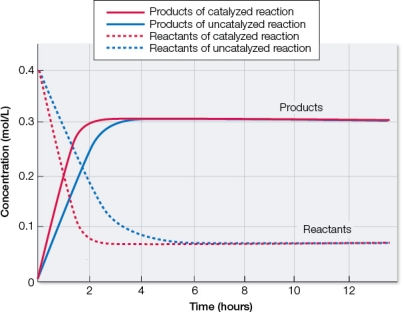 Based on the graph, which statement best describes these chemical reactions?
 (Multiple Choice)
4.8/5 (86)
(86) Refer to the figures below. 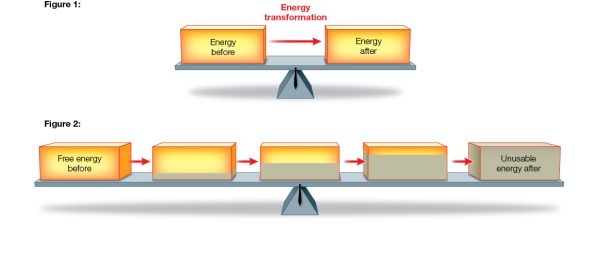 These figures can be used to illustrate the first and second laws of thermodynamics.Assign each figure to one of these laws, then explain the difference between the figures.
 (Essay)
4.8/5 (83)
(83) An inhibitor that binds reversibly to the active site is termed a(n) _______ inhibitor, whereas an inhibitor that binds reversibly to the enzyme-substrate complex is termed a(n) _______ inhibitor.
(Multiple Choice)
4.8/5 (77)
(77) Which are biological examples of potential energy (PE) and kinetic energy (KE)?
(Multiple Choice)
4.9/5 (69)
(69) Refer to the figure below. 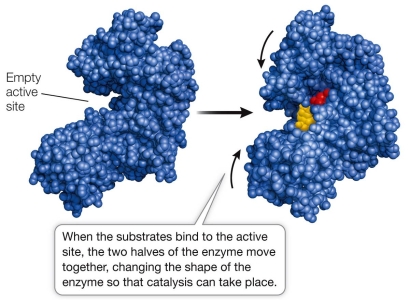 Which type of mechanism used by an enzyme to catalyze a reaction is illustrated in the figure?
 (Multiple Choice)
4.8/5 (79)
(79) Refer to the expression and table below. 
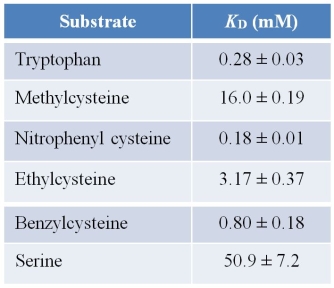 The enzyme tryptophanase catalyzes the reaction shown.However, research has revealed that compounds other than tryptophan can act as substrates for this enzyme.Some of these compounds are listed in the table along with their dissociation constants.What does the information in the table indicate about the affinity of the enzyme for compounds other than its natural substrate, tryptophan?
 (Essay)
4.8/5 (66)
(66) Glycogen is a large molecule consisting of hundreds of molecules of glucose bonded together, and thus plays an energy storage role in animal cells.The chemical reaction that adds glucose units onto a glycogen molecule is an example of a(n) _______ reaction in the cell's metabolism.
(Short Answer)
4.8/5 (77)
(77) When energy is converted from one form to another, only some of the energy is usable.The unusable energy is released to a form associated with disorder.A measure of this disorder is referred to as
(Multiple Choice)
4.8/5 (83)
(83) Refer to the figure below. 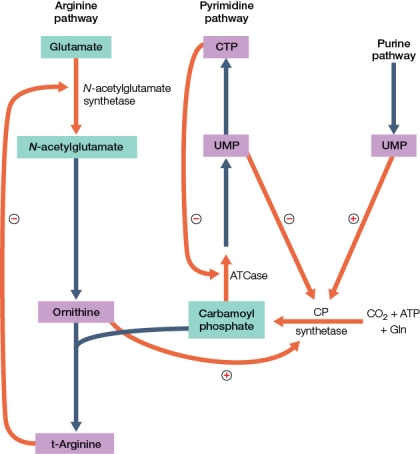 Portions of three biosynthetic pathways regulated through feedback inhibition and activation are shown.Two of these pathways intersect at carbamoyl phosphate.The third pathway generates a product that activates production of carbamoyl phosphate through allosteric modification of the enzyme carbamoyl phosphate synthetase.In this set of pathways, arginine biosynthesis is shut down through feedback inhibition when _______ and arginine reach high levels of concentration.
 (Short Answer)
4.8/5 (88)
(88) Refer to the figure below. 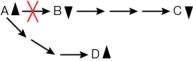 The figure illustrates how _______ of a key enzyme in a metabolic pathway can shift the flow of molecules into a different pathway.
 (Short Answer)
4.9/5 (78)
(78) The first law of thermodynamics states that the total energy in the universe is
(Multiple Choice)
4.7/5 (68)
(68) Consider two enzyme reaction solutions.Solution 1 has a ratio of enzyme to substrate of 1:100.Solution 2 has a ratio of enzyme to substrate of 100:1.Both solutions contain the same quantity of enzyme.Which reaction gives the greater reaction rate, and why?
(Multiple Choice)
4.9/5 (76)
(76) Refer to the table below. 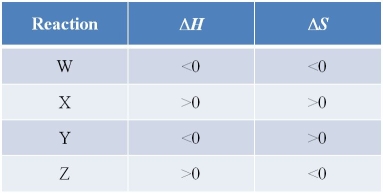 Of the four reactions listed in the table, the one that is spontaneous under all temperature conditions is reaction _______.
 (Short Answer)
4.9/5 (79)
(79) Refer to the figure below. 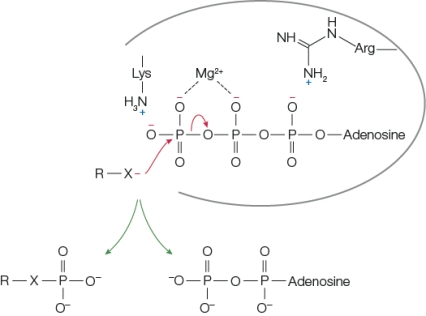 The figure shows activities at the active site of the enzyme hexokinase as it catalyzes a reaction between ATP and glucose.Based on this figure, it can be inferred that the magnesium ion functions to _______ the ATP molecule so it can be attacked by glucose.
 (Short Answer)
4.9/5 (81)
(81) 
Filters
- Essay(0)
- Multiple Choice(0)
- Short Answer(0)
- True False(0)
- Matching(0)