



 Chat with AI
Exam 8: Energy, Enzymes, and Metabolism

Exam 1: Studying Life246 Questions
Exam 2: Small Molecules and the Chemistry of Life246 Questions
Exam 3: Proteins, Carbohydrates, and Lipids246 Questions
Exam 4: Nucleic Acids and the Origin of Life246 Questions
Exam 5: Cells: the Working Units of Life248 Questions
Exam 6: Cell Membranes246 Questions
Exam 7: Cell Communication and Multicellularity246 Questions
Exam 8: Energy, Enzymes, and Metabolism246 Questions
Exam 9: Pathways That Harvest Chemical Energy246 Questions
Exam 10: Photosynthesis: Energy From Sunlight242 Questions
Exam 11: The Cell Cycle and Cell Division260 Questions
Exam 12: Inheritance, Genes, and Chromosomes250 Questions
Exam 13: Dna and Its Role in Heredity257 Questions
Exam 14: From Dna to Protein: Gene Expression252 Questions
Exam 15: Gene Mutation and Molecular Medicine251 Questions
Exam 16: Regulation of Gene Expression245 Questions
Exam 17: Genomes249 Questions
Exam 18: Recombinant Dna and Biotechnology243 Questions
Exam 20: Mechanisms of Evolution243 Questions
Exam 21: Reconstructing and Using Phylogenies246 Questions
Exam 22: Speciation247 Questions
Exam 23: Evolution of Genes and Genomes252 Questions
Exam 24: The History of Life on Earth246 Questions
Exam 25: Bacteria, Archaea, and Viruses262 Questions
Exam 26: The Origin and Diversification of Eukaryotes252 Questions
Exam 27: Plants Without Seeds: From Water to Land251 Questions
Exam 28: The Evolution of Seed Plants259 Questions
Exam 29: The Evolution and Diversity of Fungi261 Questions
Exam 30: Animal Origins and the Evolution of Body Plans248 Questions
Exam 31: Protostome Animals244 Questions
Exam 32: Deuterostome Animals246 Questions
Exam 33: The Plant Body243 Questions
Exam 34: Transport in Plants248 Questions
Exam 35: Plant Nutrition247 Questions
Exam 36: Regulation of Plant Growth246 Questions
Exam 37: Reproduction in Flowering Plants247 Questions
Exam 38: Plant Responses to Environmental Challenges246 Questions
Exam 39: Physiology, Homeostasis, and Temperature Regulation258 Questions
Exam 40: Animal Hormones249 Questions
Exam 41: Immunology: Animal Defense Systems265 Questions
Exam 42: Animal Reproduction261 Questions
Exam 43: Animal Development261 Questions
Exam 44: Neurons, Glia, and Nervous Systems250 Questions
Exam 45: Sensory Systems249 Questions
Exam 46: The Mammalian Nervous System: Structure and Higher Functions254 Questions
Exam 47: Musculoskeletal Systems259 Questions
Exam 48: Gas Exchange247 Questions
Exam 49: Circulatory Systems252 Questions
Exam 50: Nutrition, Digestion, and Absorption259 Questions
Exam 51: Salt and Water Balance and Nitrogen Excretion251 Questions
Exam 52: Animal Behavior249 Questions
Exam 53: The Physical Environment and Biogeography of Life248 Questions
Exam 54: Populations259 Questions
Exam 55: Species Interactions254 Questions
Exam 56: Communities247 Questions
Exam 57: Ecosystems238 Questions
Exam 58: A Changing Biosphere222 Questions
Select questions type


Which series best summarizes the relative energies of the different stages of an exergonic chemical reaction?
(Multiple Choice)
5.0/5  (86)
(86) Refer to the graph below. 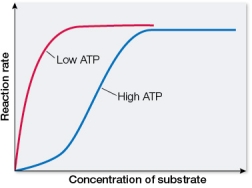 The graph shows data collected using a purified sample of the enzyme phosphofructokinase (PFK).This enzyme catalyzes the reaction between fructose 6-phosphate and ATP to form fructose 1,6-bisphosphate.Which statement is consistent with the data shown in the graph?
 (Multiple Choice)
4.7/5 (76)
(76) Refer to the figure below. 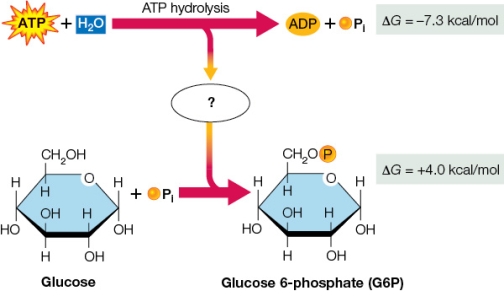 Which word best fits into this figure where the question mark is located?
 (Multiple Choice)
4.9/5 (76)
(76) Which effector of enzyme activity is least likely to be utilized by cells?
(Multiple Choice)
4.8/5 (85)
(85) When ATP is hydrolyzed, the reaction produces all of the following except
(Multiple Choice)
5.0/5 (92)
(92) The greater the affinity of an enzyme for its substrate, the _______ the substrate dissociation constant (KD).
(Short Answer)
4.7/5 (86)
(86) The standard free energy change for the hydrolysis of GTP (guanosine triphosphate) to GDP + Pi is -7.3 kcal/mol, similar to that for ATP.From this information, one can conclude that the
(Multiple Choice)
4.8/5 (79)
(79) The inhibition of enzyme activity by noncompetitive inhibitors can be reduced
(Multiple Choice)
4.8/5 (77)
(77) In a chemical reaction, transition-state intermediates have free energies that are
(Multiple Choice)
4.8/5 (75)
(75) A noncompetitive inhibitor hinders binding of a substrate to an enzyme by
(Multiple Choice)
5.0/5 (71)
(71) Refer to the figure below.  The figure shows a branched metabolic pathway involving metabolites indicated with letters.The enzymes catalyzing the steps in this pathway are indicated with numbers.What type of data would be expected, based on the pathway shown?
 (Multiple Choice)
4.9/5 (78)
(78) In glycolysis, the exergonic reaction 1,3-diphosphoglycerate 3-phosphoglycerate is coupled to the reaction ADP + Pi ATP.Based on this information, which statement is most likely to be true about the reaction ADP + Pi ATP?
(Multiple Choice)
4.8/5 (82)
(82) The hydrolysis of sucrose to glucose and fructose is exergonic.However, if sucrose is dissolved in water and the solution is kept overnight at room temperature, there is no detectable conversion to glucose and fructose.Why?
(Multiple Choice)
4.9/5 (80)
(80) The enzyme lysozyme causes strain in its substrate as part of its catalytic mechanism.The enzyme UDP-glucose dehydrogenase forms a covalent intermediate with its substrate as part of its catalytic mechanism.This intermediate breaks down to form products, regenerating the enzyme in its original form.Lysozyme differs from UDP-glucose dehydrogenase in that it does not itself undergo _______ change as part of its catalytic mechanism.
(Short Answer)
4.8/5 (63)
(63) A plant makes sugars via photosynthesis and is consumed by an herbivore.The herbivore in turn breaks down the sugars, producing energy it then uses to build a nest.Which sequence represents the energy transformation of this pathway?
(Multiple Choice)
4.9/5 (82)
(82) A theoretical enzyme, anyase, catalyzes the same reaction using five different substrates.The dissociation constants for these substrates and the enzyme are listed below.Which substrate will produce the greatest concentration of anyase-substrate complex?
(Multiple Choice)
4.9/5 (75)
(75) If the temperature of an enzyme-catalyzed reaction is increased from 20°C to 70°C, the rate of the reaction
(Multiple Choice)
4.7/5 (95)
(95) 
Filters
- Essay(0)
- Multiple Choice(0)
- Short Answer(0)
- True False(0)
- Matching(0)