



 Chat with AI
Exam 23: Evolution of Genes and Genomes

Exam 1: Studying Life246 Questions
Exam 2: Small Molecules and the Chemistry of Life246 Questions
Exam 3: Proteins, Carbohydrates, and Lipids246 Questions
Exam 4: Nucleic Acids and the Origin of Life246 Questions
Exam 5: Cells: the Working Units of Life248 Questions
Exam 6: Cell Membranes246 Questions
Exam 7: Cell Communication and Multicellularity246 Questions
Exam 8: Energy, Enzymes, and Metabolism246 Questions
Exam 9: Pathways That Harvest Chemical Energy246 Questions
Exam 10: Photosynthesis: Energy From Sunlight242 Questions
Exam 11: The Cell Cycle and Cell Division260 Questions
Exam 12: Inheritance, Genes, and Chromosomes250 Questions
Exam 13: Dna and Its Role in Heredity257 Questions
Exam 14: From Dna to Protein: Gene Expression252 Questions
Exam 15: Gene Mutation and Molecular Medicine251 Questions
Exam 16: Regulation of Gene Expression245 Questions
Exam 17: Genomes249 Questions
Exam 18: Recombinant Dna and Biotechnology243 Questions
Exam 20: Mechanisms of Evolution243 Questions
Exam 21: Reconstructing and Using Phylogenies246 Questions
Exam 22: Speciation247 Questions
Exam 23: Evolution of Genes and Genomes252 Questions
Exam 24: The History of Life on Earth246 Questions
Exam 25: Bacteria, Archaea, and Viruses262 Questions
Exam 26: The Origin and Diversification of Eukaryotes252 Questions
Exam 27: Plants Without Seeds: From Water to Land251 Questions
Exam 28: The Evolution of Seed Plants259 Questions
Exam 29: The Evolution and Diversity of Fungi261 Questions
Exam 30: Animal Origins and the Evolution of Body Plans248 Questions
Exam 31: Protostome Animals244 Questions
Exam 32: Deuterostome Animals246 Questions
Exam 33: The Plant Body243 Questions
Exam 34: Transport in Plants248 Questions
Exam 35: Plant Nutrition247 Questions
Exam 36: Regulation of Plant Growth246 Questions
Exam 37: Reproduction in Flowering Plants247 Questions
Exam 38: Plant Responses to Environmental Challenges246 Questions
Exam 39: Physiology, Homeostasis, and Temperature Regulation258 Questions
Exam 40: Animal Hormones249 Questions
Exam 41: Immunology: Animal Defense Systems265 Questions
Exam 42: Animal Reproduction261 Questions
Exam 43: Animal Development261 Questions
Exam 44: Neurons, Glia, and Nervous Systems250 Questions
Exam 45: Sensory Systems249 Questions
Exam 46: The Mammalian Nervous System: Structure and Higher Functions254 Questions
Exam 47: Musculoskeletal Systems259 Questions
Exam 48: Gas Exchange247 Questions
Exam 49: Circulatory Systems252 Questions
Exam 50: Nutrition, Digestion, and Absorption259 Questions
Exam 51: Salt and Water Balance and Nitrogen Excretion251 Questions
Exam 52: Animal Behavior249 Questions
Exam 53: The Physical Environment and Biogeography of Life248 Questions
Exam 54: Populations259 Questions
Exam 55: Species Interactions254 Questions
Exam 56: Communities247 Questions
Exam 57: Ecosystems238 Questions
Exam 58: A Changing Biosphere222 Questions
Select questions type


The comparison of the amino acid sequences of cytochrome c (see Figure 23.3) from plants to human showed that

Free
(Multiple Choice)
5.0/5  (89)
(89) Correct Answer: Verified
A
As the amount of lateral gene transfer in a taxon decreases, it becomes _______ difficult to infer relationships among lineages within the taxon and _______ to infer species boundaries.
Free
(Multiple Choice)
4.7/5 (74)
(74) Correct Answer:Verified
VerifiedE
A molecular evolutionist wants to study the dynamics of in vitro evolution for a particular gene.Which model system would be optimal for the experiment?
Free
(Multiple Choice)
4.8/5 (79)
(79) Correct Answer:Verified
VerifiedA
The occurrence of which event(s) usually does not lead to an undercounting of the real number of substitutions?
(Multiple Choice)
4.9/5 (79)
(79) According to the neutral theory of molecular evolution, the fastest rate of fixation of neutral mutations by genetic drift should occur in a population of _______ individuals.
(Multiple Choice)
4.8/5 (92)
(92) Assume there is an influenza zoonotic (the equivalent of a pandemic, in nonhuman animals) occurring among pigs.Researchers use evolutionary analysis of recent swine, horse, bird, and human influenza outbreaks and determine that a _______ has occurred from humans to pigs.
(Short Answer)
4.8/5 (79)
(79) A biologist is examining species of plants found in Thailand in the hope of finding a naturally occurring treatment for cancer.This project is an example of
(Multiple Choice)
4.8/5 (77)
(77) A researcher is interested in determining what nucleotide substitutions in TTX-resistant puffer fish sodium channels are critical for resistance.To facilitate her research, she uses PCR-based in vitro evolution to generate altered versions of the puffer fish sodium channels.To increase the possibility of generating genes that are not resistant to TTX, the researcher should
(Multiple Choice)
4.8/5 (69)
(69) To create new antibiotics, biologists are taking advantage of the principles of evolution by using polymerase chain reaction (PCR) technology to copy DNA.This is an example of _______ evolution.
(Short Answer)
4.8/5 (62)
(62) Researchers suspect that the gene FOXP2, which is involved in speech and cognition, has been under positive selection in the human lineage.Which of the following would provide the strongest support for such a claim?
(Multiple Choice)
4.8/5 (85)
(85) A researcher is studying a metabolic disorder.To identify the gene or genes linked with the disorder's phenotype, he compares the chromosomal DNA of normal volunteers and clinical patients.Despite a great deal of work, he is unable to identify a gene.Another research group, however, reports a gene.Which of the following may account for the researcher's experimental failure?
(Multiple Choice)
4.8/5 (83)
(83) Refer to the figure, which shows a phylogenetic tree of the engrailed gene family. 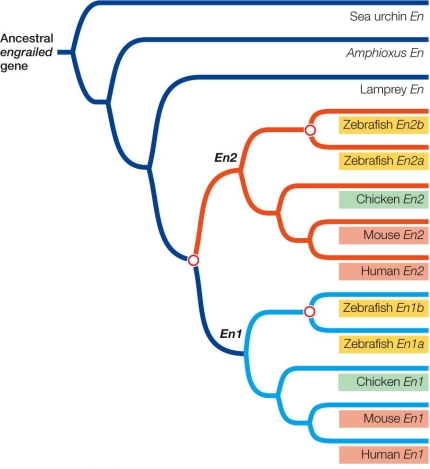 Which gene is the most closely related ortholog of human En1?
 (Multiple Choice)
4.9/5 (78)
(78) Genes from many isolates of the influenza virus have been sequenced.In certain regions of the genome, nonsynonymous substitutions are much more frequent than synonymous substitutions.Which statement is the most likely explanation for this pattern?
(Multiple Choice)
4.8/5 (88)
(88) Over evolutionary history, many groups of organisms that inhabit caves have lost the organs of sight.For instance, although surface-dwelling crayfishes have functional eyes, several crayfish species that are restricted to underground habitats lack eyes.Opsins are a group of light-sensitive proteins known to have an important function in vision (see Chapter 45), and opsin genes are expressed in eye tissues.Opsin genes are present in the genomes of eyeless, cave-dwelling crayfishes.Two alternative hypotheses that might explain the presence of opsin genes in an eyeless organism are: (1) the genes are no longer experiencing purifying selection because there is no longer selection for function in vision; and (2) the genes are experiencing selection for a function other than vision.How would you investigate these two hypotheses, using the sequences of the opsin genes in various species of crayfishes?
(Essay)
4.7/5 (95)
(95) Refer to the figure, which shows a phylogenetic tree of the engrailed gene family. 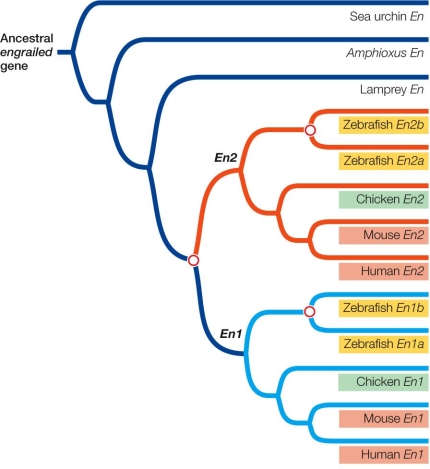 In the evolution timeline, which gene is the most recent paralog of zebrafish En2b?
 (Multiple Choice)
4.8/5 (76)
(76) 
Filters
- Essay(0)
- Multiple Choice(0)
- Short Answer(0)
- True False(0)
- Matching(0)