



 Chat with AI
Exam 23: Evolution of Genes and Genomes

Exam 1: Studying Life246 Questions
Exam 2: Small Molecules and the Chemistry of Life246 Questions
Exam 3: Proteins, Carbohydrates, and Lipids246 Questions
Exam 4: Nucleic Acids and the Origin of Life246 Questions
Exam 5: Cells: the Working Units of Life248 Questions
Exam 6: Cell Membranes246 Questions
Exam 7: Cell Communication and Multicellularity246 Questions
Exam 8: Energy, Enzymes, and Metabolism246 Questions
Exam 9: Pathways That Harvest Chemical Energy246 Questions
Exam 10: Photosynthesis: Energy From Sunlight242 Questions
Exam 11: The Cell Cycle and Cell Division260 Questions
Exam 12: Inheritance, Genes, and Chromosomes250 Questions
Exam 13: Dna and Its Role in Heredity257 Questions
Exam 14: From Dna to Protein: Gene Expression252 Questions
Exam 15: Gene Mutation and Molecular Medicine251 Questions
Exam 16: Regulation of Gene Expression245 Questions
Exam 17: Genomes249 Questions
Exam 18: Recombinant Dna and Biotechnology243 Questions
Exam 20: Mechanisms of Evolution243 Questions
Exam 21: Reconstructing and Using Phylogenies246 Questions
Exam 22: Speciation247 Questions
Exam 23: Evolution of Genes and Genomes252 Questions
Exam 24: The History of Life on Earth246 Questions
Exam 25: Bacteria, Archaea, and Viruses262 Questions
Exam 26: The Origin and Diversification of Eukaryotes252 Questions
Exam 27: Plants Without Seeds: From Water to Land251 Questions
Exam 28: The Evolution of Seed Plants259 Questions
Exam 29: The Evolution and Diversity of Fungi261 Questions
Exam 30: Animal Origins and the Evolution of Body Plans248 Questions
Exam 31: Protostome Animals244 Questions
Exam 32: Deuterostome Animals246 Questions
Exam 33: The Plant Body243 Questions
Exam 34: Transport in Plants248 Questions
Exam 35: Plant Nutrition247 Questions
Exam 36: Regulation of Plant Growth246 Questions
Exam 37: Reproduction in Flowering Plants247 Questions
Exam 38: Plant Responses to Environmental Challenges246 Questions
Exam 39: Physiology, Homeostasis, and Temperature Regulation258 Questions
Exam 40: Animal Hormones249 Questions
Exam 41: Immunology: Animal Defense Systems265 Questions
Exam 42: Animal Reproduction261 Questions
Exam 43: Animal Development261 Questions
Exam 44: Neurons, Glia, and Nervous Systems250 Questions
Exam 45: Sensory Systems249 Questions
Exam 46: The Mammalian Nervous System: Structure and Higher Functions254 Questions
Exam 47: Musculoskeletal Systems259 Questions
Exam 48: Gas Exchange247 Questions
Exam 49: Circulatory Systems252 Questions
Exam 50: Nutrition, Digestion, and Absorption259 Questions
Exam 51: Salt and Water Balance and Nitrogen Excretion251 Questions
Exam 52: Animal Behavior249 Questions
Exam 53: The Physical Environment and Biogeography of Life248 Questions
Exam 54: Populations259 Questions
Exam 55: Species Interactions254 Questions
Exam 56: Communities247 Questions
Exam 57: Ecosystems238 Questions
Exam 58: A Changing Biosphere222 Questions
Select questions type


Suppose the size of a population of marmots is 300.According to genetic drift theory, what is the probability that a newly arisen neutral mutation will become fixed in this population?
(Multiple Choice)
4.9/5  (98)
(98) A mutation in a gene in which A is changed to G is called a _______, whereas a mutation of A to T is called a _______.The former type of mutation occurs at a _______ frequency than the latter.
(Multiple Choice)
4.8/5 (91)
(91) Genes found in different species that diverge as a result of speciation are called _______, whereas genes in the same or different organisms that arise by gene duplication are called _______.
(Multiple Choice)
4.8/5 (78)
(78) A missense substitution is the same as a _______ substitution.
(Multiple Choice)
4.8/5 (83)
(83) Investigations of the mechanisms and consequences of the evolution of macromolecules make up the field of _______.
(Short Answer)
4.7/5 (76)
(76) A similarity matrix gives us a measure of the _______ number of changes that have occurred during divergence between pairs of organisms.
(Multiple Choice)
4.9/5 (90)
(90) Histones are proteins that play important roles in gene regulation.Between plants and animals, only two amino acid changes have occurred in the histone H4 protein, despite many synonymous changes.What can we infer from this observation?
(Multiple Choice)
4.8/5 (79)
(79) Which model system for evolutionary research has a natural nucleotide substitution rate as high as 1 substitution per 1,000 nucleotides per generation?
(Multiple Choice)
4.8/5 (90)
(90) Major influenza epidemics are typically triggered by _______ transmissions of the virus.
(Short Answer)
4.9/5 (65)
(65) A sequence of DNA that arose from a gene duplication and is no longer functional is known as a(n) _______.
(Short Answer)
4.9/5 (71)
(71) Within a genome, some genes are found to have multiple copies that cluster together and are very similar, both structurally and functionally.These genes tend to evolve in concert, and they are more closely related to each other than to orthologous genes of closely related species.Two different mechanisms appear to support concerted evolution.One mechanism is related to the pairing of homologous chromosomes that occurs during meiosis.Describe how this process works.
(Essay)
4.7/5 (85)
(85) Refer to the figure showing the hypothetical observed sequences from two related species and their common ancestor. 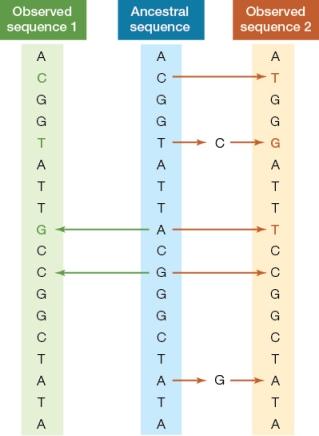 How many substitutions could be inferred from the sequence information given for species 1, species 2, and the common ancestor?
 (Short Answer)
4.9/5 (94)
(94) Consider a hypothetical enzyme-coding gene and sequences of the gene from several species of rodents.The figure shows the rates of nonsynonymous and synonymous substitutions for each of four regions of the gene. 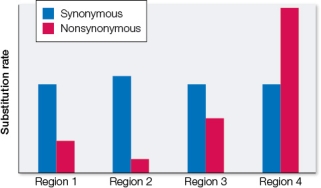 Which region is under the strongest purifying selection?
 (Short Answer)
5.0/5 (90)
(90) Refer to the figure. 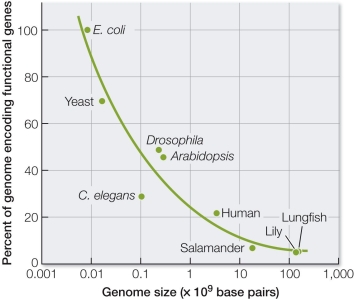 Genome size varies widely among different multicellular organisms.What is the greatest contributing cause of this variation?
 (Multiple Choice)
4.8/5 (83)
(83) Below are segments of DNA from three species of flies.Species 1 is the common ancestor of species 2 and species 3, and we have access to its DNA because it was preserved in amber. Species 1: AACTACTGCACGCTCATA
Species 2: AACTAGTGCTCGCTCACA
Species 3: AATTACTGCACGCTCACA
Having access to Species 1, we can infer that there have been _______ substitutions from Species 1 to Species 2 and Species 3.Lacking access to Species 1, we could infer that there have been _______ substitutions between Species 2 and Species 3.
(Multiple Choice)
4.8/5 (68)
(68) Refer to the table. 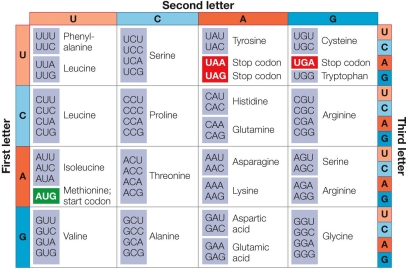 Consider the first codon in the table, UUU.How many single nucleotide substitutions at any of the three positions are synonymous substitutions?
 (Multiple Choice)
4.9/5 (75)
(75) Below are the DNA sequences from four hypothetical species of bacteria.
Species 1: AGAGAATCTGCCATGAACTGA
Species 2: AGAGAGTCTGCGCATGCACTGA
Species 3: AGAAAGTGTCAGCGGATGCACTCA
Species 4: AGAAAGTGTCAGCGCATGCACTCA
Align the sequences and construct a similarity matrix.Consider gaps of any length to be equivalent to two nucleotide differences.If two species share a gap, do not consider that a similarity.Write the similarities in the lower diagonal of the similarity matrix, and the differences in the upper diagonal.
(Essay)
4.9/5 (76)
(76) The most likely reason that crickets (Laupala) have a larger genome size than fruit flies (Drosophila) is that crickets
(Multiple Choice)
4.8/5 (82)
(82) Below are short fragments of DNA sequences from two yeast strains (A and B), which have been diverging from each other, as well as a short fragment from their common ancestor (C).
Yeast A: TGACTGCAAACATCCTAG
Yeast B: TGCCTGGACACATCGAAG
Yeast C: TGCCTGGAAACCTCCTAG
What is the minimum number of evolutionary changes that have occurred since strains A and B evolved from their common ancestor?
(Multiple Choice)
4.7/5 (90)
(90) The table shows the amino acid sequences for an eight-residue section of a small protein for five different species (1-5). 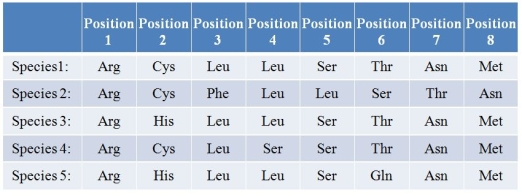 Which species differs from species 1 because of amino acid substitutions?
 (Short Answer)
4.8/5 (91)
(91) 
Filters
- Essay(0)
- Multiple Choice(0)
- Short Answer(0)
- True False(0)
- Matching(0)