



 Chat with AI
Exam 23: Evolution of Genes and Genomes

Exam 1: Studying Life246 Questions
Exam 2: Small Molecules and the Chemistry of Life246 Questions
Exam 3: Proteins, Carbohydrates, and Lipids246 Questions
Exam 4: Nucleic Acids and the Origin of Life246 Questions
Exam 5: Cells: the Working Units of Life248 Questions
Exam 6: Cell Membranes246 Questions
Exam 7: Cell Communication and Multicellularity246 Questions
Exam 8: Energy, Enzymes, and Metabolism246 Questions
Exam 9: Pathways That Harvest Chemical Energy246 Questions
Exam 10: Photosynthesis: Energy From Sunlight242 Questions
Exam 11: The Cell Cycle and Cell Division260 Questions
Exam 12: Inheritance, Genes, and Chromosomes250 Questions
Exam 13: Dna and Its Role in Heredity257 Questions
Exam 14: From Dna to Protein: Gene Expression252 Questions
Exam 15: Gene Mutation and Molecular Medicine251 Questions
Exam 16: Regulation of Gene Expression245 Questions
Exam 17: Genomes249 Questions
Exam 18: Recombinant Dna and Biotechnology243 Questions
Exam 20: Mechanisms of Evolution243 Questions
Exam 21: Reconstructing and Using Phylogenies246 Questions
Exam 22: Speciation247 Questions
Exam 23: Evolution of Genes and Genomes252 Questions
Exam 24: The History of Life on Earth246 Questions
Exam 25: Bacteria, Archaea, and Viruses262 Questions
Exam 26: The Origin and Diversification of Eukaryotes252 Questions
Exam 27: Plants Without Seeds: From Water to Land251 Questions
Exam 28: The Evolution of Seed Plants259 Questions
Exam 29: The Evolution and Diversity of Fungi261 Questions
Exam 30: Animal Origins and the Evolution of Body Plans248 Questions
Exam 31: Protostome Animals244 Questions
Exam 32: Deuterostome Animals246 Questions
Exam 33: The Plant Body243 Questions
Exam 34: Transport in Plants248 Questions
Exam 35: Plant Nutrition247 Questions
Exam 36: Regulation of Plant Growth246 Questions
Exam 37: Reproduction in Flowering Plants247 Questions
Exam 38: Plant Responses to Environmental Challenges246 Questions
Exam 39: Physiology, Homeostasis, and Temperature Regulation258 Questions
Exam 40: Animal Hormones249 Questions
Exam 41: Immunology: Animal Defense Systems265 Questions
Exam 42: Animal Reproduction261 Questions
Exam 43: Animal Development261 Questions
Exam 44: Neurons, Glia, and Nervous Systems250 Questions
Exam 45: Sensory Systems249 Questions
Exam 46: The Mammalian Nervous System: Structure and Higher Functions254 Questions
Exam 47: Musculoskeletal Systems259 Questions
Exam 48: Gas Exchange247 Questions
Exam 49: Circulatory Systems252 Questions
Exam 50: Nutrition, Digestion, and Absorption259 Questions
Exam 51: Salt and Water Balance and Nitrogen Excretion251 Questions
Exam 52: Animal Behavior249 Questions
Exam 53: The Physical Environment and Biogeography of Life248 Questions
Exam 54: Populations259 Questions
Exam 55: Species Interactions254 Questions
Exam 56: Communities247 Questions
Exam 57: Ecosystems238 Questions
Exam 58: A Changing Biosphere222 Questions
Select questions type


Refer to the figure. 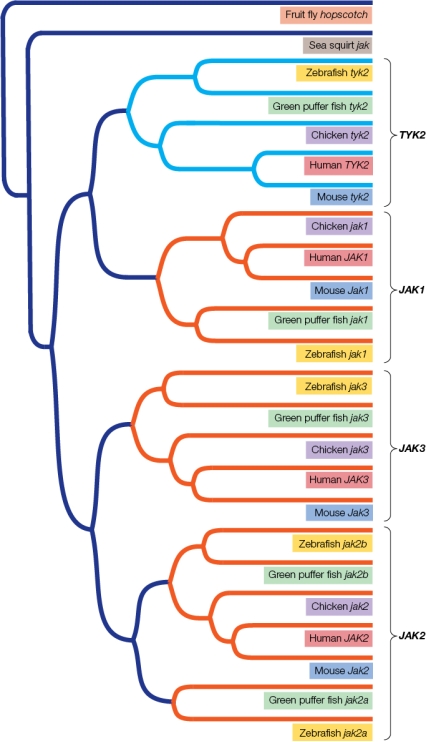 Based on the information provided in the phylogenetic gene tree, multiple gene duplication events followed by mutations have created _______ that consist(s) of JAK and TYK2 genes.
 (Multiple Choice)
4.9/5  (90)
(90) Biologists who are searching for a natural compound to improve corn yield are practicing _______.
(Short Answer)
4.9/5 (91)
(91) A gene family that codes for various hormone receptors has been accumulating nucleotide substitutions at a rate of 0.4 substitutions per million years.On average, there have been 60 substitutions between the common ancestor of this gene family and each of the various living forms of this gene.Based on these numbers, this hormone receptor gene family likely originated _______ million years ago.
(Multiple Choice)
4.8/5 (80)
(80) In an experiment, researchers split a bacterial colony in two, allowing each of the new colonies to evolve separately.They then sequence a gene from colony 1 and colony 2.In the common ancestor, at nucleotide site 327 there is G.In colony 1, there is C; in colony 2, there is C.This is an example of a _______ substitution.
(Multiple Choice)
4.9/5 (80)
(80) Below are short fragments of DNA sequences from two yeast strains (A and B), which have been diverging from each other, as well as a short fragment from their common ancestor (C). Yeast A: TGACTGCAAACATCCTAG
Yeast B: TGCCTGGACACATCGAAG
Yeast C: TGCCTGGAAACCTCCTAG
What is the minimum number of evolutionary changes that have occurred between the common ancestor and strain A?
(Multiple Choice)
4.8/5 (86)
(86) Refer to the figure, which shows the process of in vitro evolution of a new RNA molecule. 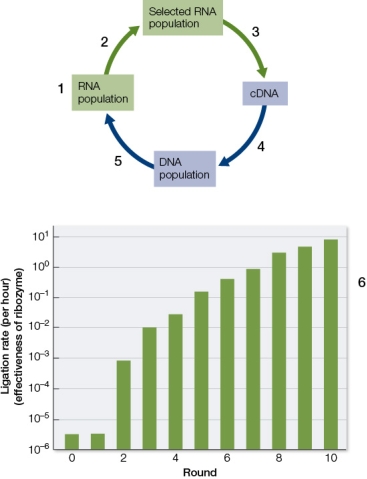 During which numbered step are mutations most likely to occur?
 (Multiple Choice)
5.0/5 (83)
(83) The developmental genes bicoid and zen are two distinct genes, with different functions, that were derived from a relatively old gene duplication.They are thus
(Multiple Choice)
4.8/5 (77)
(77) A hypothetical human protein sequence is 161 amino acids long.The homologous sequence in chimpanzees is 160 amino acids long.Which modification would most likely be needed to align the sequences?
(Multiple Choice)
4.9/5 (78)
(78) Which comparison procedure would tend to make it easier to obtain correct sequence alignments?
(Multiple Choice)
4.9/5 (70)
(70) A group of homologous genes with related functions is known as a(n) _______.
(Short Answer)
4.8/5 (76)
(76) Fossil, morphological, and molecular evidence shows that langurs and ruminants do not share a recent common ancestor.This is important with respect to lysozyme evolution, because it supports the hypothesis that the similar changes observed in the lysozyme sequence in both langurs and ruminants
(Multiple Choice)
4.9/5 (72)
(72) Suppose three sibling species of frogs have the following DNA sequences at a portion of a gene: Species 1: AGTCTAGATCGCGGTCG
Species 2: AGTCGATCGCGGACG
Species 3: TGTCTAGATCACGGTCG
Recall that the observed number of mutations can differ from the total number of actual substitutions that occurred in pairwise sequence comparisons.Which modification would align the three sequences so they could be used to make comparisons?
(Multiple Choice)
4.9/5 (71)
(71) The following sequences were obtained from a hypothetical gene in three species of Drosophila:
D.melanogaster: GGCTTGTAGCTGTGCTCGCCGCTAGTCGG
D.simulans: AGGCTTGTAGCTGTGCTCGCCGCTAGTAGG
D.erecta: AGGGTAGCTGTGCTCACCGCTCGTCGG
How many differences have arisen between D.melanogaster and D.erecta sequences?
(Short Answer)
4.9/5 (83)
(83) The enzyme _______ has evolved new functions in animals that perform foregut fermentation.
(Short Answer)
4.8/5 (81)
(81) The genes that code for the enzyme lysozyme from a number of organisms whose diets comprise mostly leaves and grass were sequenced.Comparisons of the gene sequences revealed that
(Multiple Choice)
4.9/5 (92)
(92) Recent studies in yeast and flies show that most duplicated genes are _______ (on an evolutionary scale), suggesting a(n) _______ rate of pseudogene formation.
(Multiple Choice)
4.7/5 (84)
(84) 
Filters
- Essay(0)
- Multiple Choice(0)
- Short Answer(0)
- True False(0)
- Matching(0)