



 Chat with AI
Exam 23: Evolution of Genes and Genomes

Exam 1: Studying Life246 Questions
Exam 2: Small Molecules and the Chemistry of Life246 Questions
Exam 3: Proteins, Carbohydrates, and Lipids246 Questions
Exam 4: Nucleic Acids and the Origin of Life246 Questions
Exam 5: Cells: the Working Units of Life248 Questions
Exam 6: Cell Membranes246 Questions
Exam 7: Cell Communication and Multicellularity246 Questions
Exam 8: Energy, Enzymes, and Metabolism246 Questions
Exam 9: Pathways That Harvest Chemical Energy246 Questions
Exam 10: Photosynthesis: Energy From Sunlight242 Questions
Exam 11: The Cell Cycle and Cell Division260 Questions
Exam 12: Inheritance, Genes, and Chromosomes250 Questions
Exam 13: Dna and Its Role in Heredity257 Questions
Exam 14: From Dna to Protein: Gene Expression252 Questions
Exam 15: Gene Mutation and Molecular Medicine251 Questions
Exam 16: Regulation of Gene Expression245 Questions
Exam 17: Genomes249 Questions
Exam 18: Recombinant Dna and Biotechnology243 Questions
Exam 20: Mechanisms of Evolution243 Questions
Exam 21: Reconstructing and Using Phylogenies246 Questions
Exam 22: Speciation247 Questions
Exam 23: Evolution of Genes and Genomes252 Questions
Exam 24: The History of Life on Earth246 Questions
Exam 25: Bacteria, Archaea, and Viruses262 Questions
Exam 26: The Origin and Diversification of Eukaryotes252 Questions
Exam 27: Plants Without Seeds: From Water to Land251 Questions
Exam 28: The Evolution of Seed Plants259 Questions
Exam 29: The Evolution and Diversity of Fungi261 Questions
Exam 30: Animal Origins and the Evolution of Body Plans248 Questions
Exam 31: Protostome Animals244 Questions
Exam 32: Deuterostome Animals246 Questions
Exam 33: The Plant Body243 Questions
Exam 34: Transport in Plants248 Questions
Exam 35: Plant Nutrition247 Questions
Exam 36: Regulation of Plant Growth246 Questions
Exam 37: Reproduction in Flowering Plants247 Questions
Exam 38: Plant Responses to Environmental Challenges246 Questions
Exam 39: Physiology, Homeostasis, and Temperature Regulation258 Questions
Exam 40: Animal Hormones249 Questions
Exam 41: Immunology: Animal Defense Systems265 Questions
Exam 42: Animal Reproduction261 Questions
Exam 43: Animal Development261 Questions
Exam 44: Neurons, Glia, and Nervous Systems250 Questions
Exam 45: Sensory Systems249 Questions
Exam 46: The Mammalian Nervous System: Structure and Higher Functions254 Questions
Exam 47: Musculoskeletal Systems259 Questions
Exam 48: Gas Exchange247 Questions
Exam 49: Circulatory Systems252 Questions
Exam 50: Nutrition, Digestion, and Absorption259 Questions
Exam 51: Salt and Water Balance and Nitrogen Excretion251 Questions
Exam 52: Animal Behavior249 Questions
Exam 53: The Physical Environment and Biogeography of Life248 Questions
Exam 54: Populations259 Questions
Exam 55: Species Interactions254 Questions
Exam 56: Communities247 Questions
Exam 57: Ecosystems238 Questions
Exam 58: A Changing Biosphere222 Questions
Select questions type


The tomato genome has about 32,000 functional genes.In comparison, the human genome contains about _______ as many.
(Multiple Choice)
4.8/5  (88)
(88) Which scenario is not a likely occurrence after a gene duplication event?
(Multiple Choice)
4.7/5 (87)
(87) In a sequence of DNA taken from various species of snails, researchers have found that the rates of nonsynonymous substitutions and synonymous substitutions are roughly the same.What can we infer from this pattern?
(Multiple Choice)
4.8/5 (86)
(86) Which outcome results from the misalignment of highly repeated genes?
(Multiple Choice)
4.7/5 (83)
(83) An evolutionary biologist is studying gene A.The biologist constructs a gene tree to see how it is related in various species.The gene tree reveals multiple copies of the gene in each species.Within each species the copies of gene A are homologous but not identical.These results indicate that the biologist has identified _______ of gene A that are related through gene duplication events.
(Short Answer)
4.9/5 (77)
(77) Biologists use a chemical derived from a bacterium to help treat sewage waste.This is an example of
(Multiple Choice)
4.9/5 (91)
(91) Copies of genes in the same or different species that are related as the result of gene duplications are known as
(Multiple Choice)
4.7/5 (92)
(92) Transitions, which are changes from _______, occur _______ transversions.
(Multiple Choice)
4.8/5 (90)
(90) Changes to _______ will not affect the phenotype of an organism.
(Multiple Choice)
4.7/5 (68)
(68) Two species of plants that diverged 25 million years ago have accumulated an estimated 18 nucleotide differences in a gene.Species A has an average population size of 2 million, while species B has an average population size of 0.8 million.Both of these plants are annuals, with one generation per year.Assuming that the substitutions are all neutral, the estimated neutral mutation rate for this gene is _______ per million generations.
(Short Answer)
4.8/5 (90)
(90) In order to estimate the age of the split between the globin gene clusters, scientists did which of the following?
(Multiple Choice)
4.8/5 (95)
(95) Refer to figure. 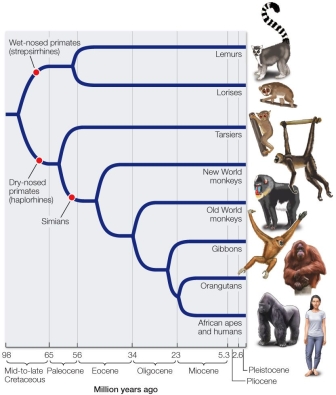 A researcher compares the sequences of a specific gene from various primate species.At nucleotide position 687 of this gene, all but two of the primates have a cytosine: the human has adenine, and the lemur has guanine at this position.This is evidence that the nucleotide substitutions at position 687 in humans and chimpanzees are most likely an example of
 (Multiple Choice)
4.8/5 (79)
(79) A number of genes that evolved from duplications of an ancestral gene now code for odor receptors in Drosophila.These odor receptor genes thus comprise a gene
(Multiple Choice)
4.8/5 (83)
(83) Molecular evolutionists are able to study evolution directly using research models such as viruses, bacteria, and unicellular eukaryotes because substitution rates are related to _______ rather than to _______.
(Multiple Choice)
4.8/5 (74)
(74) Biased gene conversion is a mechanism of _______ wherein copy number _______.
(Multiple Choice)
4.9/5 (77)
(77) Refer to the table and sequence.  If C were substituted for the nucleotide in position 4 (highlighted) of the sequence, this would be characterized as a _______ nucleotide substitution.
 (Multiple Choice)
4.7/5 (72)
(72) 
Filters
- Essay(0)
- Multiple Choice(0)
- Short Answer(0)
- True False(0)
- Matching(0)