



 Chat with AI
Exam 23: Evolution of Genes and Genomes

Exam 1: Studying Life246 Questions
Exam 2: Small Molecules and the Chemistry of Life246 Questions
Exam 3: Proteins, Carbohydrates, and Lipids246 Questions
Exam 4: Nucleic Acids and the Origin of Life246 Questions
Exam 5: Cells: the Working Units of Life248 Questions
Exam 6: Cell Membranes246 Questions
Exam 7: Cell Communication and Multicellularity246 Questions
Exam 8: Energy, Enzymes, and Metabolism246 Questions
Exam 9: Pathways That Harvest Chemical Energy246 Questions
Exam 10: Photosynthesis: Energy From Sunlight242 Questions
Exam 11: The Cell Cycle and Cell Division260 Questions
Exam 12: Inheritance, Genes, and Chromosomes250 Questions
Exam 13: Dna and Its Role in Heredity257 Questions
Exam 14: From Dna to Protein: Gene Expression252 Questions
Exam 15: Gene Mutation and Molecular Medicine251 Questions
Exam 16: Regulation of Gene Expression245 Questions
Exam 17: Genomes249 Questions
Exam 18: Recombinant Dna and Biotechnology243 Questions
Exam 20: Mechanisms of Evolution243 Questions
Exam 21: Reconstructing and Using Phylogenies246 Questions
Exam 22: Speciation247 Questions
Exam 23: Evolution of Genes and Genomes252 Questions
Exam 24: The History of Life on Earth246 Questions
Exam 25: Bacteria, Archaea, and Viruses262 Questions
Exam 26: The Origin and Diversification of Eukaryotes252 Questions
Exam 27: Plants Without Seeds: From Water to Land251 Questions
Exam 28: The Evolution of Seed Plants259 Questions
Exam 29: The Evolution and Diversity of Fungi261 Questions
Exam 30: Animal Origins and the Evolution of Body Plans248 Questions
Exam 31: Protostome Animals244 Questions
Exam 32: Deuterostome Animals246 Questions
Exam 33: The Plant Body243 Questions
Exam 34: Transport in Plants248 Questions
Exam 35: Plant Nutrition247 Questions
Exam 36: Regulation of Plant Growth246 Questions
Exam 37: Reproduction in Flowering Plants247 Questions
Exam 38: Plant Responses to Environmental Challenges246 Questions
Exam 39: Physiology, Homeostasis, and Temperature Regulation258 Questions
Exam 40: Animal Hormones249 Questions
Exam 41: Immunology: Animal Defense Systems265 Questions
Exam 42: Animal Reproduction261 Questions
Exam 43: Animal Development261 Questions
Exam 44: Neurons, Glia, and Nervous Systems250 Questions
Exam 45: Sensory Systems249 Questions
Exam 46: The Mammalian Nervous System: Structure and Higher Functions254 Questions
Exam 47: Musculoskeletal Systems259 Questions
Exam 48: Gas Exchange247 Questions
Exam 49: Circulatory Systems252 Questions
Exam 50: Nutrition, Digestion, and Absorption259 Questions
Exam 51: Salt and Water Balance and Nitrogen Excretion251 Questions
Exam 52: Animal Behavior249 Questions
Exam 53: The Physical Environment and Biogeography of Life248 Questions
Exam 54: Populations259 Questions
Exam 55: Species Interactions254 Questions
Exam 56: Communities247 Questions
Exam 57: Ecosystems238 Questions
Exam 58: A Changing Biosphere222 Questions
Select questions type


The _______ technique permits comparison of sequences of amino acids in proteins or sequences of nucleotides in DNA, and it enables the detection of deletions and insertions in sequences that are being compared.
(Short Answer)
4.8/5  (81)
(81) Two species of pine trees differ by a nucleotide substitution in the coding region of a gene, but the proteins produced by this gene are the same in both species.This substitution is thus a _______ substitution.
(Short Answer)
4.7/5 (73)
(73) Which general principle of molecular evolution can you most reasonably infer?
(Multiple Choice)
4.8/5 (87)
(87) Refer to the table 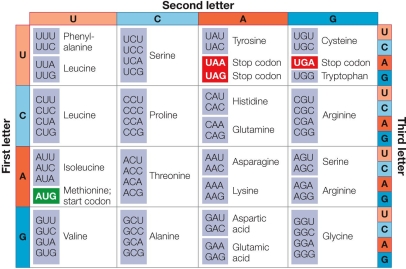 Consider the codon UUA.Which of the following codons is representative of one or more synonymous substitution(s)?
 (Multiple Choice)
4.9/5 (72)
(72) The following sequences have been obtained from a hypothetical gene in three species of Drosophila:
D.melanogaster: GGCTTGTAGCTGTGCTCGCCGCTAGTCGG
D.simulans: AGGCTTGTAGCTGTGCTCGCCGCTAGTAGG
D.erecta: AGGGTAGCTGTGCTCACCGCTCGTCGG
If we assume that each observed substitution is equivalent to 2 nucleotide substitutions, a total of _______ substitution(s) has/have occurred between D.melanogaster and D.simulans.
(Short Answer)
4.8/5 (65)
(65) Noncoding DNA takes up a small proportion of the genomes of _______, which tend to have _______ population sizes.
(Multiple Choice)
4.8/5 (73)
(73) Depictions of lateral gene transfer events on the underlying species tree are known as
(Multiple Choice)
4.7/5 (81)
(81) The sickness whooping cough is caused by infection with the bacterium Bordetella pertussis, which produces pertussis toxin.This toxin inhibits the activity of a protein that regulates adenylyl cyclase.One symptom of this inhibition is the development of a severe cough that can be so strong that it breaks ribs.Vaccines for B.pertussis are effective, but the bacterium can develop sequence differences that allow it to escape detection by the immune system.To develop an updated vaccine that confers immunity to a new strain of B.pertussis, researchers would
(Multiple Choice)
5.0/5 (90)
(90) The number of actual substitutions that have occurred between diverging lineages in a sequence will usually be _______ than the number of substitutions observed when sequences are compared, and this discrepancy should _______ with increasing evolutionary divergence.
(Multiple Choice)
4.9/5 (88)
(88) In an experiment, researchers split a bacterial colony in two, allowing each of the new colonies to evolve separately.They then sequence a gene from colony 1 and colony 2.In the common ancestor, at nucleotide site 167 there is T.In colony 1, there is C; in colony 2, there is T.This is an example of a _______ substitution.
(Multiple Choice)
4.7/5 (78)
(78) A molecular evolutionist is collaborating with a researcher who wants to develop antibiotics that specifically bind to certain proteins on pathogenic chlamydia bacteria without harming beneficial bacteria in the host animal gut.The molecular evolutionary research approach that would best aid this project would be to investigate
(Multiple Choice)
4.8/5 (82)
(82) The best way to detect whether lateral gene transfer has occurred would be by
(Multiple Choice)
4.8/5 (88)
(88) The mutation rate of a gene in a species of minnows is 2 per million nucleotides per generation.Only 25 percent of the mutations of this gene are selectively neutral; the rest are deleterious.What is the substitution rate of this gene (per million nucleotides per generation)?
(Multiple Choice)
4.9/5 (73)
(73) In an experiment, researchers split a bacterial colony in two, allowing each of the new colonies to evolve separately.They then sequence a gene from colony 1 and colony 2.In the common ancestor, at nucleotide site 56 there is A.In colony 1, there is C; in colony 2, there is T.This is an example of a _______ substitution.
(Multiple Choice)
4.9/5 (92)
(92) In which order would a molecular evolutionist perform the following tasks: (1) construct a similarity matrix, (2) align the sequences, and (3) use a model of evolution to correct for multiple substitutions and other factors?
(Multiple Choice)
4.8/5 (83)
(83) Below are short fragments of DNA sequences from two yeast strains (A and B), which have been diverging from each other, as well as a short fragment from their common ancestor (C). Yeast A: TGACTGCAAACATCCTAG
Yeast B: TGCCTGGACACATCGAAG
Yeast C: TGCCTGGAAACCTCCTAG
Lacking information from the common ancestor, what would you conclude is the minimum number of evolutionary changes occurring between strains A and B?
(Multiple Choice)
4.9/5 (79)
(79) Based on what you have learned about evolutionary processes, what modifications could you introduce into in vitro evolution experiments (such as the one shown in Figure 23.13) to increase the diversity or rate of evolution of new molecules?
(Essay)
5.0/5 (60)
(60) Respiratory syncytial virus (RSV) is a human-specific virus that causes infections of the lungs and respiratory tract and commonly infects infants and young children.In the young and immunosuppressed it can cause bronchiolitis and pneumonia.There are multiple strains of RSV, which has made it difficult to develop a protective vaccine.To better understand the evolution of different RSV strains, scientists should
(Multiple Choice)
4.8/5 (87)
(87) 
Filters
- Essay(0)
- Multiple Choice(0)
- Short Answer(0)
- True False(0)
- Matching(0)