



 Chat with AI
Exam 23: Evolution of Genes and Genomes

Exam 1: Studying Life246 Questions
Exam 2: Small Molecules and the Chemistry of Life246 Questions
Exam 3: Proteins, Carbohydrates, and Lipids246 Questions
Exam 4: Nucleic Acids and the Origin of Life246 Questions
Exam 5: Cells: the Working Units of Life248 Questions
Exam 6: Cell Membranes246 Questions
Exam 7: Cell Communication and Multicellularity246 Questions
Exam 8: Energy, Enzymes, and Metabolism246 Questions
Exam 9: Pathways That Harvest Chemical Energy246 Questions
Exam 10: Photosynthesis: Energy From Sunlight242 Questions
Exam 11: The Cell Cycle and Cell Division260 Questions
Exam 12: Inheritance, Genes, and Chromosomes250 Questions
Exam 13: Dna and Its Role in Heredity257 Questions
Exam 14: From Dna to Protein: Gene Expression252 Questions
Exam 15: Gene Mutation and Molecular Medicine251 Questions
Exam 16: Regulation of Gene Expression245 Questions
Exam 17: Genomes249 Questions
Exam 18: Recombinant Dna and Biotechnology243 Questions
Exam 20: Mechanisms of Evolution243 Questions
Exam 21: Reconstructing and Using Phylogenies246 Questions
Exam 22: Speciation247 Questions
Exam 23: Evolution of Genes and Genomes252 Questions
Exam 24: The History of Life on Earth246 Questions
Exam 25: Bacteria, Archaea, and Viruses262 Questions
Exam 26: The Origin and Diversification of Eukaryotes252 Questions
Exam 27: Plants Without Seeds: From Water to Land251 Questions
Exam 28: The Evolution of Seed Plants259 Questions
Exam 29: The Evolution and Diversity of Fungi261 Questions
Exam 30: Animal Origins and the Evolution of Body Plans248 Questions
Exam 31: Protostome Animals244 Questions
Exam 32: Deuterostome Animals246 Questions
Exam 33: The Plant Body243 Questions
Exam 34: Transport in Plants248 Questions
Exam 35: Plant Nutrition247 Questions
Exam 36: Regulation of Plant Growth246 Questions
Exam 37: Reproduction in Flowering Plants247 Questions
Exam 38: Plant Responses to Environmental Challenges246 Questions
Exam 39: Physiology, Homeostasis, and Temperature Regulation258 Questions
Exam 40: Animal Hormones249 Questions
Exam 41: Immunology: Animal Defense Systems265 Questions
Exam 42: Animal Reproduction261 Questions
Exam 43: Animal Development261 Questions
Exam 44: Neurons, Glia, and Nervous Systems250 Questions
Exam 45: Sensory Systems249 Questions
Exam 46: The Mammalian Nervous System: Structure and Higher Functions254 Questions
Exam 47: Musculoskeletal Systems259 Questions
Exam 48: Gas Exchange247 Questions
Exam 49: Circulatory Systems252 Questions
Exam 50: Nutrition, Digestion, and Absorption259 Questions
Exam 51: Salt and Water Balance and Nitrogen Excretion251 Questions
Exam 52: Animal Behavior249 Questions
Exam 53: The Physical Environment and Biogeography of Life248 Questions
Exam 54: Populations259 Questions
Exam 55: Species Interactions254 Questions
Exam 56: Communities247 Questions
Exam 57: Ecosystems238 Questions
Exam 58: A Changing Biosphere222 Questions
Select questions type


Transcription factors are proteins that bind specific DNA sequences to regulate gene transcription.Some families of transcription factors bind zinc molecules to form structural motifs called zinc fingers, which facilitate binding to the DNA.Transcription factors that have the so-called classical zinc finger motif bind each zinc molecule via two cysteine and two histidine amino acids.When comparing the orthologs of these genes in closely related species, one would expect to find that the position and conservation of the cysteine and histidine amino acids in the compared sequences are
(Multiple Choice)
4.9/5  (71)
(71) When researchers apply the principles of evolution to produce new molecules that can be used for pharmaceuticals, they are
(Multiple Choice)
4.9/5 (82)
(82) Refer to the figure. 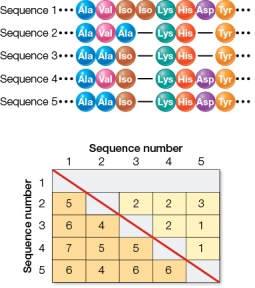 What is the correct order of sequence numbers in the top row of the similarity matrix?
 (Multiple Choice)
5.0/5 (86)
(86) Suppose three sibling species of frogs have the following DNA sequences at a portion of a gene: Species 1: AGTCTAGATCGCGGTCG
Species 2: AGTCGATCGCGGACG
Species 3: TGTCTAGATCACGGTCG
Recall that the observed number of mutations can differ from the total number of actual substitutions that occurred in pairwise sequence comparisons.If we assume that a gap of any length is equivalent to three nucleotide substitutions, how many substitutions have occurred between Species 1 and Species 2?
(Multiple Choice)
4.8/5 (76)
(76) Genome sizes vary tremendously among organisms.Size does not directly correlate with complexity, as organisms that have similar complexities can differ by as much as 40 times.Yet, these same organisms may have similar numbers of genes, with noncoding DNA making up the tremendous difference in genome sizes.One hypothesis is that the proportion of coding to noncoding DNA in the genome of a species is related to the sizes of the populations typical of the species.Explain how the coding-to-noncoding DNA ratios in species with different typical population sizes might be related to the relative importance of natural selection and genetic drift in the evolution of the species.
(Essay)
4.8/5 (80)
(80) Suppose that under the conditions of an experiment, a particular virus has an expected substitution rate of 1 per 2,000 nucleotides per generation and a genome size of 10,000 nucleotides.The virus has one generation per hour.We would expect _______ substitutions between 9:00 am on Monday and 1:00 pm on Friday of the same week.
(Multiple Choice)
4.8/5 (80)
(80) Chorion genes are involved in making the eggshells of many insect species.In some species, as multiple copies of these chorion genes evolved within the same species, the similarity of the copies was maintained.This phenomenon is known as _______ evolution.
(Short Answer)
4.9/5 (75)
(75) A researcher studies the evolutionary relationships between influenza viruses by comparing the genomic sequences of the viruses found in pigs, ducks, and humans in a given year.When evaluating the viruses that had infected these hosts the previous year, she identifies a cross-species transfer from humans to pigs.This information supports the hypothesis that cross-species transfer leads to more severe disease if during the previous year
(Multiple Choice)
4.9/5 (88)
(88) Refer to the figure. 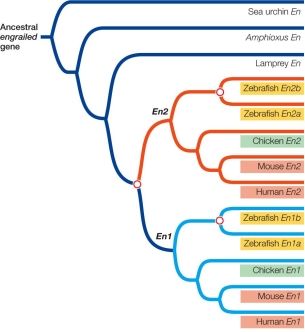 Which pair of genes contains paralogs?
 (Multiple Choice)
5.0/5 (82)
(82) Suppose that under the conditions of an experiment, a particular virus has an expected substitution rate of 1 per 2,000 nucleotides per generation and a genome size of 10,000 nucleotides.The virus has one generation per hour.Suppose you wanted to have populations of this virus to acquire approximately 100 substitutions.How long would you let the experiment run?
(Multiple Choice)
5.0/5 (68)
(68) Suppose the size of a population of frogs is 600.According to genetic drift theory, the probability that a newly arisen neutral mutation will become fixed in this population is 1 in _______.
(Short Answer)
4.9/5 (80)
(80) Below are sequences of part of a gene taken from three species of plants. Plant A: AGATCTACGCGCAGTTTC
Plant B: AGATTGGCGCAGTATC
Plant C: AGATTAGGCGCAGTTTC
Align the sequences.If each added gap required to align the sequences represents two nucleotide differences, how many differences are between species A and species B?
(Multiple Choice)
4.9/5 (79)
(79) A team of biologists is examining the gene tree of a gene family of early embryonic development genes.They should focus on comparing _______ when mapping changes in function due to gene duplication.
(Multiple Choice)
4.8/5 (74)
(74) A DNA substitution does not change the amino acid sequence of the protein.This change is thus a _______ substitution.
(Multiple Choice)
4.9/5 (84)
(84) To determine the rates at which organisms lose DNA, researchers have used _______ that have LTRs.
(Short Answer)
4.9/5 (72)
(72) A gene family has been accumulating nucleotide substitutions at a rate of 0.15 per million years.On average, there have been 30 substitutions between the common ancestor of this gene family and each of the various living forms of this gene.Based on these numbers, this gene family likely originated _______ million years ago.
(Short Answer)
4.8/5 (81)
(81) What is the primary function of the products of the globin genes?
(Multiple Choice)
4.9/5 (87)
(87) Mutations in the third position of codons are the least likely to affect the amino acid sequence.Mutations in the second position are most likely to change the amino acid sequence, whereas first-position mutations are intermediate.Based on what you know about molecular evolution, predict the relative rates of evolution for first-, second-, and third-position codon nucleotides, from least likely to most likely.
(Multiple Choice)
4.8/5 (69)
(69) 
Filters
- Essay(0)
- Multiple Choice(0)
- Short Answer(0)
- True False(0)
- Matching(0)