



 Chat with AI
Exam 23: Evolution of Genes and Genomes

Exam 1: Studying Life246 Questions
Exam 2: Small Molecules and the Chemistry of Life246 Questions
Exam 3: Proteins, Carbohydrates, and Lipids246 Questions
Exam 4: Nucleic Acids and the Origin of Life246 Questions
Exam 5: Cells: the Working Units of Life248 Questions
Exam 6: Cell Membranes246 Questions
Exam 7: Cell Communication and Multicellularity246 Questions
Exam 8: Energy, Enzymes, and Metabolism246 Questions
Exam 9: Pathways That Harvest Chemical Energy246 Questions
Exam 10: Photosynthesis: Energy From Sunlight242 Questions
Exam 11: The Cell Cycle and Cell Division260 Questions
Exam 12: Inheritance, Genes, and Chromosomes250 Questions
Exam 13: Dna and Its Role in Heredity257 Questions
Exam 14: From Dna to Protein: Gene Expression252 Questions
Exam 15: Gene Mutation and Molecular Medicine251 Questions
Exam 16: Regulation of Gene Expression245 Questions
Exam 17: Genomes249 Questions
Exam 18: Recombinant Dna and Biotechnology243 Questions
Exam 20: Mechanisms of Evolution243 Questions
Exam 21: Reconstructing and Using Phylogenies246 Questions
Exam 22: Speciation247 Questions
Exam 23: Evolution of Genes and Genomes252 Questions
Exam 24: The History of Life on Earth246 Questions
Exam 25: Bacteria, Archaea, and Viruses262 Questions
Exam 26: The Origin and Diversification of Eukaryotes252 Questions
Exam 27: Plants Without Seeds: From Water to Land251 Questions
Exam 28: The Evolution of Seed Plants259 Questions
Exam 29: The Evolution and Diversity of Fungi261 Questions
Exam 30: Animal Origins and the Evolution of Body Plans248 Questions
Exam 31: Protostome Animals244 Questions
Exam 32: Deuterostome Animals246 Questions
Exam 33: The Plant Body243 Questions
Exam 34: Transport in Plants248 Questions
Exam 35: Plant Nutrition247 Questions
Exam 36: Regulation of Plant Growth246 Questions
Exam 37: Reproduction in Flowering Plants247 Questions
Exam 38: Plant Responses to Environmental Challenges246 Questions
Exam 39: Physiology, Homeostasis, and Temperature Regulation258 Questions
Exam 40: Animal Hormones249 Questions
Exam 41: Immunology: Animal Defense Systems265 Questions
Exam 42: Animal Reproduction261 Questions
Exam 43: Animal Development261 Questions
Exam 44: Neurons, Glia, and Nervous Systems250 Questions
Exam 45: Sensory Systems249 Questions
Exam 46: The Mammalian Nervous System: Structure and Higher Functions254 Questions
Exam 47: Musculoskeletal Systems259 Questions
Exam 48: Gas Exchange247 Questions
Exam 49: Circulatory Systems252 Questions
Exam 50: Nutrition, Digestion, and Absorption259 Questions
Exam 51: Salt and Water Balance and Nitrogen Excretion251 Questions
Exam 52: Animal Behavior249 Questions
Exam 53: The Physical Environment and Biogeography of Life248 Questions
Exam 54: Populations259 Questions
Exam 55: Species Interactions254 Questions
Exam 56: Communities247 Questions
Exam 57: Ecosystems238 Questions
Exam 58: A Changing Biosphere222 Questions
Select questions type


Which scenario would tend to make obtaining correct sequence alignments difficult?
(Multiple Choice)
4.8/5  (70)
(70) Which statement provides the strongest evidence that most noncoding DNA is slightly deleterious?
(Multiple Choice)
4.9/5 (87)
(87) Refer to the figure. 

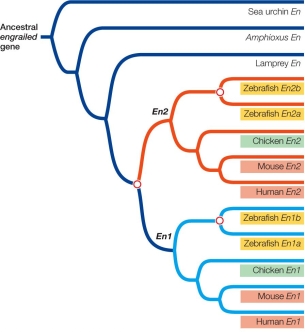 Which set of genes contains parologs?
 (Multiple Choice)
4.9/5 (77)
(77) In which organism or organisms would you find the enzyme lysozyme serving a defensive role against invading bacteria?
(Multiple Choice)
4.8/5 (75)
(75) The sea snake is resistant to poisoning by the puffer fish sodium channel toxin tetrodoxin (TTX).To determine which regions of the sea snake sodium channel confer resistance, a researcher can _______ the sea snake sodium channel genes.
(Multiple Choice)
4.8/5 (83)
(83) As the amount of lateral gene transfer in a taxon increases, it becomes _______ difficult to infer relationships among lineages within the taxon and _______ to infer species boundaries.
(Multiple Choice)
4.9/5 (78)
(78) Which statement about ribosomal RNA (rRNA) genes is false?
(Multiple Choice)
4.7/5 (77)
(77) Puffer fish possess a chemical called _______ that acts as a toxin by blocking _______.
(Multiple Choice)
4.8/5 (69)
(69) _______ is most likely to lead to an increase in the rate that pseudogenes accumulate in a population.
(Multiple Choice)
4.8/5 (84)
(84) You are a molecular evolutionist and have found five successive ancestors of today's Arctic lemming (a type of rodent) frozen in the Arctic permafrost.You sequence the genomes of these ancestral lemmings and the modern lemming.For most genes, if you graph the number of actual substitutions on the x axis and the number of observed substitutions on the y axis, the slope of this graph will most likely
(Multiple Choice)
4.9/5 (97)
(97) Humans, mice, rats, chickens, and all other bony vertebrates have two groups of a developmental gene.The most likely explanation is that these two groups of genes arose from a gene duplication event in the common ancestor of
(Multiple Choice)
4.8/5 (99)
(99) Below are short fragments of DNA sequences from two yeast strains (A and B), which have been diverging from each other, as well as a short fragment from their common ancestor (C). Yeast A: TGACTGCAAACATCCTAG
Yeast B: TGCCTGGACACATCGAAG
Yeast C: TGCCTGGAAACCTCCTAG
What type of information would best allow you to detect whether back substitutions occurred at any of the 18 nucleotides of the sequence as strain A evolved from the common ancestor?
(Multiple Choice)
4.9/5 (76)
(76) Which genes would most likely experience biased gene conversion?
(Multiple Choice)
4.9/5 (79)
(79) The table shows the amino acid sequences for an eight-residue section of a small protein for five different species (1-5). 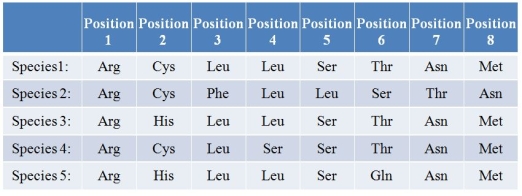 Which species differs from species 1 because of an amino acid insertion?
 (Short Answer)
4.7/5 (66)
(66) Below are shown segments of DNA from three species of flies.Species 1 is the common ancestor of species 2 and species 3, and we have access to its DNA because it was preserved in amber. Species 1: AACTACTGCACGCTCATA
Species 2: AACTAGTGCTCGCTCACA
Species 3: AATTACTGCACGCTCACA
There have been _______ single and _______ parallel changes as species 2 and 3 evolved from species 1.
(Multiple Choice)
4.9/5 (73)
(73) Amino acid sequences of a homologous protein found in three species of dragonflies are presented below: Dragonfly 1: Met-Gln-Leu-Ile-Val-Arg-Ser
Dragonfly 2: Met-Gln-Leu-Ile-Val-Ser
Dragonfly 3: Met-Gln-Leu-Val-Arg-Ser
How many gaps are required to properly align these three species? (Note: Align Dragonfly 2 and Dragonfly 3 sequences with the Dragonfly 1 sequence.)
(Multiple Choice)
4.8/5 (62)
(62) 
Filters
- Essay(0)
- Multiple Choice(0)
- Short Answer(0)
- True False(0)
- Matching(0)