



 Chat with AI
Exam 23: Evolution of Genes and Genomes

Exam 1: Studying Life246 Questions
Exam 2: Small Molecules and the Chemistry of Life246 Questions
Exam 3: Proteins, Carbohydrates, and Lipids246 Questions
Exam 4: Nucleic Acids and the Origin of Life246 Questions
Exam 5: Cells: the Working Units of Life248 Questions
Exam 6: Cell Membranes246 Questions
Exam 7: Cell Communication and Multicellularity246 Questions
Exam 8: Energy, Enzymes, and Metabolism246 Questions
Exam 9: Pathways That Harvest Chemical Energy246 Questions
Exam 10: Photosynthesis: Energy From Sunlight242 Questions
Exam 11: The Cell Cycle and Cell Division260 Questions
Exam 12: Inheritance, Genes, and Chromosomes250 Questions
Exam 13: Dna and Its Role in Heredity257 Questions
Exam 14: From Dna to Protein: Gene Expression252 Questions
Exam 15: Gene Mutation and Molecular Medicine251 Questions
Exam 16: Regulation of Gene Expression245 Questions
Exam 17: Genomes249 Questions
Exam 18: Recombinant Dna and Biotechnology243 Questions
Exam 20: Mechanisms of Evolution243 Questions
Exam 21: Reconstructing and Using Phylogenies246 Questions
Exam 22: Speciation247 Questions
Exam 23: Evolution of Genes and Genomes252 Questions
Exam 24: The History of Life on Earth246 Questions
Exam 25: Bacteria, Archaea, and Viruses262 Questions
Exam 26: The Origin and Diversification of Eukaryotes252 Questions
Exam 27: Plants Without Seeds: From Water to Land251 Questions
Exam 28: The Evolution of Seed Plants259 Questions
Exam 29: The Evolution and Diversity of Fungi261 Questions
Exam 30: Animal Origins and the Evolution of Body Plans248 Questions
Exam 31: Protostome Animals244 Questions
Exam 32: Deuterostome Animals246 Questions
Exam 33: The Plant Body243 Questions
Exam 34: Transport in Plants248 Questions
Exam 35: Plant Nutrition247 Questions
Exam 36: Regulation of Plant Growth246 Questions
Exam 37: Reproduction in Flowering Plants247 Questions
Exam 38: Plant Responses to Environmental Challenges246 Questions
Exam 39: Physiology, Homeostasis, and Temperature Regulation258 Questions
Exam 40: Animal Hormones249 Questions
Exam 41: Immunology: Animal Defense Systems265 Questions
Exam 42: Animal Reproduction261 Questions
Exam 43: Animal Development261 Questions
Exam 44: Neurons, Glia, and Nervous Systems250 Questions
Exam 45: Sensory Systems249 Questions
Exam 46: The Mammalian Nervous System: Structure and Higher Functions254 Questions
Exam 47: Musculoskeletal Systems259 Questions
Exam 48: Gas Exchange247 Questions
Exam 49: Circulatory Systems252 Questions
Exam 50: Nutrition, Digestion, and Absorption259 Questions
Exam 51: Salt and Water Balance and Nitrogen Excretion251 Questions
Exam 52: Animal Behavior249 Questions
Exam 53: The Physical Environment and Biogeography of Life248 Questions
Exam 54: Populations259 Questions
Exam 55: Species Interactions254 Questions
Exam 56: Communities247 Questions
Exam 57: Ecosystems238 Questions
Exam 58: A Changing Biosphere222 Questions
Select questions type


Refer to the figure. 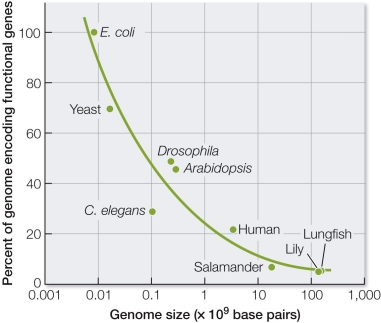 Genome size varies widely among different multicellular organisms.The greatest contributing cause of this variation is the amount of _______.
 (Short Answer)
4.9/5  (72)
(72) Most mutations in studies using in vitro evolution are introduced from
(Multiple Choice)
4.8/5 (87)
(87) In a phylogenetic tree of primates, a gene involved in the production of brain peptides shows 25 silent substitutions but only 4 missense substitutions.From these results, we can infer that
(Multiple Choice)
4.7/5 (89)
(89) Nonsynonymous substitutions, synonymous substitutions, and pseudogenes have different rates of evolution, on average.Which order correctly represents those rates, from fastest to slowest?
(Multiple Choice)
4.8/5 (78)
(78) Consider the case of in vitro evolution used to generate RNA molecules with ligase activity.What is the primary source of selection?
(Multiple Choice)
4.7/5 (87)
(87) Consider the case of in vitro evolution used to generate RNA molecules with ligase activity.If the researchers used a DNA polymerase in the PCR that was more accurate, which of the following would be most likely?
(Multiple Choice)
4.9/5 (82)
(82) In the absence of purifying and positive selection, the ratio of the rate of synonymous substitutions to the rate of nonsynonymous substitutions should be near
(Multiple Choice)
4.8/5 (88)
(88) Below are sequences of part of a gene taken from three species of plants. Plant A: AGATCTACGCGCAGTTTC
Plant B: AGATTAGGCGCAGTATC
Plant C: AGATTAGGCGCAGTTTC
To align these sequences, one should add a gap to species
(Multiple Choice)
4.9/5 (77)
(77) The two mechanisms that produce concerted evolution both rely upon _______ to occur.
(Multiple Choice)
4.9/5 (88)
(88) The nucleotide at a position in a DNA sequence changes from C to A to C.This is an example of a _______ substitution.
(Multiple Choice)
4.8/5 (80)
(80) Biased gene conversion would tend to _______ the amount of _______.
(Multiple Choice)
4.8/5 (76)
(76) Refer to the figure, which shows a phylogenetic tree of the engrailed gene family.  Which gene is the same evolutionary distance from zebrafish En1b as is zebrafish En2b?
 (Multiple Choice)
4.8/5 (69)
(69) Two species of grasshoppers have the same neutral mutation rate for any particular gene, but species A has a population size that is ten times the size of species B.The substitution rate in species A should be _______ that of species B.
(Short Answer)
4.9/5 (86)
(86) In a eukaryote, one would expect to find the lowest rate of nonsynonymous nucleotide substitutions in an
(Multiple Choice)
4.8/5 (92)
(92) Refer to the table, which shows the genome sizes, development times, and population sizes of four species of salamanders.  These salamander data are consistent with
 (Multiple Choice)
4.9/5 (77)
(77) Many more synonymous than nonsynonymous substitutions have occurred in insects in the gene sevenless, which is involved in eye development.This gene is most likely under _______ selection.
(Short Answer)
4.9/5 (79)
(79) Under the conditions of an experiment, a particular virus has an expected substitution rate of 1 substitution per 5,000 nucleotides per generation and a genome size of 10,000 nucleotides.If the virus has one generation per hour, we would expect approximately _______ substitutions between 9 am on Monday and 1 pm on Friday of the same week.
(Multiple Choice)
4.8/5 (85)
(85) The voltage-gated sodium channels of neurons are membrane proteins that play a fundamental role in the generation of action potentials.Blockage of their activity by toxins, such as tetrodoxin, causes paralysis.To determine which nucleotides confer resistance to tetrodoxin in puffer fish and other resistant animals, researchers can _______ the sodium channel genes of resistant and nonresistant animals.
(Multiple Choice)
4.9/5 (60)
(60) Kimura's _______ theory of molecular evolution proposes that most molecular variations in natural populations are selectively equivalent.
(Short Answer)
4.8/5 (79)
(79) 
Filters
- Essay(0)
- Multiple Choice(0)
- Short Answer(0)
- True False(0)
- Matching(0)