



 Chat with AI
Exam 48: Gas Exchange

Exam 1: Studying Life246 Questions
Exam 2: Small Molecules and the Chemistry of Life246 Questions
Exam 3: Proteins, Carbohydrates, and Lipids246 Questions
Exam 4: Nucleic Acids and the Origin of Life246 Questions
Exam 5: Cells: the Working Units of Life248 Questions
Exam 6: Cell Membranes246 Questions
Exam 7: Cell Communication and Multicellularity246 Questions
Exam 8: Energy, Enzymes, and Metabolism246 Questions
Exam 9: Pathways That Harvest Chemical Energy246 Questions
Exam 10: Photosynthesis: Energy From Sunlight242 Questions
Exam 11: The Cell Cycle and Cell Division260 Questions
Exam 12: Inheritance, Genes, and Chromosomes250 Questions
Exam 13: Dna and Its Role in Heredity257 Questions
Exam 14: From Dna to Protein: Gene Expression252 Questions
Exam 15: Gene Mutation and Molecular Medicine251 Questions
Exam 16: Regulation of Gene Expression245 Questions
Exam 17: Genomes249 Questions
Exam 18: Recombinant Dna and Biotechnology243 Questions
Exam 20: Mechanisms of Evolution243 Questions
Exam 21: Reconstructing and Using Phylogenies246 Questions
Exam 22: Speciation247 Questions
Exam 23: Evolution of Genes and Genomes252 Questions
Exam 24: The History of Life on Earth246 Questions
Exam 25: Bacteria, Archaea, and Viruses262 Questions
Exam 26: The Origin and Diversification of Eukaryotes252 Questions
Exam 27: Plants Without Seeds: From Water to Land251 Questions
Exam 28: The Evolution of Seed Plants259 Questions
Exam 29: The Evolution and Diversity of Fungi261 Questions
Exam 30: Animal Origins and the Evolution of Body Plans248 Questions
Exam 31: Protostome Animals244 Questions
Exam 32: Deuterostome Animals246 Questions
Exam 33: The Plant Body243 Questions
Exam 34: Transport in Plants248 Questions
Exam 35: Plant Nutrition247 Questions
Exam 36: Regulation of Plant Growth246 Questions
Exam 37: Reproduction in Flowering Plants247 Questions
Exam 38: Plant Responses to Environmental Challenges246 Questions
Exam 39: Physiology, Homeostasis, and Temperature Regulation258 Questions
Exam 40: Animal Hormones249 Questions
Exam 41: Immunology: Animal Defense Systems265 Questions
Exam 42: Animal Reproduction261 Questions
Exam 43: Animal Development261 Questions
Exam 44: Neurons, Glia, and Nervous Systems250 Questions
Exam 45: Sensory Systems249 Questions
Exam 46: The Mammalian Nervous System: Structure and Higher Functions254 Questions
Exam 47: Musculoskeletal Systems259 Questions
Exam 48: Gas Exchange247 Questions
Exam 49: Circulatory Systems252 Questions
Exam 50: Nutrition, Digestion, and Absorption259 Questions
Exam 51: Salt and Water Balance and Nitrogen Excretion251 Questions
Exam 52: Animal Behavior249 Questions
Exam 53: The Physical Environment and Biogeography of Life248 Questions
Exam 54: Populations259 Questions
Exam 55: Species Interactions254 Questions
Exam 56: Communities247 Questions
Exam 57: Ecosystems238 Questions
Exam 58: A Changing Biosphere222 Questions
Select questions type


Which condition would increase the amount of oxygen diffusing from the lungs into the blood?

Free
(Multiple Choice)
4.9/5  (83)
(83) Correct Answer: Verified
A
In human lungs, the gas exchange surface area provided by _______ is enormous.
Free
(Multiple Choice)
4.9/5 (82)
(82) Correct Answer:Verified
VerifiedE
Which statement about 2,3-bisphosphoglyceric acid (BPG) is true?
Free
(Multiple Choice)
4.9/5 (64)
(64) Correct Answer:Verified
VerifiedD
Which characterizes the situation faced by a water-breathing ectotherm as water temperature drops?
(Multiple Choice)
4.9/5 (67)
(67) In patients with pulmonary fibrosis, excess fibrous connective tissue thickens the walls of the lungs, making the lung tissue less elastic.Why would this lowered elasticity decrease the ability of these patients to exercise?
(Essay)
4.8/5 (92)
(92) A human's basic breathing rhythm is generated in the _______ and modified by neurons in or above the _______.
(Multiple Choice)
4.9/5 (77)
(77) During tidal breathing, respiratory _______ neurons in the medulla _______ just before the start of an _______.
(Multiple Choice)
4.9/5 (84)
(84) In fish gas exchange systems, blood flows through gill lamellae in a direction opposite to water flow, a phenomenon known as _______.
(Short Answer)
4.7/5 (88)
(88) Refer to the figure showing the O2-binding/dissociation curves for human and llama hemoglobins. 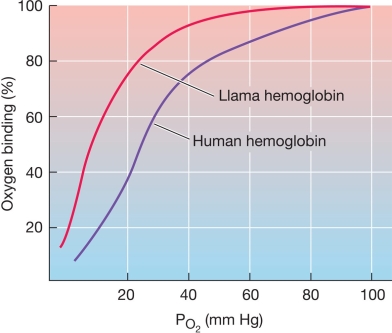 South American camelids (i.e., llamas, alpacas, guanacos, and vicuñas) are native to the Andes Mountains.In the natural habitat of these mammals, more than 5,000 meters above sea level, the PO2 is below 85 mm Hg, and the PO2 in the camelids' lungs is about 50 mm Hg.The hemoglobins of these camelids are different from that of humans.Why would llama hemoglobin be advantageous at high altitudes?
 (Essay)
4.9/5 (80)
(80) Refer to the graph showing several different O2-binding/dissociation curves for hemoglobin. 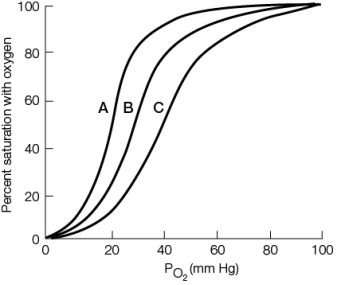 Curve _______ would most likely represent a normal adult human, curve _______ would most likely represent an adult human exposed to high altitude, and curve _______ would most likely represent a human fetus.
 (Multiple Choice)
4.7/5 (82)
(82) Refer to the figure showing the hemoglobin-oxygen binding/dissociation curve. 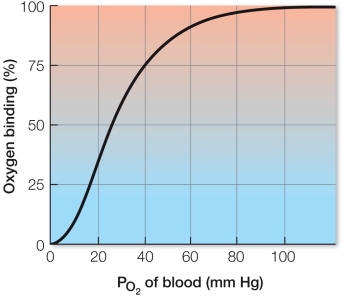 Which statement about hemoglobin's O2-binding/dissociation curve is true?
 (Multiple Choice)
4.9/5 (83)
(83) If a new air pollutant were to destroy the surfactant in people's lungs, one likely result would be
(Multiple Choice)
4.8/5 (82)
(82) Refer to the figure showing models of concurrent and countercurrent gas exchange. 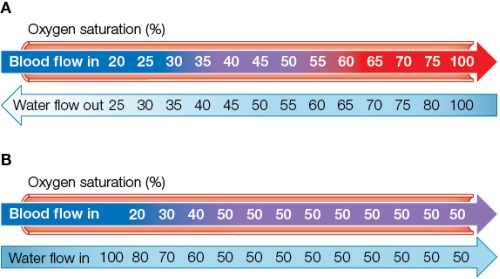 If you did an experiment in which you measured the oxygen saturation of the blood and water going through a gill in goldfish, your results would look most like panel _______, because _______.
 (Multiple Choice)
4.8/5 (78)
(78) Chemosensors on the surface of the medulla are sensitive to
(Multiple Choice)
4.8/5 (65)
(65) 
Filters
- Essay(0)
- Multiple Choice(0)
- Short Answer(0)
- True False(0)
- Matching(0)